Renewable Energy Credits on Blockchain: How Digital Ledgers Are Transforming Green Energy Trading
 Feb, 7 2026
Every time a wind turbine spins or a solar panel generates power, it creates something invisible but valuable: a renewable energy credit. These aren’t physical tokens. They’re digital proof that one megawatt-hour of clean electricity was produced. For companies wanting to say they’re using green power - even if they’re just plugged into the regular grid - these credits are essential. But here’s the problem: the old system for tracking them is broken.
Traditionally, renewable energy credits (RECs) were managed through paper records, spreadsheets, and centralized registries. Auditors had to verify each claim. Brokers took cuts. Transactions took weeks. And worst of all, the same credit could be sold twice - a flaw called double-counting. A 2022 study by IRENA estimated that 3-5% of all RECs in traditional systems had been claimed by more than one party. That’s fraud, hidden in plain sight.
How Blockchain Fixes the REC Mess
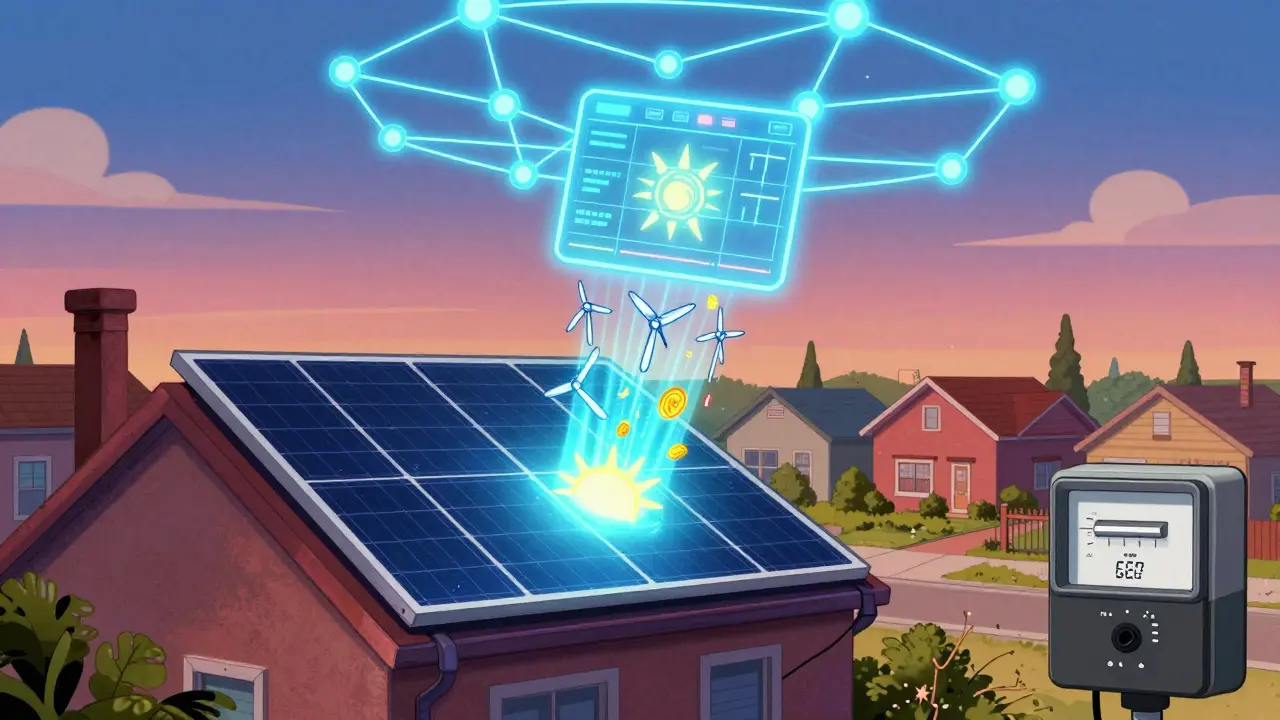
Blockchain changes everything by turning RECs into digital tokens on a public, tamper-proof ledger. Think of it like a shared Google Sheet that no one can delete from or edit without proof. Every time a solar farm produces 1 MWh of electricity, a smart meter sends the data to the blockchain. A digital certificate is created instantly. No middlemen. No delays. No guesswork.
The Energy Web Chain, launched in 2019 by the Energy Web Foundation, is one of the most widely adopted systems. It’s built specifically for energy markets, not just copied from Bitcoin or Ethereum. It uses proof-of-stake consensus - meaning it’s fast, cheap, and uses 99% less energy than Bitcoin mining. It also supports ERC-20 tokens, so RECs can be traded like any other digital asset on compatible platforms.
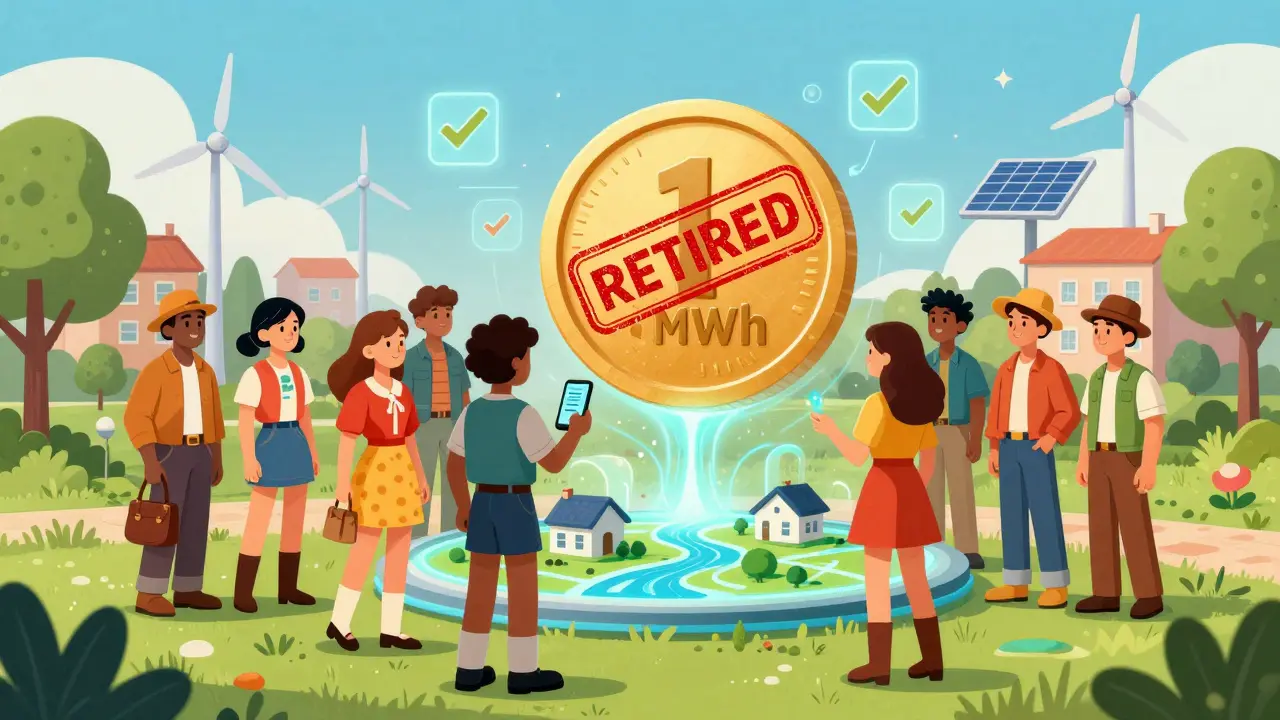
Power Ledger, an Australian platform founded in 2016, shows how this works in real life. In 2023 alone, it processed over 1.2 million REC transactions with zero fraud. How? Because every credit is tied to a unique digital fingerprint. Once it’s sold and retired (meaning claimed by a buyer), it’s permanently marked as used. No one else can touch it.
Real Savings, Real Speed
Traditional REC systems cost about 5% of a certificate’s value just in administrative fees. Blockchain cuts that to 1-2%. In Germany’s Microgrid project, transaction costs dropped by 40%, and paperwork processing time fell by 70%. That’s not theory - it’s what happened on the ground.
Speed matters too. In the old system, it could take 30 days to settle a REC sale. With Power Ledger, transactions clear in 15 seconds. A homeowner in Perth, Australia, reported selling 372 kWh of excess solar power through the app and getting paid within 24 hours - compared to the 45-day wait with their old utility provider. That kind of turnaround turns passive energy producers into active participants in the market.
Who’s Using This Now?
It’s not just startups. Sixty-eight of the Fortune 100 companies now use blockchain-based RECs for their sustainability reports. Why? Because investors demand transparency. If you claim to be 100% renewable, you need to prove it - and blockchain gives you a public, verifiable trail.
Europe leads in adoption. The EU’s 2023 Renewable Energy Directive officially recognizes blockchain-verified Guarantees of Origin (GOs) as valid proof of renewable energy use. In contrast, the U.S. has no federal standard - but 18 states have launched pilot programs. California, New York, and Illinois are testing systems that link smart meters directly to blockchain ledgers.
Developing regions are catching up fast. In Colombia, a platform by Grid Singularity helped 1,200 rural energy producers - many of them small solar operators - receive payments 83% faster than before. In Australia, the Brooklyn Microgrid project let 350 households trade 4.7 GWh of solar energy peer-to-peer using blockchain, bypassing utilities entirely.
Challenges Still Exist
But this isn’t magic. Blockchain-based RECs face real hurdles.
First, integration. Most energy grids were built decades ago. Connecting legacy metering systems to a blockchain network can cost $500,000 to $2 million. That’s a barrier for small producers. Second, regulation. In many countries, energy regulators haven’t updated rules to accept digital certificates. A 2023 survey by the Energy Web Foundation found that 73% of implementers cited regulatory misalignment as their biggest obstacle.
Then there’s the digital divide. A failed project in Kenya showed that 62% of intended users couldn’t complete transactions because they lacked smartphone literacy. Blockchain won’t work if the people who need it most can’t access the app.
And fragmentation. There are over 12 competing tokenization standards. The Energy Web Chain, Power Ledger, WePower, and LO3 Energy all use different formats. Without a universal standard, cross-border trading stays messy. That’s why the September 2023 integration between Energy Web Chain and the International REC Standard (I-REC) was a game-changer - it allowed verified credits to move across borders for the first time. In Q4 2023 alone, $287 million in RECs were traded using this new bridge.

What’s Coming Next?
By mid-2024, Energy Web Foundation launched Origin, a production-ready platform already used by 47 energy operators across 15 countries. The big next step? Auto-Issue, launching in Q3 2024. This feature will automatically generate RECs the moment a smart meter records production - no manual input needed. Imagine a wind farm turning on, and within seconds, its credits appear on the blockchain. No forms. No delays.
By 2025, the system will start tracking carbon co-benefits. Not just “this was renewable energy,” but “this avoided 0.8 tons of CO2 emissions.” That’s critical for companies wanting to offset their full footprint.
And by 2026, the Energy Web Chain will roll out quantum-resistant cryptography. Yes, even that’s being planned. Because if quantum computers ever break current encryption, the entire system must be ready.
Should You Care?
If you’re a business trying to hit net-zero goals, yes. Blockchain-based RECs give you auditable, real-time proof that your sustainability claims are legitimate. No more greenwashing accusations.
If you’re a homeowner with solar panels, yes. You can now sell your extra energy directly to neighbors - and get paid in hours, not months.
If you’re a policymaker, yes. The global market for blockchain in renewable energy is projected to hit $12.65 billion by 2028. That’s a 56.3% annual growth rate. This isn’t a niche experiment. It’s becoming infrastructure.
The biggest win? Trust. In a world full of climate claims, blockchain gives us something rare: verifiable truth. You don’t have to take anyone’s word for it. The ledger shows you exactly where the energy came from - and who owned it.
What’s the difference between a Renewable Energy Credit (REC) and a Guarantee of Origin (GO)?
They’re essentially the same thing - just named differently by region. A REC is the term used in North America and Australia. A Guarantee of Origin (GO) is the European term. Both represent 1 MWh of renewable electricity and serve the same purpose: proving the source of energy. The only difference is which regulatory body issues them. Blockchain systems now support both formats, and the integration between Energy Web Chain and I-REC allows them to be traded across borders.
Can individuals buy and sell RECs on blockchain platforms?
Yes - but it’s easier in some places than others. In Australia, Power Ledger lets homeowners sell their solar credits directly to neighbors or businesses via a mobile app. In the U.S., most platforms are still geared toward businesses and utilities. However, pilot programs in states like California and New York are opening up retail access. You’ll need a digital wallet, a smart meter, and sometimes approval from your local utility. The barrier is higher than buying crypto, but it’s getting simpler.
Do blockchain RECs cost more than traditional ones?
No - they cost less. The price of the actual energy credit doesn’t change. But blockchain cuts out intermediaries, so the transaction fees drop from 5% to 1-2%. That means more money goes to the energy producer. A wind farm owner might get $100 for a REC under the old system. With blockchain, they might net $98 instead of $95. That difference adds up fast at scale.
Is blockchain REC technology secure from hacking?
The ledger itself is extremely secure. Data on the Energy Web Chain and similar platforms is stored across hundreds of nodes, encrypted with SHA-256, and verified by consensus. No single point of failure exists. But the weak link is often the front-end - the app or website you use to access it. If you download a fake app or click a phishing link, your wallet can be stolen. That’s why using official platforms and enabling two-factor authentication matters more than the blockchain itself.
Why hasn’t the U.S. adopted blockchain RECs nationwide?
Because energy regulation in the U.S. is state-by-state. There’s no federal agency that controls REC issuance. So while 18 states have pilot programs, others still rely on paper-based registries. The Center for Resource Solutions, which manages most U.S. RECs, hasn’t yet fully embraced blockchain. Until there’s federal coordination or pressure from major corporations (like Apple or Google demanding blockchain-verified credits), adoption will remain patchy.
What skills do you need to implement a blockchain REC system?
You need three things: energy sector knowledge (how grids, meters, and certificates work), blockchain basics (how ledgers and smart contracts function), and technical implementation skills. Solidity - the programming language for Ethereum-based systems - is the most common skill needed. Energy Web Foundation recommends 40-60 hours of training for energy professionals to get up to speed. Most companies hire a hybrid team: energy engineers, blockchain developers, and compliance officers.
Are blockchain RECs better for the environment than traditional ones?
Not directly - they don’t generate more renewable energy. But they make the market more efficient. By reducing fraud, lowering costs, and enabling peer-to-peer trading, blockchain encourages more people to invest in solar and wind. A 2024 RMI report found that blockchain-enabled markets increased small-scale solar adoption by 19% in pilot regions. So while the tech itself isn’t green, it makes the green economy work better.