Anti-Money Laundering Crypto Enforcement in Bangladesh: Risks and Reality
 Nov, 23 2026
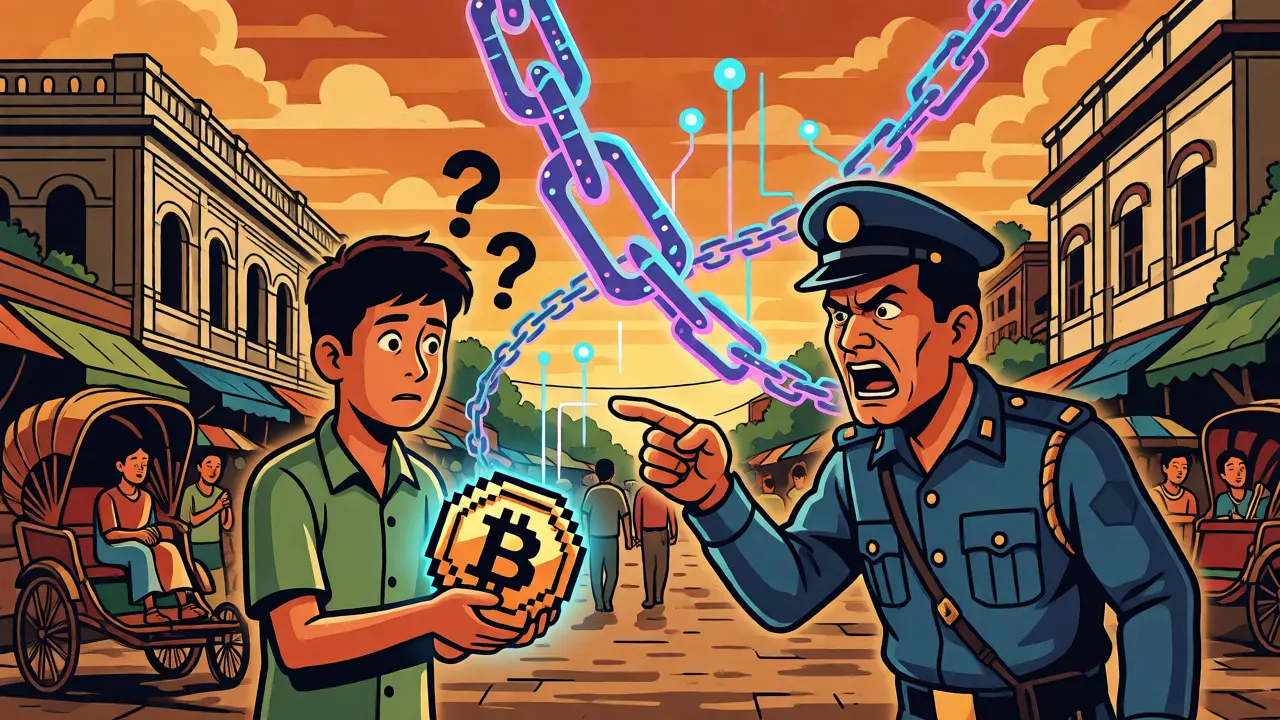
Imagine trying to buy a cup of coffee with Bitcoin in Dhaka. In most parts of the world, you might get a weird look or a polite refusal. In Bangladesh, you could end up in handcuffs. The country maintains one of the strictest cryptocurrency enforcement regimes in Asia, treating digital assets not just as unregulated tools, but as active threats to national financial stability. If you are an investor, a developer, or just someone curious about the local market, understanding the legal landscape here is critical. It’s not just about "no taxes"; it’s about potential jail time.
The confusion stems from a specific regulatory gap. There is no single law that says "Bitcoin is illegal." Instead, authorities use a patchwork of older financial laws to crack down on crypto activities. This creates a gray area where ownership might be technically ambiguous, but trading and mining are aggressively prosecuted under anti-money laundering (AML) statutes. For anyone operating in this space, the risk isn't just regulatory fines-it's criminal liability.
The Legal Framework: How Bangladesh Bans Crypto Without a Ban Law
You might wonder how a country bans something without explicitly naming it in legislation. The Bangladesh Bank central banking authority relies on existing frameworks. The primary tool is the Foreign Exchange Regulations Act of 1947. Since cryptocurrencies are often treated as foreign currency or speculative assets, using them for payments violates regulations governing foreign exchange. Additionally, the Money Laundering Prevention Act of 2012 provides the teeth for enforcement. Authorities argue that because crypto transactions can be anonymous, they facilitate money laundering and terrorist financing.
The ICT Act also plays a role, particularly regarding the digital infrastructure required for mining and trading platforms. When the Bangladesh Bank issued its first major warning against Bitcoin in 2014, it set the tone. By 2017, the stance hardened into a declaration that cryptocurrency usage was illegal due to these specific risks. Today, while you won't find a statute titled "The Crypto Prohibition Act," the practical effect is identical. Engaging in crypto trades, holding significant amounts, or running mining rigs exposes you to scrutiny under these broader financial laws.
Enforcement Actions: From Warnings to Arrests
It’s easy to dismiss regulations as paper tigers until you see the police vans. In 2024, several individuals were arrested in Dhaka for operating clandestine crypto mining operations. These weren't minor infractions; authorities deemed these activities violations of strict AML laws. The government treats unauthorized mining not as a hobby, but as an industrial activity that drains electricity and obscures capital flows.
The Criminal Investigation Department (CID) works closely with the central bank. Their guidance clarifies a subtle but important distinction: mere ownership of a small amount of crypto might not always lead to immediate prosecution, but engaging in money laundering or foreign currency violations using crypto will. This means if you convert your salary into USDT and then send it abroad without proper documentation, you are breaking the law. The decentralized nature of wallets, especially those using networks like TRC20, makes tracing difficult, but when authorities do catch offenders, the penalties include potential jail time.

The FATF Gap and International Pressure
Bangladesh faces significant pressure from the global community. The Financial Action Task Force (FATF), which sets global standards for combating money laundering, requires countries to regulate virtual assets. Recommendation 15 specifically addresses Virtual Asset Service Providers (VASPs). Currently, Bangladesh’s framework does not fully comply with these standards. This non-compliance is risky. If Bangladesh fails to align with FATF recommendations, it could face grey-listing, which would make international banking more expensive and difficult for all Bangladeshi businesses, not just crypto users.
The Ministry of Finance oversees financial policy and could theoretically introduce new legislation, but there is little movement toward liberalization. Instead, the focus remains on protecting the traditional banking system. The lack of a specific tax regime adds another layer of complexity. The National Board of Revenue applies the general Income Tax Ordinance of 1984 to crypto transactions. However, without clear guidelines on how to value volatile assets for tax purposes, compliance becomes a nightmare for anyone trying to stay on the right side of the law.
Regional Contrast: Isolation in South Asia
To understand why Bangladesh’s approach is so extreme, look at its neighbors. While Bangladesh tightens its grip, Pakistan has moved in the opposite direction. In May 2025, Pakistan established the Pakistan Digital Assets Authority (PDAA) to regulate exchanges and wallets. They even allocated 2,000 megawatts of power for Bitcoin mining and formed a National Crypto Committee. This divergence leaves Bangladesh increasingly isolated in the region.
| Feature | Bangladesh | Pakistan | India |
|---|---|---|---|
| Legal Status | Implicitly Banned | Regulated | Taxed & Regulated |
| Mining | Illegal | Encouraged (Strategic Reserve) | Allowed with Restrictions |
| Key Agency | Bangladesh Bank | PDAA / SBP | RBI / CBDT |
| FATF Compliance | Gaps Identified | Improving | Compliant Framework |
This isolation has economic consequences. Informal crypto markets thrive underground, estimated to be worth billions across the region. In Bangladesh, this activity happens outside the formal banking sector, meaning the government loses visibility and control. The contradiction is stark: the government embraces blockchain technology for land records and e-governance through the National Blockchain Strategy, yet rejects cryptocurrency for private financial use. You can use the tech, but you can’t own the coin.

Practical Implications for Users and Investors
If you live in Bangladesh or plan to do business there, what does this mean for you? First, avoid peer-to-peer (P2P) trading platforms that promise high returns. Many past scams, like the MTFE Ponzi scheme, exploited the regulatory vacuum to lure investors before disappearing with their funds. Second, be cautious with mobile money services. Bangladesh is a pioneer in fintech, with widespread adoption of mobile financial services. However, integrating crypto into these channels is legally fraught. Using mobile money to buy crypto, or vice versa, can trigger flags for AML investigations.
For developers, the environment is challenging. Building a crypto-based startup means navigating a hostile regulatory climate. You cannot easily open a corporate bank account for crypto revenues. Most successful ventures either operate offshore or pivot to pure blockchain applications that don’t involve token speculation. The lack of clarity discourages foreign direct investment in the local crypto ecosystem, pushing talent and capital to jurisdictions with clearer rules.
Future Outlook: Will Change Come?
Will Bangladesh ever legalize crypto? Don’t hold your breath. The current administration prioritizes financial stability over innovation. The fear of capital flight-where citizens move wealth out of the country via stablecoins-is real. As long as the taka faces inflationary pressure, authorities view crypto as a leakage valve for the economy. However, international pressure from the FATF may force some form of recognition. Not necessarily legalization, but perhaps a regulated sandbox where limited trading is allowed under strict KYC (Know Your Customer) protocols.
Until then, the status quo holds. The implicit ban remains effective because enforcement is visible. Arrests for mining and trading keep the public wary. For now, crypto in Bangladesh is less of a financial instrument and more of a legal hazard. If you’re looking to invest, diversify away from this jurisdiction. If you’re building tech, separate the blockchain utility from the monetary asset.
Is owning cryptocurrency illegal in Bangladesh?
Technically, there is no explicit law banning the ownership of cryptocurrency. However, the Bangladesh Bank has declared it illegal for use in payments and trading. Possession itself is a gray area, but using it for transactions or converting it to fiat currency without proper authorization can lead to legal trouble under foreign exchange and anti-money laundering laws.
Can I mine Bitcoin in Bangladesh?
No, cryptocurrency mining is explicitly illegal. The government views mining operations as violations of energy regulations and anti-money laundering laws. Recent arrests in Dhaka for clandestine mining operations highlight that authorities actively enforce this ban, imposing penalties including jail time for offenders.
Why does Bangladesh ban cryptocurrency?
The primary reasons are concerns over money laundering, terrorist financing, and financial instability. The central bank argues that the anonymity of crypto facilitates illicit flows of capital and undermines the control of the traditional banking system. Additionally, there are fears about capital flight during periods of economic stress.
Are there any taxes on crypto in Bangladesh?
There is no specific cryptocurrency tax regime. However, the National Board of Revenue applies the general Income Tax Ordinance of 1984 to all income sources, including crypto transactions. Because the legal status is unclear, tax compliance is complex and rarely enforced specifically for crypto gains, though any income derived from crypto-related activities is theoretically taxable.
How does Bangladesh's policy compare to other Asian countries?
Bangladesh has one of the strictest policies in Asia. While countries like India tax and regulate crypto, and Pakistan has recently moved toward establishing a regulatory framework with the PDAA, Bangladesh maintains an implicit ban. This places it closer to China’s earlier hardline stance than to the evolving frameworks seen in Southeast Asia and South Asia.