Carbon Credit Blockchain Projects: How Tokenization Is Fixing Climate Finance
 Nov, 7 2026
You buy a carbon offset online. It costs $15. The website promises it plants trees in Brazil or protects rainforests in Indonesia. But here is the uncomfortable truth: you have no idea if that tree actually exists. You certainly don’t know if someone else already bought the same "offset." This lack of trust is the single biggest bottleneck stopping climate finance from scaling. Enter Carbon Credit Blockchain Projects. These aren't just tech buzzwords; they are infrastructure attempts to turn vague promises into verifiable, tradable digital assets.
If you’ve been following the intersection of crypto and climate, you’ve likely heard terms like TCO2, BCT, and NCT thrown around. It can feel like alphabet soup. But beneath the jargon lies a serious attempt to solve double-counting, improve liquidity, and bring transparency to the voluntary carbon market (VCM). Let’s break down what these projects actually do, who is leading the charge, and whether this technology delivers on its hype.
Why Traditional Carbon Markets Need a Tech Upgrade
The traditional carbon market is slow, opaque, and fragmented. Before blockchain entered the chat, trading carbon credits involved brokers, spreadsheets, and weeks of paperwork. A credit issued in one country might take months to verify and trade elsewhere. Worse, there was no global ledger. If Company A retired a credit for "avoided deforestation" in Peru, how did Company B know it wasn’t the same credit sold to Company C?
Double counting became a massive risk. Registries kept their own books, often disconnected from each other. This fragmentation stifled investment because corporations couldn’t easily audit their supply chains or prove their ESG claims with hard data. Blockchain offers a solution by creating a shared, immutable source of truth. When a credit is tokenized, its history-issuance, transfer, retirement-is recorded on-chain forever. No more hidden ledgers.
| Feature | Traditional Market | Blockchain Tokenized Market |
|---|---|---|
| Transparency | Low; private registries | High; public on-chain data |
| Liquidity | Low; bilateral trades | High; DeFi pools & AMMs |
| Settlement Time | Days to Weeks | Seconds to Minutes |
| Fractionalization | Difficult | Easy; ERC-20 standards |
| Double Counting Risk | Medium-High | Low (if bridged correctly) |
Toucan Protocol: The Infrastructure Backbone
You can’t talk about this space without mentioning Toucan Protocol. Launched in October 2021, Toucan became the first major bridge between traditional carbon registries (like Verra and Gold Standard) and the Ethereum blockchain. Their core innovation is Tokenized CO2 (TCO2), which allows users to retire real-world carbon credits on-chain.
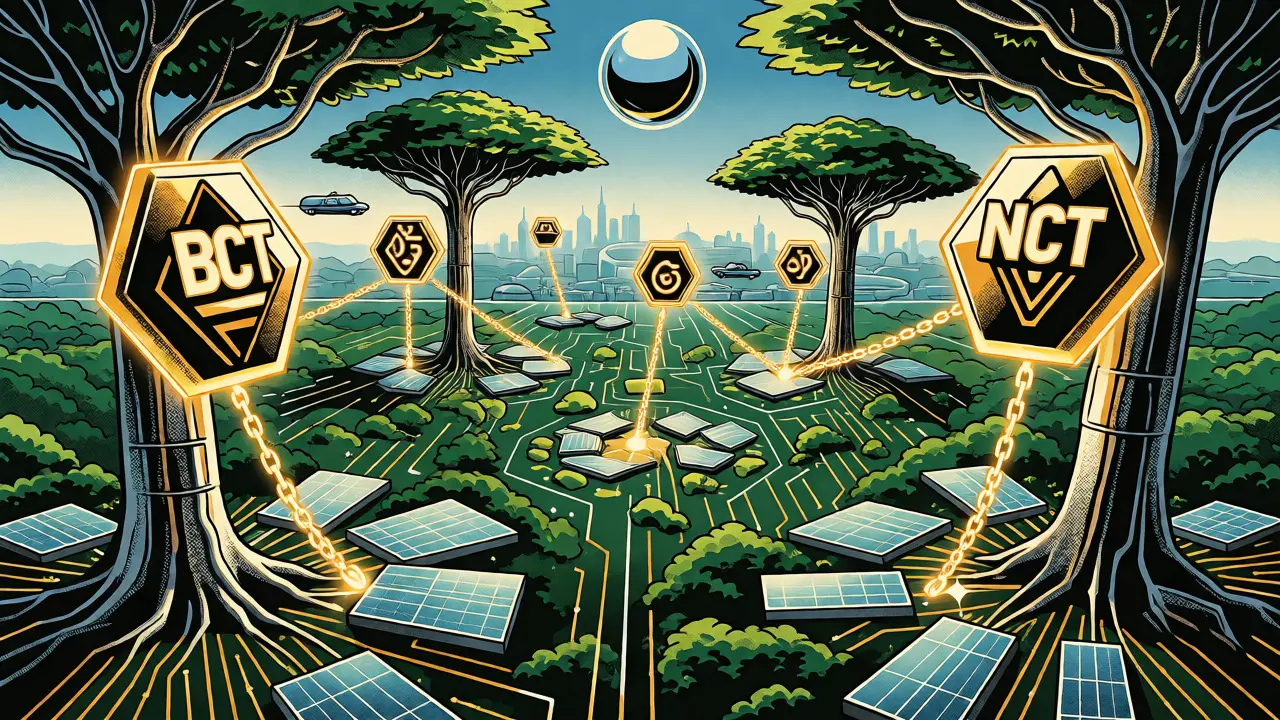
Toucan didn’t just tokenize individual credits; they created pools. This is crucial for liquidity. Instead of buying one specific credit from one specific forest project, you can buy a basket of credits. Two main tokens emerged from this:
- BCT (Base Carbon Tonnes): A pool of older, lower-quality credits. It acts as a stablecoin-like asset for carbon, widely used in DeFi applications.
- NCT (Nature Carbon Tonnes): A newer pool focused on nature-based solutions with higher quality standards. It’s designed for buyers who want better verification.
Within six months of launch, over 20 million tonnes were tokenized. That’s huge volume. But it also revealed a problem: garbage in, garbage out. Many of those early credits were old, low-quality offsets from renewable energy projects that would have happened anyway. This led to some registries temporarily banning tokenization until quality controls improved.
KlimaDAO and On-Chain Liquidity
If Toucan is the road, KlimaDAO is the gas station and the bank combined. KlimaDAO operates on top of Toucan’s infrastructure, providing a marketplace and treasury management system for carbon credits. They hold a significant portion of the BCT supply, effectively acting as a central bank for on-chain carbon.
Why does this matter? Because it creates price discovery. In traditional markets, prices are negotiated privately. On KlimaDAO, you see real-time pricing based on supply and demand. Developers can build apps that automatically buy carbon when prices drop, integrating sustainability directly into software workflows. For example, an e-commerce platform could use Klima’s API to automatically purchase and retire a fraction of a carbon credit for every order placed. This makes carbon neutral shopping seamless.
AirCarbon Exchange and Enterprise Solutions
Not all blockchain projects are about decentralized finance (DeFi) speculation. Some focus purely on enterprise efficiency. AirCarbon Exchange (ACX) targets institutional investors and large corporations. They use blockchain not for trading volatility, but for record-keeping and settlement speed.
ACX provides a custody model where companies can hold carbon credits securely while retaining ownership rights. It links directly to major registries, ensuring that the digital token always represents a verified real-world asset. This reduces the operational friction for banks and asset managers who want exposure to carbon markets without navigating the messy world of crypto wallets and smart contract risks.
Puro.Earth: Focusing on Removals, Not Just Avoidance
Critics often argue that traditional carbon credits are weak because they pay people *not* to cut down trees (avoidance), rather than actively removing CO2 from the atmosphere (removal). Puro.Earth addresses this by focusing exclusively on engineered removals like biochar and direct air capture. Their blockchain registry ensures these high-integrity credits are tracked immutably.
Major clients like Microsoft and Shopify use Puro’s platform. Why? Because corporate reputations depend on credible offsets. Paying for a dubious avoided-deforestation credit looks bad in an annual report. Paying for verified biochar sequestration, tracked on a transparent ledger, looks much stronger. Puro proves that blockchain works best when paired with rigorous scientific verification.
The Quality Control Crisis
Here is the elephant in the room: not all tokenized credits are good credits. The early rush of Toucan saw millions of tonnes of low-quality credits enter the ecosystem. These were often credits from hydroelectric dams built decades ago or wind farms that were already profitable. Tokenizing them added liquidity but didn’t add environmental value.
This caused a backlash. Regulators and environmental groups worried that blockchain was enabling greenwashing at scale. To fix this, new standards are emerging. Projects are now vetting credits before tokenization, using AI and satellite data to verify additionality (did the project actually cause the emission reduction?) and permanence (will the carbon stay stored?). The market is bifurcating: cheap, speculative BCT-style tokens versus premium, high-integrity NCT-style tokens.
How to Evaluate a Carbon Credit Project
If you’re looking to invest in or utilize these platforms, don’t just look at the logo. Dig deeper. Here is a checklist for evaluating any carbon credit blockchain project:
- Registry Integration: Does the project bridge to reputable registries like Verra, Gold Standard, or American Carbon Registry? If it’s an isolated island, its value is questionable.
- Quality Filters: Does the protocol filter out old or low-quality credits? Look for mechanisms that exclude credits pre-dating certain years or lacking third-party audits.
- Liquidity Depth: Check the trading volume on platforms like KlimaDAO or Uniswap. Low volume means high slippage and difficulty exiting positions.
- Retirement Mechanism: Ensure the platform has a clear, irreversible process for retiring tokens. Once retired, the token should be burned or locked permanently so it can’t be resold.
- Oracle Reliability: How does the blockchain know the real-world status of the credit? Trustworthy oracles (data feeds) are essential to prevent fraud.
Future Outlook: Convergence and Regulation
We are moving toward a hybrid model. Pure crypto-native projects are partnering with traditional financial institutions. Banks are exploring tokenized carbon as collateral for loans. Governments are starting to look at blockchain for national carbon tracking systems. The EU’s Carbon Border Adjustment Mechanism (CBAM) may eventually require digital proof of emissions, something blockchain excels at providing.
However, regulatory uncertainty remains. If regulators decide that tokenized carbon credits are securities, compliance costs will skyrocket. Conversely, clear frameworks could unlock trillions in institutional capital. For now, the most successful projects are those that prioritize integrity over hype, working closely with scientists and auditors rather than just developers.
What is the difference between BCT and NCT?
BCT (Base Carbon Tonnes) is a pooled token representing a basket of older, lower-quality carbon credits, often used for liquidity and DeFi speculation. NCT (Nature Carbon Tonnes) is a newer pool focused on higher-quality, nature-based credits with stricter verification standards, aimed at buyers seeking genuine environmental impact.
Can I lose my money if the carbon credit becomes worthless?
Yes. Like any commodity or crypto asset, carbon credit tokens fluctuate in value based on market demand, regulatory changes, and perceptions of quality. Additionally, if a underlying credit is found to be fraudulent or non-additional, its tokenized version may lose credibility and value rapidly.
Does tokenizing carbon credits eliminate double counting?
It significantly reduces the risk but doesn't magically eliminate it. Tokenization requires a "bridge" that retires the credit in the traditional registry before minting the token. If the bridge is secure and the registry updates correctly, double counting is prevented. However, technical bugs or poor governance can still lead to errors.
Is buying tokenized carbon credits tax-deductible?
This depends entirely on your jurisdiction and how you classify the purchase (investment vs. expense). In many countries, purchasing carbon credits is treated as a business expense if linked to operations, but regulations vary. Always consult a tax professional familiar with digital assets in your region.
Which blockchain networks host these projects?
Ethereum is the primary network due to its security and DeFi maturity. However, projects are expanding to Layer 2 solutions like Polygon and Arbitrum to reduce transaction fees. Some newer projects are experimenting with Solana or Avalanche for faster throughput.