Celestia and Modular Blockchain Projects: A Guide to the Future of Web3
 Oct, 18 2026
Imagine trying to run a marathon while solving complex math problems, managing your finances, and answering phone calls simultaneously. That’s essentially what traditional blockchains like Bitcoin or Ethereum do every second. They handle execution, consensus, settlement, and data availability all on one single track. It works, but it gets slow and expensive as more people join. This is where Celestia enters the chat. Launched in October 2023, Celestia isn’t just another blockchain; it’s a fundamental rethink of how we build decentralized networks. It separates these heavy tasks into different layers, allowing each part to do its job without slowing down the others.
If you’ve been following crypto trends, you’ve probably heard the term "modular blockchain" thrown around a lot. But what does it actually mean for developers, investors, and users? Why are projects moving away from the monolithic model that has served us well for over a decade? And specifically, how does Celestia fit into this new landscape? We’re going to break down the tech, the economics, and the real-world implications of this shift, without drowning you in jargon.
The Problem with Monolithic Blockchains
To understand why Celestia matters, you first need to grasp the bottleneck it solves. Traditional Layer 1 blockchains are monolithic. This means every node on the network must download, verify, and execute every transaction. If you want to send $5 worth of tokens, every computer in the network has to check that transaction, even if they don’t care about your specific trade. This creates massive redundancy.
Vitalik Buterin famously described this as the "blockchain trilemma." The idea is that it’s incredibly difficult to achieve decentralization, security, and scalability all at once. Bitcoin chose decentralization and security, sacrificing speed. Early Ethereum tried to balance them, but gas fees skyrocketed when demand spiked. Monolithic chains hit a hard ceiling because adding more users requires every node to work harder. You can’t just add more computers to make it faster; you have to upgrade the hardware requirements for everyone, which hurts decentralization.
This is where the modular approach flips the script. Instead of one giant machine doing everything, you split the stack. You have a layer for data availability, a layer for settlement, and separate layers for execution. This allows specialized solutions to emerge. For example, an execution layer can be optimized purely for gaming transactions, while another handles high-frequency trading, all sharing the same secure data foundation.
How Celestia Works: Data Availability as a Service
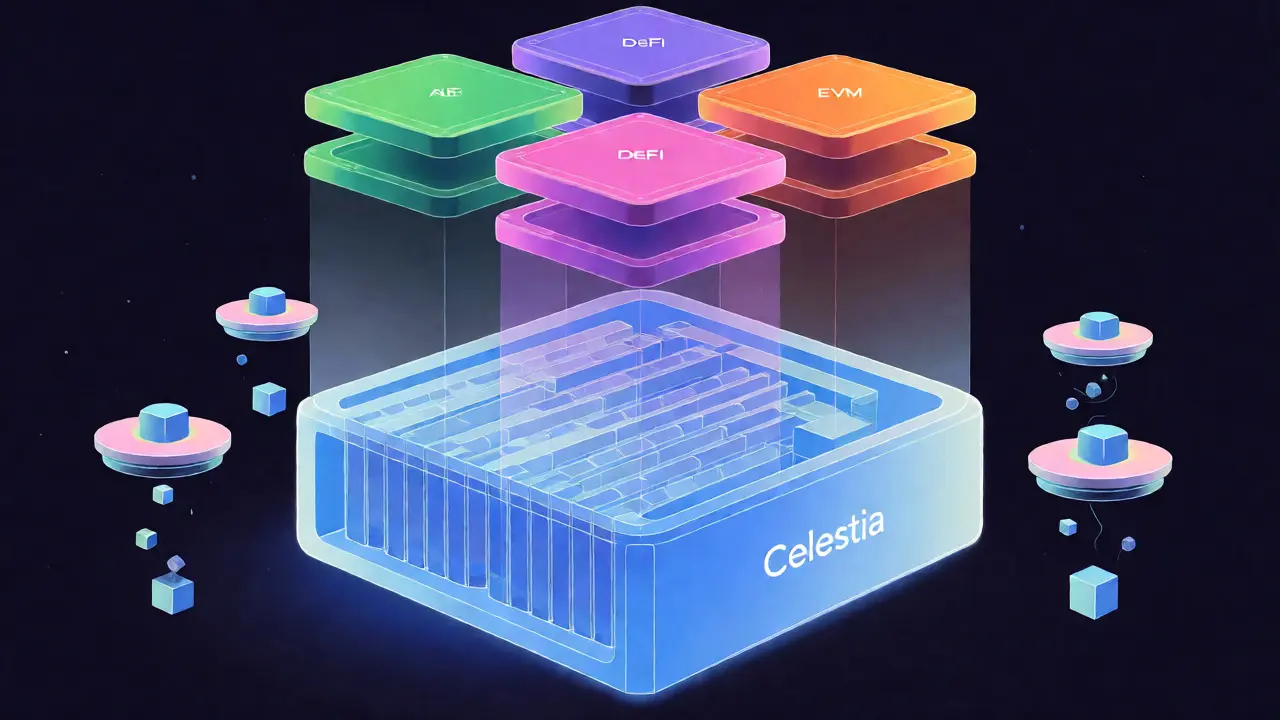
Celestia is a modular data availability network that provides consensus and data availability services to any application, allowing anyone to launch their own scalable and customizable rollups. Think of it as the ultimate library archive. In a monolithic system, everyone carries a copy of the entire library in their backpack. In Celestia’s model, Celestia stores the books (data) securely. Developers building rollups (execution layers) only need to fetch the specific pages relevant to their app, not the whole library.
The magic here lies in two key technologies: Data Availability Sampling (DAS) and Namespace Merkle Trees (NMT).
DAS is the game-changer for light nodes. In traditional blockchains, verifying that data is available requires downloading the whole block. With DAS, a lightweight node can randomly sample small chunks of a block. If those chunks are there, the node can statistically prove with high confidence that the rest of the data exists, without downloading gigabytes of information. This means your laptop, or even a mobile device, can act as a secure verifier. It reduces the barrier to entry for running a node, boosting decentralization.
NMTs solve the problem of data organization. Each application on Celestia gets its own "namespace." When a rollup posts data to Celestia, it tags it with its namespace ID. Other apps ignore this data completely. This prevents network congestion caused by irrelevant traffic. If App A is spamming the network, App B doesn’t suffer performance hits because it simply filters out App A’s namespace. This isolation is crucial for scaling thousands of independent chains.
The Modular Stack: Who Does What?
In a modular ecosystem, roles are clearly defined. Let’s look at how the pieces fit together using Celestia as the base layer.
| Function | Monolithic Chain (e.g., Ethereum L1) | Modular Chain (e.g., Celestia + Rollup) |
|---|---|---|
| Data Availability | Handled by the main chain nodes | Specialized DA layer (Celestia) |
| Consensus | Integrated with execution | Separate consensus mechanism (Tendermint/Cosmos SDK) |
| Execution | Runs on main chain | Offloaded to Rollups/Layer 2s |
| Settlement | Main chain | Can be handled by rollups or shared settlement layer |
| Scalability | Limited by main chain throughput | Scales linearly with number of rollups |
Celestia explicitly removes execution from its core responsibilities. It doesn’t care *what* the transactions do, only that they are ordered and available. This allows developers to build execution environments tailored to specific needs. Want an EVM-compatible chain? Build it. Want a Rust-based chain for DeFi? Build it. Want a custom virtual machine for a game? Go for it. All these chains can post their data to Celestia, inheriting its security and data availability guarantees.
Why Investors and Builders Are Betting on Modularity
The buzz around Celestia isn’t just hype; it’s backed by serious capital and technical necessity. Before its mainnet launch, Celestia raised $55 million across Series A and B rounds, achieving a valuation of over $1 billion. Backers included heavyweights like Coinbase Ventures, Jump Crypto, and Galaxy Digital. These aren’t speculative gamblers; they’re strategic investors looking for infrastructure plays.
For builders, the appeal is autonomy. On a monolithic chain, you’re subject to the governance and roadmap of the main chain. If Ethereum changes its fee structure or upgrades its consensus, you feel the impact. On Celestia, you launch your own sovereign rollup. You control the gas token, the fee market, and the execution logic. You pay Celestia for data posting, but you keep the profits from your app’s usage.
Consider the current state of Layer 2s on Ethereum. While they scale execution, they still rely on Ethereum for data availability. As L2 activity grows, Ethereum’s blob space (via EIP-4844) helps, but it’s still a shared resource. Celestia offers dedicated capacity. If you’re a high-volume exchange, you might prefer paying for guaranteed data slots on a specialized DA network rather than competing for space on a general-purpose chain.
Celestia vs. Competitors: Where Does It Fit?
Celestia isn’t alone in the modular race. Projects like EigenLayer, Dymension, and AltLayer are also pushing modularity, but they approach it differently.
- EigenLayer: Focuses on "restaking," allowing Ethereum stakers to secure other protocols. It leverages Ethereum’s existing security rather than creating a new DA layer from scratch.
- Dymension: Builds a settlement layer on top of Cosmos, aiming to simplify rollup launches with its "RollApp" framework. It often uses Celestia or similar DA layers underneath.
- AltLayer: Provides instant scaling for existing dApps by spinning up temporary rollups. It’s more of a tooling provider than a foundational DA network.
Celestia distinguishes itself by being a purpose-built data availability network. It uses the Tendermint Core consensus engine, known for its fast finality (sub-second). This contrasts with Ethereum’s probabilistic finality. For applications requiring immediate confirmation, like payments or gaming, Celestia’s architecture offers distinct advantages. Plus, its native support for multiple programming languages via the Cosmos SDK means you aren’t locked into Solidity/EVM constraints.

Challenges and Risks
No technology is perfect, and modularity brings its own set of headaches. The biggest challenge is composability. In a monolithic world, smart contracts can easily talk to each other because they live in the same state. In a modular world, data is scattered across different rollups. If App A on Rollup X wants to interact with App B on Rollup Y, they need bridges or interoperability protocols. These cross-chain communications can introduce latency and complexity.
Another risk is the fragmentation of liquidity. If every project runs its own rollup with its own token and fee market, users might get tired of bridging assets between dozens of chains. Solutions like shared sequencers and unified bridge standards are being developed to mitigate this, but it’s an ongoing engineering battle.
Security assumptions also change. While Celestia secures the data, the correctness of execution relies on the rollup’s fraud proofs or validity proofs. If a rollup has a bug in its execution logic, Celestia won’t catch it-it just ensures the bad data was posted. Users must trust the rollup’s code, not just the underlying DA layer.
What’s Next for Celestia?
The team behind Celestia hasn’t rested on its laurels since the 2023 launch. Recent updates, such as the Ginger upgrade announced in late 2024, reduced block times from 12 seconds to 6 seconds. This 50% improvement in speed makes Celestia competitive with some Layer 2 solutions for time-sensitive applications.
Looking ahead, expect to see more integration with major ecosystems. The Cosmos community is already deeply involved, but adoption in the Ethereum ecosystem is critical. Tools that allow Ethereum rollups to use Celestia for DA are gaining traction. Additionally, as data volumes grow with AI-driven on-chain activities and social media dApps, the demand for cheap, high-throughput data availability will only increase. Celestia is positioned to capture this demand by offering a specialized service rather than a general-purpose platform.
For now, the message is clear: the future of blockchain isn’t one giant supercomputer. It’s a network of specialized machines working together. Celestia is the backbone that lets them communicate securely. Whether you’re a developer looking to launch a niche app or an investor scanning for infrastructure plays, understanding the modular shift is no longer optional-it’s essential.
Is Celestia a Layer 1 or Layer 2 blockchain?
Celestia is technically a Layer 1 blockchain, but it functions differently from traditional L1s. It specializes exclusively in consensus and data availability, leaving execution to higher layers (rollups). It serves as the foundational data layer for many Layer 2 solutions.
What is Data Availability Sampling (DAS)?
Data Availability Sampling is a cryptographic technique that allows light nodes to verify that all transaction data has been published without downloading the entire block. By randomly sampling small chunks of data, nodes can statistically prove the data's availability with high confidence, significantly reducing hardware requirements.
Can I build an EVM-compatible chain on Celestia?
Yes. Celestia supports various execution environments. Developers can build EVM-compatible rollups using tools like Arbitrum Nitro or Optimism Bedrock, which post their data to Celestia for security and availability.
How does Celestia solve the blockchain trilemma?
By separating data availability from execution, Celestia avoids the bottlenecks of monolithic chains. It achieves high scalability through specialized DA layers and maintains decentralization by allowing light nodes to verify data via sampling, thus addressing the trade-offs between speed, security, and decentralization.
What is the native token of Celestia?
The native token is TIA. It is used for staking to secure the network, paying for data availability fees, and participating in governance.