Crypto Business Setup in UAE Free Zones: A Practical Guide to VARA, ADGM & DIFC Licenses
 May, 3 2026
Setting up a crypto business in the United Arab Emirates isn't just about picking an office and buying a license. It’s about navigating a sophisticated, multi-layered regulatory ecosystem that has evolved rapidly since 2020. If you are looking for a jurisdiction that balances innovation with strict oversight, the UAE is currently one of the most attractive destinations globally. However, the path to compliance depends entirely on which free zone you choose and what specific activities your business will perform.
The regulatory landscape is not monolithic. You cannot simply get a generic "crypto license" from a single federal body and operate everywhere. Instead, you must align with specific authorities like VARA, ADGM, or DIFC, each with distinct rules, capital requirements, and fee structures. This guide breaks down exactly how these systems work, who they are for, and what it costs to get started in 2026.
Why the UAE Regulatory Framework Matters
The UAE didn’t jump into crypto regulation overnight. The foundation was laid in 2020 when the Securities and Commodities Authority (SCA) issued Decision No. (23) regarding crypto asset activities. This was followed by Administrative Decision No. (11) in 2021, which provided clearer guidance. The real game-changer came in December 2022 with Cabinet Resolution No. (111). This resolution created a comprehensive framework for virtual assets across the entire country, including all free zones.
This federal-level coordination is crucial. Before this resolution, there were gray areas that could leave investors exposed. Now, Article 4 of the resolution explicitly prohibits anyone from engaging in virtual asset activities without approval from either the SCA or the relevant local licensing authority. This means you cannot operate in the shadows. The system is designed to ensure that every entity undergoes enhanced due diligence, adhering to strict Anti-Money Laundering (AML) and Combating the Financing of Terrorism (CFT) controls.
For entrepreneurs, this clarity is a double-edged sword. On one hand, it eliminates regulatory uncertainty, making the UAE a safe harbor for institutional capital. On the other hand, it demands rigorous compliance from day one. You need to understand which regulator governs your specific model before you even draft your business plan.
The Four Pillars of Crypto Regulation in UAE
To set up shop, you need to know which of the four primary regulatory bodies applies to your business model. Each has a different scope, target audience, and operational requirement.
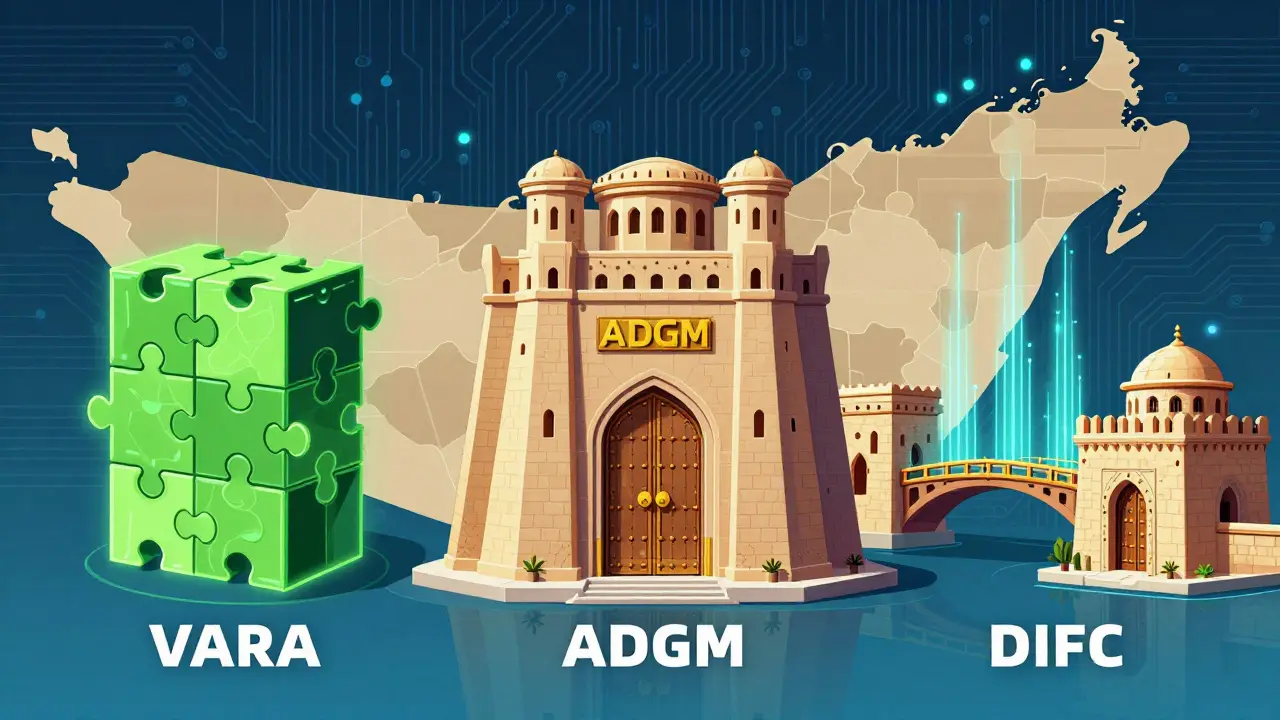
- Virtual Assets Regulatory Authority (VARA): Established in 2022, VARA is the world’s first dedicated virtual asset regulator. It operates under the Dubai World Trade Centre free zone and oversees all virtual asset activities in Dubai, excluding the Dubai International Financial Centre (DIFC). VARA is ideal for retail-focused businesses, exchanges, and startups looking for a modular licensing approach.
- Abu Dhabi Global Market (ADGM): An international financial free zone where the Financial Services Regulatory Authority (FSRA) issues licenses. ADGM targets institutional players, such as large fund managers, custodians, and brokers. It emphasizes high-grade compliance and is suited for sophisticated financial institutions rather than small retail operations.
- Dubai International Financial Centre (DIFC): Regulated by the Dubai Financial Services Authority (DFSA), the DIFC offers a middle ground. It allows for dealing in investments, custody, and running trading facilities within a traditional financial services framework. It connects crypto firms with established banking infrastructure.
- Federal Level (SCA & Central Bank): For businesses operating outside the free zones (in mainland Dubai or Abu Dhabi), the SCA regulates token classifications and securities-like tokens. The Central Bank of the UAE oversees crypto activities that intersect with payment infrastructure, such as stablecoins and cross-border payments, but does not issue exchange licenses directly.
Deep Dive: VARA Licensing for Dubai Businesses
If you are launching a new crypto venture in Dubai, VARA is likely your starting point. Its unique selling proposition is its modular license structure. Unlike other jurisdictions that offer blanket clearance, VARA requires activity-specific approvals. This means if you start as a wallet provider, you don’t automatically have permission to run an exchange. You apply for the specific activity you intend to perform.
This modular approach allows for responsible scaling. You can begin with lower-risk activities and expand into more complex ones like token issuance or custody as you build compliance capabilities. VARA covers several key activities:
- Exchange services
- Fiat-to-virtual asset broker services
- Virtual asset-to-virtual asset broker services
- Transfer services
- Custody and wallet provision
- Token issuance
Token issuance is particularly nuanced under VARA. It is divided into two categories. Category 1 tokens require both a license and specific approval from VARA. Category 2 tokens require a licensed distributor. Some closed-loop tokens are exempt from licensing but still fall under VARA’s oversight. This distinction helps prevent unregulated public offerings while allowing private utility tokens to exist within a controlled environment.
Capital Requirements and Fee Structures in 2025-2026
One of the most common questions is: "How much money do I need to start?" The answer varies significantly based on your chosen activity and regulator. For VARA, the financial barriers are structured to ensure seriousness without being prohibitive for well-capitalized startups.
| Cost Component | Range (AED) | Approximate Range (USD) |
|---|---|---|
| Paid-up Capital Requirement | AED 100,000 - AED 1,500,000 | $27,000 - $408,000 |
| Application Fees | AED 40,000 - AED 100,000 | $11,000 - $27,000 |
| Annual Supervision Fees | AED 80,000 - AED 200,000 | $22,000 - $54,000 |
Note that these fees are subject to change as regulations refine. The paid-up capital is held in escrow or verified through bank statements to prove solvency. Higher-risk activities, such as operating a full-service exchange, will naturally sit at the top end of these ranges. Lower-risk activities, like certain advisory roles, may be closer to the bottom.
In contrast, ADGM often requires higher capital commitments because it caters to institutional clients. While exact figures depend on the specific FSRA license type, expect significant upfront investment in compliance infrastructure, legal teams, and technology security. The trade-off is access to a highly trusted brand and direct connections to global banks.
Key Differences: VARA vs. ADGM vs. DIFC
Choosing between these three major hubs comes down to your business model and long-term strategy. Here is a practical comparison to help you decide.
| Feature | VARA (Dubai) | ADGM (Abu Dhabi) | DIFC (Dubai) |
|---|---|---|---|
| Target Audience | Startups, Retail Exchanges, Web3 Projects | Institutional Investors, Fund Managers, Large Banks | Mid-sized Firms, Traditional Finance Integrators |
| Licensing Approach | Modular (Activity-Specific) | Comprehensive Institutional | Hybrid (Financial Services + Crypto) |
| Entry Barrier | Moderate (AED 100k+) | High (Strict Compliance Standards) | Moderate to High |
| Banking Access | Good (Growing Local Partnerships) | Excellent (Global Bank Connections) | Very Good (Established Banking Hub) |
| Best For | New Entrants, NFT Platforms, DeFi Protocols | Custody Solutions, Hedge Funds, Asset Managers | Security Token Offerings, Traditional Brokerages |
VARA’s modular system is perfect if you want to test the market with a specific service, like a wallet app, before expanding into trading. ADGM is better if you already have institutional backing and need to convince conservative global partners of your legitimacy. DIFC serves those who want to bridge the gap between traditional finance and digital assets, leveraging existing banking relationships.

Step-by-Step: Setting Up Your Crypto Business
Once you’ve selected your regulator, the process follows a logical sequence. Skipping steps here leads to delays and rejection.
- Define Your Activity Scope: Be precise. Are you offering custody? Exchange services? Or just advice? Your business plan must detail this clearly. Vague descriptions lead to requests for clarification, slowing down the process.
- Incorporate in the Free Zone: You must register your company in the relevant free zone (e.g., DWTC for VARA, ADGM for FSRA). This involves standard corporate registration, naming approval, and lease agreements.
- Prepare Compliance Framework: This is the most critical part. You need robust AML/CFT policies, Know Your Customer (KYC) procedures, and data protection protocols. VARA and FSRA will audit these extensively.
- Meet Capital Requirements: Deposit the required paid-up capital into a local bank account or provide proof of funds. Ensure your technology and security infrastructure meets their standards (e.g., cold storage solutions, penetration testing).
- Submit Application: File your application with the regulator. Include your business plan, compliance manuals, fit-and-proper checks for directors, and technical architecture diagrams.
- Undergo Due Diligence: Expect background checks on all key personnel. The SCA and local authorities conduct enhanced due diligence to ensure no links to illicit activities.
- Receive License: Once approved, you receive your activity-specific license. Remember, this doesn’t mean you can expand freely. Any new activity requires a separate application.
Navigating Restrictions and Pitfalls
While the UAE is welcoming, it is not a wild west. There are strict restrictions you must respect. First, anonymous transactions are heavily scrutinized. Every wallet address linked to your business must be traceable to a verified user. Second, promoting unlicensed crypto services is illegal. You cannot advertise your platform until your license is active.
Another common pitfall is misunderstanding token classification. If your token behaves like a security (offering profit-sharing or equity-like rights), it falls under SCA jurisdiction, even if you’re in a free zone. Misclassifying a security token as a utility token can result in severe penalties and forced delisting. Always consult with legal experts specializing in UAE crypto law to classify your assets correctly.
Additionally, the Central Bank of the UAE is piloting the Digital Dirham, a Central Bank Digital Currency (CBDC). While this doesn’t directly impact private crypto licenses yet, it signals that future regulations may integrate CBDCs with private virtual asset frameworks. Staying updated on these developments is essential for long-term viability.
Future Outlook: What’s Next for UAE Crypto?
As we move through 2026, the UAE continues to refine its position as a global crypto hub. Expect further integration between free zone regulators. For instance, interoperability between VARA and ADGM licenses may simplify multi-jurisdictional operations for larger firms. The SCA is also expected to release more detailed guidelines on tokenized securities, reducing ambiguity for investment funds.
The focus remains on balancing innovation with security. Regulators are increasingly using technology themselves-such as blockchain analytics tools-to monitor compliance in real-time. This means your internal monitoring systems must be equally advanced. The era of manual reporting is ending; automated, API-driven compliance is becoming the standard.
For entrepreneurs, this evolution means higher initial costs but greater stability. The UAE is building a reputation for reliability, attracting serious capital rather than speculative hype. If you are prepared to invest in compliance and transparency, the UAE offers one of the clearest paths to legitimizing a crypto business in the world.
Can I operate a crypto business in the UAE without a license?
No. Under Cabinet Resolution No. (111) of 2022, it is illegal to engage in any virtual asset activities without approval from the Securities and Commodities Authority (SCA) or the relevant local licensing authority like VARA or ADGM. Operating without a license can result in heavy fines, imprisonment, and asset seizure.
What is the difference between VARA and ADGM licenses?
VARA (Virtual Assets Regulatory Authority) in Dubai uses a modular licensing system suitable for startups and retail-focused businesses, with lower entry barriers. ADGM (Abu Dhabi Global Market) targets institutional players like fund managers and large custodians, requiring stricter compliance and higher capital commitments. Choose VARA for flexibility and ADGM for institutional credibility.
How much does it cost to get a crypto license in Dubai?
For VARA licenses, paid-up capital ranges from AED 100,000 to AED 1.5 million ($27,000 to $408,000). Application fees are between AED 40,000 and AED 100,000, with annual supervision fees of AED 80,000 to AED 200,000. These costs vary based on the specific activity, such as exchange services versus wallet provision.
Do I need a separate license for each crypto activity?
Yes, especially under VARA’s modular system. You receive activity-specific approvals. If you start as a wallet provider and later want to offer exchange services, you must apply for a new license for that specific activity. This ensures you only operate within your approved compliance capacity.
Is the UAE safe for crypto investors?
The UAE is considered one of the safest jurisdictions due to its clear regulatory framework and strict enforcement of AML/CFT laws. The presence of dedicated regulators like VARA and FSRA ensures that businesses adhere to high standards, protecting investors from fraud and illicit activities. However, always verify that a platform holds a valid license before investing.
Can I hold a VARA license and operate in mainland Dubai?
A VARA license allows you to operate within Dubai’s economic free zones. To operate in mainland Dubai (outside free zones), you typically need approval from the Securities and Commodities Authority (SCA). Cross-jurisdictional operations require careful legal structuring to comply with both local and federal regulations.
What happens if my crypto token is classified as a security?
If your token is classified as a security, it falls under the jurisdiction of the Securities and Commodities Authority (SCA), regardless of your free zone license. You must comply with securities laws, which include stricter disclosure requirements and investor protections. Misclassification can lead to legal penalties and forced cessation of operations.