Crypto Taxation in China: Why There Are No Tax Rules
 Apr, 30 2026
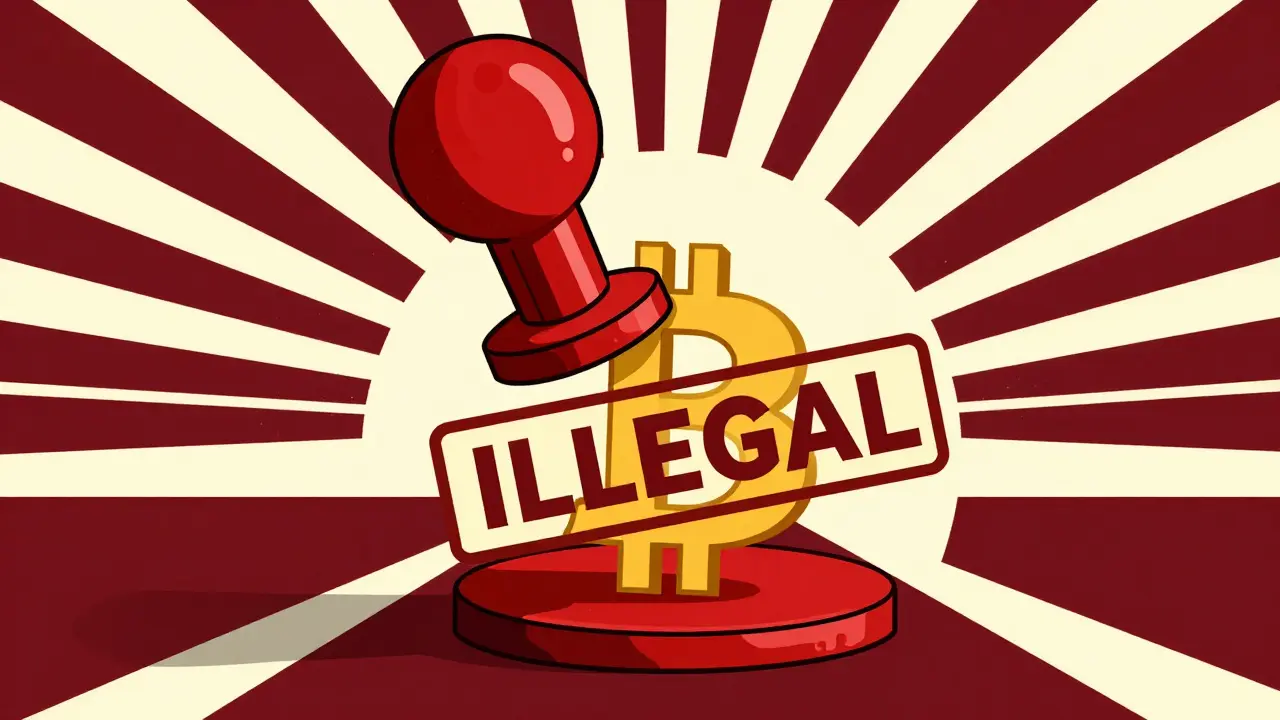
If you are searching for a tax bracket or a reporting form for your digital assets in China, you won't find one. That is because you cannot "tax" something that is completely illegal. While most of the world is arguing over whether Bitcoin is a security or a commodity, China has taken a much more drastic route: they simply erased it from the legal map.
The short answer is that crypto taxation in China doesn't exist because the government has moved past taxation and into full-scale prohibition. In other countries, the government says, "You can trade this, but we want a cut of the profit." In China, the state says, "You cannot trade this, you cannot mine this, and you shouldn't even own it." This shift transforms a tax conversation into a legal survival conversation.
The Total Ban: More Than Just a Tax Dodge
To understand why there are no tax guidelines, you have to look at the current legal landscape. As of June 1, 2025, the People's Bank of China the central bank of the People's Republic of China (PBOC) implemented a comprehensive ownership ban. This isn't just a ban on exchanges or mining farms; it's a ban on the actual possession of cryptocurrency.
When the PBOC classifies crypto activities as "illegal financial activities," it removes them from the realm of civil tax law and pushes them into the realm of criminal law. In a normal tax environment, if you make a profit, you pay capital gains tax. In China's current framework, any profit made from crypto is viewed as "illicit proceeds." Instead of paying a percentage to the tax office, you risk having the entire amount confiscated by the state.
This approach creates a stark reality for anyone operating within Chinese borders. Whether you are a citizen or a foreign national visiting the country, the rules are the same. There is no special exemption for expats. If you are caught engaging in transactions, you aren't looking at a tax audit; you are looking at administrative penalties or potential criminal charges for financial fraud.
A 16-Year Slide Into Prohibition
China didn't wake up one day and decide to ban everything. This was a slow, methodical squeeze that lasted over a decade and a half. It started back in 2009 with simple restrictions on using virtual currencies to buy real-world goods. For years, the government tried to keep crypto at arm's length, but the popularity of the tech grew faster than the rules could keep up.
| Date | Regulatory Action | Impact |
|---|---|---|
| Dec 2013 | Banking Restrictions | Banks banned from processing Bitcoin transactions. |
| April 2014 | Account Closures | PBOC ordered the closing of Bitcoin trading accounts. |
| Sept 2017 | ICO Ban | Initial Coin Offerings and exchanges were forced to stop. |
| June 2021 | Mining Ban | Mining outlawed due to energy and speculation concerns. |
| Sept 2021 | Trading Ban | Comprehensive ban on all crypto trading and transactions. |
| June 2025 | Ownership Ban | Possessing cryptocurrency becomes a prohibited activity. |
By the time we hit 2021, the government realized that simply banning the "business" of crypto wasn't enough because people were still holding assets. The final blow in 2025 was designed to eliminate the incentive to hold digital assets entirely. By making ownership illegal, they effectively killed the need for a tax framework.

The Digital Yuan: The State's Alternative
Why go to such extremes? The answer lies in control. China isn't actually against the technology of digital ledger systems; they are against the decentralization of it. While they hate Bitcoin, they love the Digital Yuan China's central bank digital currency (CBDC) designed to replace physical cash and decentralised tokens.
The Digital Yuan serves as the state-controlled alternative. Unlike a decentralized coin, the digital yuan allows the government to see every single transaction in real-time. It provides the efficiency of digital payments without the "risk" of a currency they cannot control or tax. In this ecosystem, taxation is seamless and automatic because the state owns the rails the money moves on.
This is a fundamental philosophical split. In the West, we see regulators trying to fit crypto into existing tax boxes. In China, the government simply built their own box and told everyone they must use it.
Comparing China to the Rest of the World
To see how weird China's position is, you only have to look at its neighbors. For instance, Taiwan has a completely different vibe. They don't ban the tech; they just tax it. In Taiwan, there is a 5% value-added tax (VAT) on trading revenue. It's a standard business arrangement: you operate, you make money, you pay the government.
In the US or Europe, the focus is on Capital Gains Tax a tax on the profit realized from the sale of a non-inventory asset. If you buy an asset for $10k and sell it for $20k, you pay tax on that $10k gain. China's approach ignores this entire concept. If you make that $10k gain in China, you aren't a "taxpayer"-you are a suspect in an illegal financial activity.
This creates a massive legal gray area. While holding a coin might not always land you in jail immediately, any contract you sign involving crypto is considered void. If someone scams you out of your Bitcoin in China, you cannot go to the police to get it back, because the law doesn't recognize the asset as yours to begin with.

Could the Rules Ever Change?
There are tiny cracks in the wall. In July 2025, the Shanghai State-owned Assets Supervision and Administration Commission held a debate about digital assets. They talked about Stablecoins cryptocurrencies designed to have a stable price, typically pegged to a commodity or currency and how to respond to them strategically.
Some experts believe that as the global economy becomes more dependent on digital assets, China might soften its stance. It's hard to ignore the rest of the world's financial evolution forever. However, any "softening" would likely not look like Western deregulation. Instead, it would probably be a highly controlled, state-approved version of digital assets where the government maintains an absolute kill-switch.
Is it illegal to own Bitcoin in China in 2026?
Yes. Since June 1, 2025, the People's Bank of China has prohibited the ownership of cryptocurrencies. While enforcement varies, the legal status is that possessing these assets is a violation of state policy.
Do I have to pay taxes on crypto gains if I live in China?
There is no official crypto tax rate because the activity is illegal. However, any gains made from crypto are viewed as illicit proceeds and can be seized by the government entirely rather than just being taxed.
Does the ban apply to foreigners visiting China?
Yes, the prohibition on cryptocurrency activities applies to everyone within the borders of China, regardless of their nationality.
What happens if I am caught mining crypto in China?
Mining is strictly prohibited. Authorities systematically shut down mining facilities and those involved can face severe administrative penalties and criminal charges related to illegal energy consumption and financial speculation.
Is the Digital Yuan the same as cryptocurrency?
No. While both are digital, the Digital Yuan is a Central Bank Digital Currency (CBDC). It is centralized, controlled by the state, and is the legal tender of China, whereas cryptocurrencies like Bitcoin are decentralized and illegal.
Next Steps and Risks
If you are a business owner or an individual with ties to China, the priority isn't tax planning-it's risk mitigation. Avoid using Chinese bank accounts for any crypto-related transfers, as the PBOC has enhanced enforcement protocols to freeze accounts linked to "illegal financial activities." If you are managing assets across borders, ensure your crypto activity is strictly isolated from your Chinese financial footprint to avoid severe legal complications.