DegenSwap Review: Is This New DeFi Aggregator Worth Your Risk?
 May, 8 2026
So, you’ve heard the name DegenSwap. Maybe you saw it trending on a crypto forum, or perhaps you’re looking for that next big yield opportunity in DeFi. It sounds promising. The branding is bold, and the promise of an "aggregator of aggregators" with cross-chain capabilities feels like exactly what the fragmented crypto market needs. But here’s the hard truth: DegenSwap is not your typical stable exchange. It’s a high-risk, experimental protocol launched in 2024 that is still finding its footing in a sea of giants.
If you are considering putting real capital into this platform, you need to look past the hype. We’re going to break down what DegenSwap actually does, how much money is really moving through it, and whether the risks outweigh the potential rewards. Spoiler alert: if you’re looking for deep liquidity and institutional-grade security, this might not be the place for you yet.
What Exactly Is DegenSwap?
To understand DegenSwap, you first have to understand the problem it tries to solve. In the world of decentralized finance (DeFi), liquidity is scattered. You might find the best price for Ethereum on Uniswap, but the best price for a specific stablecoin swap on Curve. Most users don’t want to check five different websites to get the best rate. That’s where DEX aggregators come in.
DegenSwap positions itself as an "aggregator of aggregators." Instead of just connecting to one liquidity source, it pulls data from major players like 1inch, SushiSwap, and Curve Finance. It operates across two major networks: Ethereum and Binance Smart Chain (BSC). The goal is simple: give you the absolute best price by scanning multiple protocols simultaneously while optimizing for gas fees.
However, there’s a catch. Despite this sophisticated backend theory, the actual user experience on DegenSwap is surprisingly sparse. As of late 2025, the platform supports only a very limited selection of trading pairs-often just one to three coins at any given time. This isn’t the robust marketplace you see on Binance or Coinbase. It’s a niche tool, likely aimed at traders who are already deep into the DeFi weeds and know exactly which obscure tokens they want to swap.
The Liquidity Reality Check
Liquidity is the lifeblood of any exchange. Without it, you can’t buy or sell without moving the price drastically against yourself-a phenomenon known as slippage. When we look at the numbers for DegenSwap, the picture is concerning for anyone planning to trade significant amounts.
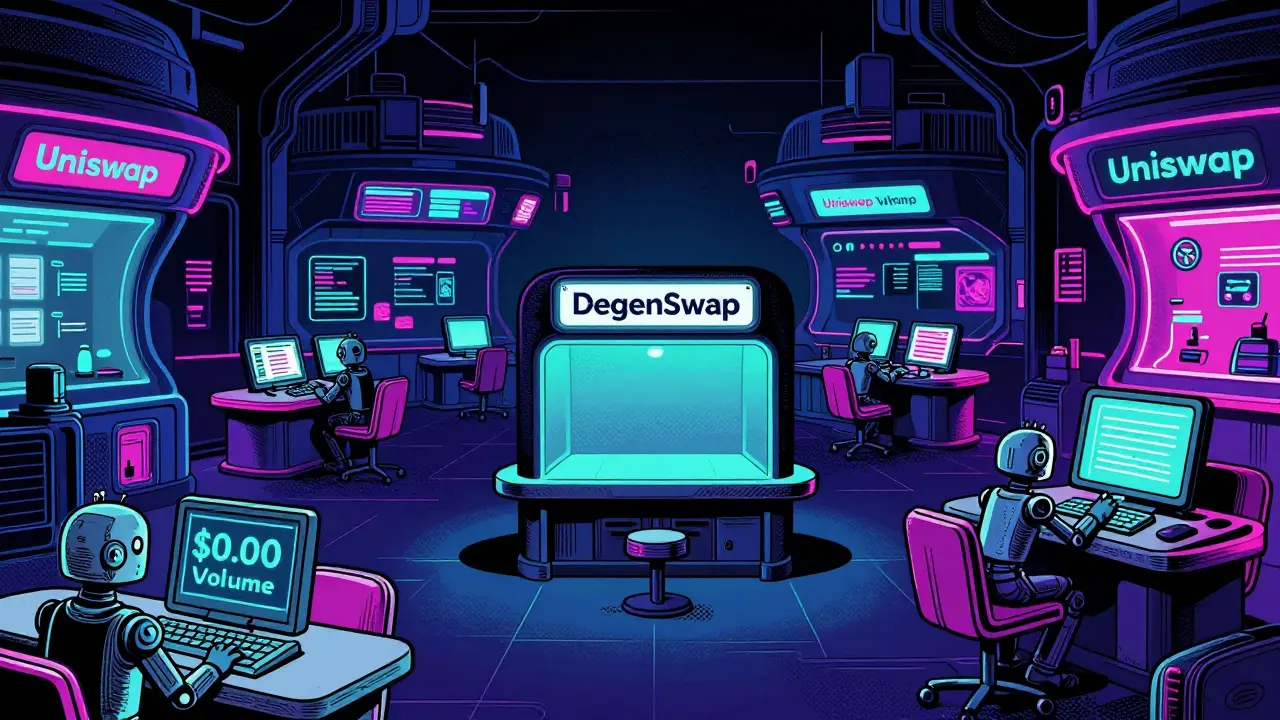
Data from mid-2025 shows 24-hour trading volumes that often hit $0.00. Yes, zero. On days when there is activity, it’s minimal. For example, a specific pair involving ATH and WDEGEN recorded a volume of just $42.00 before going inactive because no trades occurred for over three hours. Compare this to Uniswap, which processes billions of dollars daily. The difference is night and day.
This lack of volume has serious implications. If you try to swap $1,000 or even $10,000 on DegenSwap, you will likely face massive slippage. The order book depth is thin-showing roughly $155 on the buy side and $154 on the sell side within a 2% price range. That means if you throw more than that amount at the market, you’ll eat up all the available liquidity and get a terrible execution price. For small, speculative bets, it might work. For serious trading, it’s practically unusable right now.
Fees, Gas, and Hidden Costs
One of DegenSwap’s main selling points is its claim of "100% gas and fee optimization." In theory, this sounds great. By routing your trade through the most efficient path across Ethereum and BSC, you should save money on transaction fees. And since it’s a decentralized exchange, there are no withdrawal fees or account maintenance charges like you’d pay on a centralized platform.
But let’s talk about reality. Ethereum gas fees can be volatile. Even if DegenSwap finds the cheapest route, if the network is congested, you’re still paying the miner. Furthermore, the spread on DegenSwap’s primary trading pair sits around 0.66%. While that doesn’t sound huge, combined with the low liquidity we discussed earlier, the effective cost of trading can be much higher due to slippage. You aren’t just paying a fee; you’re paying for the inefficiency of a shallow market.
Unlike traditional exchanges, DegenSwap doesn’t offer margin trading or leverage. This is actually a safety feature for many users. It means you can’t accidentally liquidate your entire portfolio due to a sudden price swing. But it also limits the types of strategies you can employ. You’re strictly spot trading here.
Security and Trust: Who’s Behind the Curtain?
In crypto, trust is earned, not given. DegenSwap raised $3 million in funding to launch its cross-chain aggregator functionality. That’s a decent start, showing some institutional interest in the model. However, compared to competitors like 1inch or Matcha (by 0x), which have raised hundreds of millions, $3 million is a drop in the bucket. It suggests a smaller team with fewer resources for security audits and bug bounties.
Because DegenSwap is a decentralized protocol, there is no customer support hotline. If something goes wrong with your transaction-if you send funds to the wrong address or get stuck in a smart contract-you’re on your own. There’s no CEO to call. You rely on community forums and documentation, which, frankly, are currently lacking. The platform’s interface shows "No new listings available" and "No top gainers," indicating a quiet, almost dormant ecosystem.
There are no major red flags regarding hacks or exploits reported publicly as of early 2026, but the absence of evidence isn’t evidence of absence. With such low adoption, the code hasn’t been stress-tested by thousands of users trying to break it. This makes it a gamble. You’re betting that the developers wrote secure code without the benefit of widespread scrutiny.
| Feature | DegenSwap | Uniswap | 1inch |
|---|---|---|---|
| Type | DEX Aggregator | AMM DEX | DEX Aggregator |
| Liquidity Depth | Very Low (~$155) | High (Billions) | High (Aggregated) |
| Supported Chains | Ethereum, BSC | Ethereum, Polygon, Arbitrum, etc. | Ethereum, BSC, Polygon, Avalanche, etc. |
| User Base | Negligible | Massive | Large |
| Risk Level | High (Experimental) | Medium (Smart Contract Risk) | Medium (Smart Contract Risk) |
The DSWAP Token: A Speculative Bet
You can’t talk about DegenSwap without talking about its native token, DSWAP. Tokens like these are often used to govern the protocol or provide fee discounts. But for most retail investors, they’re viewed as a speculative asset.
The price history of DSWAP is a rollercoaster. In September 2025, it was valued at around $0.0325. Before that, it had swung wildly between $0.078 and $0.052 in a single week. Analysts from CoinDataFlow offered varying predictions for 2025, ranging from a conservative $0.037 to an optimistic $0.073. Some bullish models, assuming Bitcoin-like growth patterns, suggested prices could reach $0.71 or even $2.51, but these are highly theoretical and depend on massive adoption that simply isn’t happening yet.
Coinbase analysts were more cautious, predicting a price of approximately $0.04 SGD (Singapore Dollars) for 2026 with minimal movement. This stagnation reflects the broader issue: without active trading pairs and user engagement, the token lacks fundamental utility. Buying DSWAP right now is less of an investment in a working product and more of a bet on the brand’s future potential. It’s high risk, high reward, but mostly risk.
Who Should Use DegenSwap?
Let’s be clear about who this platform is for. It is not for beginners. If you are new to crypto, stick to centralized exchanges like Coinbase or Kraken, or established DEXs like Uniswap. They have better interfaces, deeper liquidity, and proven track records.
DegenSwap might appeal to:
- DeFi Degens: Traders who are comfortable with high risk, low liquidity, and hunting for alpha in obscure tokens.
- Small-Scale Swappers: Users moving tiny amounts of capital where slippage matters less.
- Token Holders: Those who believe in the long-term vision of the DSWAP token and want to support the ecosystem.
If you fall into any of these categories, proceed with caution. Always double-check the contract addresses, use a hardware wallet for signing transactions, and never invest more than you can afford to lose entirely.
Final Verdict: Wait and Watch
DegenSwap has an interesting concept. An aggregator that optimizes across Ethereum and BSC while focusing on gas efficiency is a solid idea. The technology exists, and the funding suggests someone believes in it. But ideas don’t make markets-liquidity and users do.
As of May 2026, DegenSwap is struggling to attract either. The trading volumes are near zero, the supported pairs are minimal, and the community engagement is non-existent. Until you see consistent daily volume, a broader selection of tokens, and positive user feedback, I would recommend keeping DegenSwap on your watchlist rather than your active trading list. The crypto market moves fast, and today’s obscure DEX could be tomorrow’s standard-or it could fade away completely. For now, the risks far outweigh the benefits for the average trader.
Is DegenSwap safe to use?
Safety in DeFi is relative. DegenSwap uses smart contracts on Ethereum and BSC, which carry inherent risks. While there have been no major public hacks reported, the platform is new (launched in 2024) and has limited audit transparency compared to giants like Uniswap. The low liquidity also poses a financial risk, as large trades can result in significant losses due to slippage. Always use a hardware wallet and never connect your primary bank-linked wallet to new protocols.
Can I buy DEGEN or DSWAP on Binance?
You cannot buy DSWAP directly on the Binance centralized exchange. However, you may be able to access DegenSwap-related tokens through the Binance Web3 Wallet, which allows you to interact with decentralized exchanges. This means you are swapping via DeFi protocols, not buying from Binance’s direct inventory. Be aware of the additional gas fees and slippage involved in this process.
Why is the trading volume on DegenSwap so low?
The low volume is due to limited adoption and a narrow selection of trading pairs. As a newer entrant in a crowded market, DegenSwap has struggled to attract liquidity providers and traders. Without deep liquidity pools, larger traders avoid the platform due to high slippage costs, creating a cycle that keeps volume low. It is essentially a niche platform for very specific, small-scale trades.
What is the difference between DegenSwap and 1inch?
Both are DEX aggregators, meaning they search multiple exchanges for the best price. However, 1inch is a mature, widely adopted platform with deep liquidity across dozens of blockchains. DegenSwap is a newer, smaller competitor focusing primarily on Ethereum and BSC. 1inch has a much larger user base, higher trading volumes, and more established security audits, making it a safer choice for most users.
Is DSWAP a good investment in 2026?
Investing in DSWAP is highly speculative. The token has shown significant volatility and low trading activity. Analyst predictions vary widely, but the lack of fundamental utility and low platform usage suggest high risk. It should only be considered by experienced traders who understand the risks of micro-cap DeFi tokens and are willing to potentially lose their entire investment.