Environmental Concerns of NFT Art: Energy Use, Blockchains, and What’s Changed
 Feb, 21 2026
When you buy an NFT artwork, you’re not just buying a digital image. You’re paying for a record on a blockchain - a digital ledger that tracks who owns what. But every time that record is created, sold, or moved, it uses electricity. A lot of it. And that’s where the problem starts.
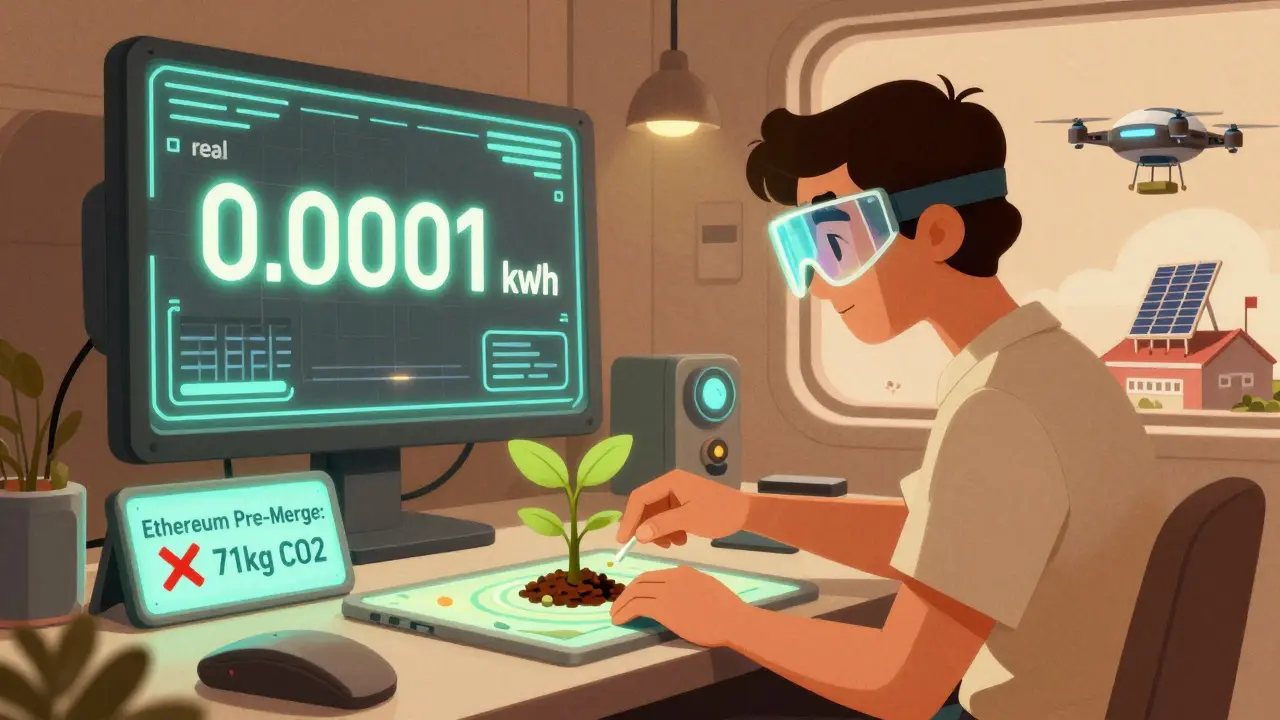
Back in 2021, an NFT sale on Ethereum could use as much energy as a person in the U.S. consumes in a week. One single NFT minted on Ethereum before September 2022 released 71 kilograms of CO2 - the same as driving a car 100 miles. That’s not a typo. That’s what was happening when artists like Beeple sold digital art for millions, and the world watched in awe. But behind the hype was a hidden cost: the environment.
How NFTs Use Energy - And Why It Matters
NFTs don’t live in the cloud like a photo on Instagram. They live on blockchains, which are decentralized networks of computers working together to verify transactions. To keep these networks secure, they use consensus mechanisms. The oldest and most energy-hungry one is called Proof-of-Work (PoW).
PoW works like a high-stakes race. Thousands of computers compete to solve complex math puzzles. The first one to solve it gets rewarded with cryptocurrency. But the catch? All those computers are running nonstop, using massive amounts of electricity. Most of that power still comes from fossil fuels in many parts of the world.
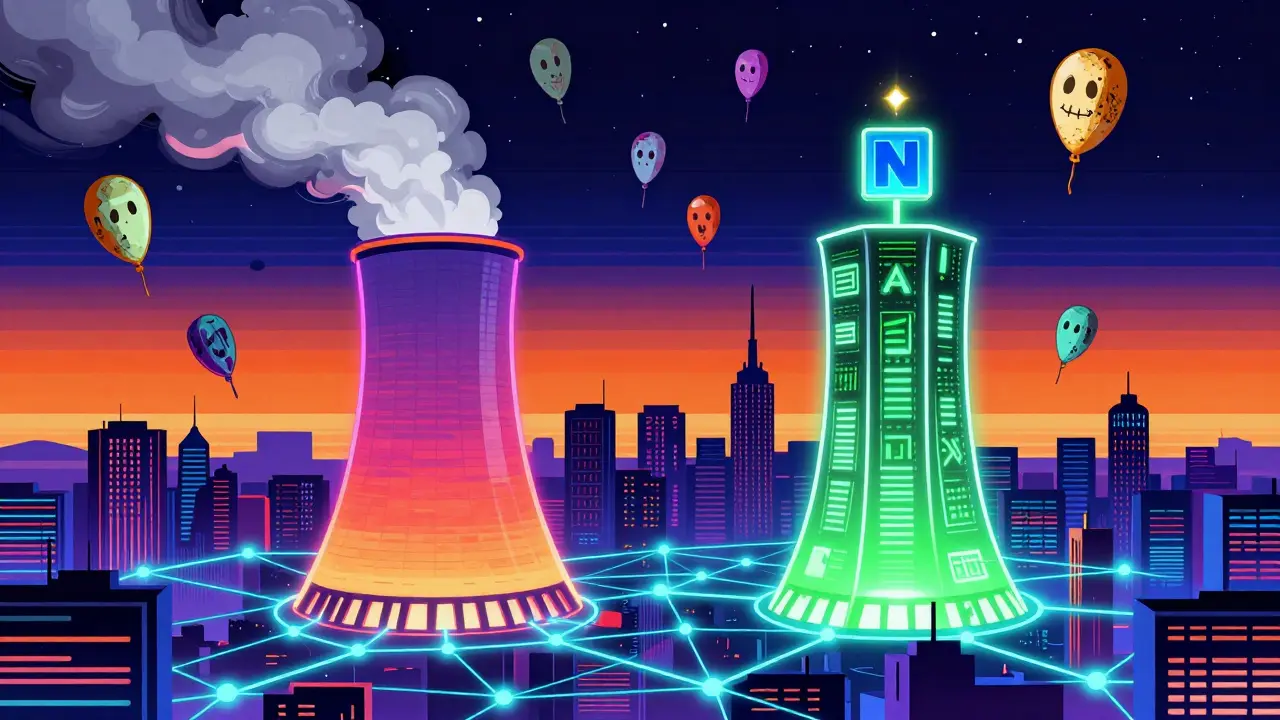
Before the Merge, Ethereum - the blockchain behind 75% of all NFTs - used 112 terawatt-hours (TWh) of electricity per year. That’s more than the entire country of the Netherlands. Bitcoin? It used 707 kWh per transaction. One NFT on Bitcoin could use more energy than charging your phone for five years.
And it wasn’t just the blockchain. The digital files linked to NFTs - the JPEGs, videos, audio - were often stored on decentralized networks like IPFS or Filecoin. These systems also need servers running 24/7, consuming even more energy. The whole chain - minting, storing, transferring - added up fast.
The Big Shift: Ethereum’s Merge
On September 15, 2022, everything changed. Ethereum switched from Proof-of-Work to Proof-of-Stake (PoS). This wasn’t a small update. It was a full overhaul.
PoS doesn’t need computers racing to solve puzzles. Instead, validators are chosen based on how much cryptocurrency they’re willing to lock up as collateral. No mining. No energy-hungry hardware. Just a simple check: "Do you have enough skin in the game?"
The result? Ethereum’s energy use dropped by 99.95%. From 112 TWh per year to just 0.01 TWh. That’s like turning off a power plant the size of a small country. The environmental impact of a single NFT on Ethereum today is now roughly 0.0003 kWh - less than sending three emails.
Cambridge University called it "one of the most significant decarbonization events in tech history." So why are people still talking about NFTs harming the planet? Because the old data won’t go away. And not everyone moved.
Not All Blockchains Are Created Equal
Even after Ethereum’s switch, NFTs are still being made on other blockchains - and their energy use varies wildly.
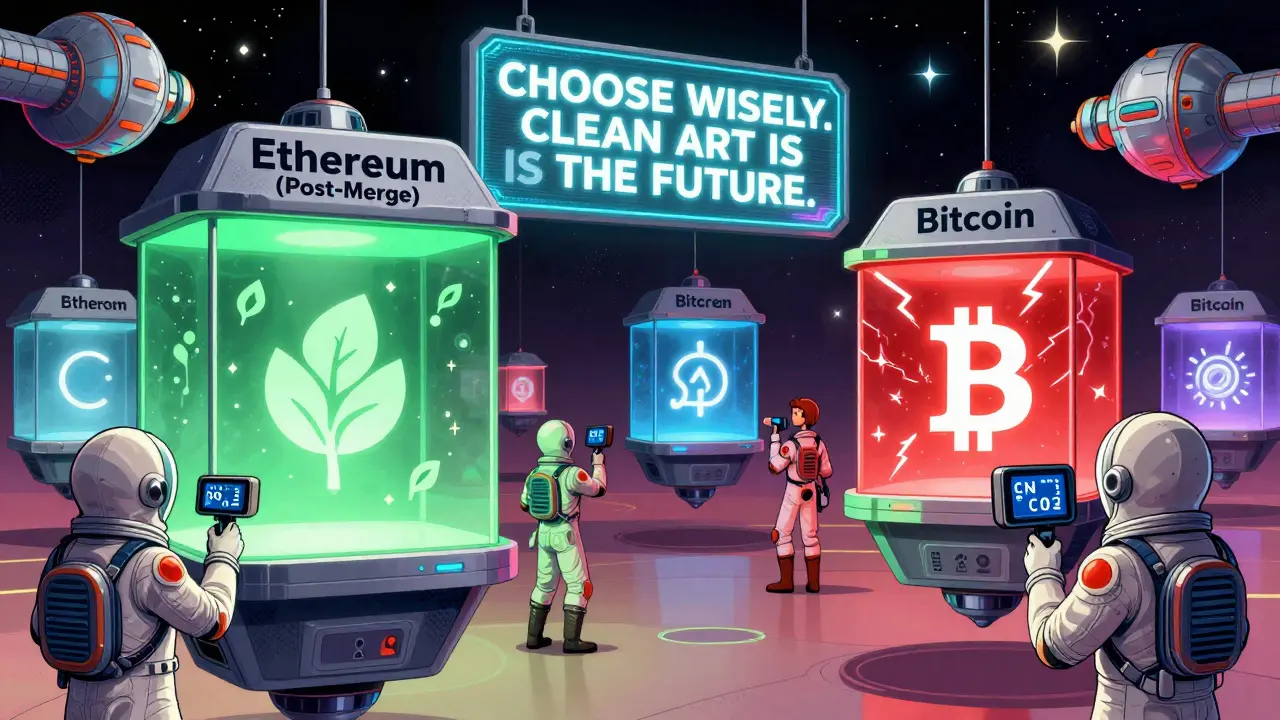
- Bitcoin: Still uses PoW. 707 kWh per transaction. Avoid for NFTs.
- Ethereum (post-Merge): 0.0003 kWh. The new standard.
- Tezos: 0.0001 kWh. Uses PoS. 2 million times more efficient than old Ethereum.
- Solana: 0.00046 kWh. Hybrid system. Fast and low-energy.
- Polygon: 0.000676 kWh. Sidechain of Ethereum. Very efficient.
- Hedera: 0.00017 kWh. Uses hashgraph. Ultra-low energy.
That’s not a typo. Tezos uses 2 million times less energy than Ethereum did before the Merge. If you’re an artist making NFTs, choosing the right blockchain isn’t just a tech decision - it’s an environmental one.
What’s Still a Problem?
Yes, Ethereum is cleaner. But the system isn’t perfect.
First, legacy NFTs. Millions of NFTs created on Ethereum before September 2022 still exist. Their carbon footprint? Permanent. Researchers at ETH Zurich estimate those early transactions released 15.2 million tons of CO2. That’s like adding 3.3 million cars to the road for a year. You can’t undo that.
Second, the supporting tech. Even if your NFT is on a clean blockchain, the wallet you use, the marketplace you buy from, and the storage system holding your artwork might still run on coal-powered servers. Many NFT platforms still use Amazon Web Services or Google Cloud - energy sources that aren’t always renewable.
Third, the rebound effect. As NFTs get cheaper and easier to make, more people are making them. In 2023, over 95% of all NFTs had zero sales. That means millions of digital assets were minted, stored, and forgotten - each one using a little energy. Clean tech doesn’t fix overuse.
What’s Being Done to Fix It?
The industry is responding - slowly, but visibly.
Sotheby’s and Christie’s now only sell NFTs on Ethereum (post-Merge), Tezos, or Polygon. Sotheby’s reported a 92% drop in carbon emissions per transaction after switching. Adobe launched Content Credentials in 2023 - a system that automatically adds carbon footprint data to digital files. If you buy an NFT, you can now see exactly how much CO2 was used to create and store it.
Regulations are catching up too. The EU’s MiCA law, effective in 2024, requires all blockchain platforms operating in Europe to disclose their energy use. New York’s Climate Friendly Mining Act, also in 2024, forces crypto operations to prove they’re using clean energy.
Artists are stepping up. Beeple partnered with Coorest to plant 1,000 trees to offset the emissions from his 2022 NFT drop. Platforms like Zora and Foundation now offer carbon offset options at checkout. The market for carbon credits tied to NFTs grew from $12 million in 2021 to $87 million in 2023.
What Should Artists and Buyers Do Now?
If you’re an artist:
- Don’t mint on Ethereum unless you’re sure it’s post-Merge.
- Choose Tezos, Polygon, or Solana. They’re clean, fast, and cheap.
- Use platforms that show carbon data - like those certified by the Eco-Verified NFT standard.
- Offset your emissions. Even small donations to reforestation projects help.
If you’re a buyer:
- Ask: "Which blockchain is this NFT on?" If they don’t know, walk away.
- Support artists who use low-energy chains. Vote with your wallet.
- Don’t buy NFTs just to flip them. Most sit unsold - and waste energy.
The tools are here. The knowledge is out there. You don’t need to be a coder to make a difference. Just ask a few questions.
The Future Is Cleaner - But Not Automatic
Gartner predicts that by 2026, 68% of the NFT art market will run on low-energy blockchains. That’s a huge shift. But it won’t happen by accident.
The environmental damage from early NFTs can’t be erased. But future damage? That’s still up to us. Every choice - which blockchain you use, which artist you support, which marketplace you trust - adds up.
The myth that NFTs are inherently bad for the planet? That’s outdated. The truth is more complicated: NFTs can be clean. But only if we make them that way.
Are NFTs still bad for the environment in 2026?
Not necessarily. NFTs created on Ethereum after September 2022 (post-Merge), Tezos, Solana, Polygon, or Hedera use 99.9% less energy than before. A single NFT on these chains now uses about the same energy as sending a text message. But NFTs on Bitcoin or old Ethereum chains are still very high-impact. The problem isn’t NFTs - it’s which blockchain you use.
How much CO2 does one NFT emit today?
It depends on the blockchain. On Ethereum (post-Merge): 0.0003 kWh - roughly 0.07 kg of CO2. On Tezos: 0.0001 kWh - about 0.02 kg of CO2. Compare that to pre-Merge Ethereum, which emitted 71 kg per NFT. That’s a 99.9% drop. Most modern NFTs now have a carbon footprint smaller than a single Google search.
Why do some people still say NFTs are harmful?
Because they’re using old data. Before 2022, NFTs on Ethereum were extremely energy-intensive. That legacy still exists - millions of NFTs created before the Merge still carry their original carbon footprint. Also, many NFT marketplaces, wallets, and storage systems still run on conventional energy grids. So while the blockchain part is clean, the rest of the ecosystem isn’t always. Awareness is growing, but change takes time.
Can NFTs be carbon neutral?
Yes - and some already are. Artists and platforms are now partnering with carbon offset programs like Coorest and IMPT to plant trees or fund renewable energy projects that balance out emissions. Adobe’s Content Credentials system also lets artists embed carbon data directly into NFTs. But true neutrality requires active effort - it doesn’t happen automatically. You have to choose it.
Should I avoid buying NFTs because of the environment?
Not if you make informed choices. Avoid NFTs on Bitcoin or old Ethereum. Look for those on Tezos, Polygon, or post-Merge Ethereum. Support artists who disclose their carbon footprint. Don’t buy just to flip - most NFTs never sell, and each one uses energy. If you’re thoughtful, you can enjoy digital art without harming the planet.