Future of KYC in Crypto Industry: How Identity Verification Is Reshaping Crypto by 2027
 Mar, 12 2026
By 2026, if you want to trade crypto on any major platform, you will go through KYC. There’s no way around it anymore. What started as a vague suggestion from regulators has become the backbone of every legitimate crypto exchange. It’s no longer about whether you agree with it-it’s about understanding how it works, why it’s here to stay, and what it means for your privacy, your access, and your future in crypto.
Why KYC Isn’t Going Away
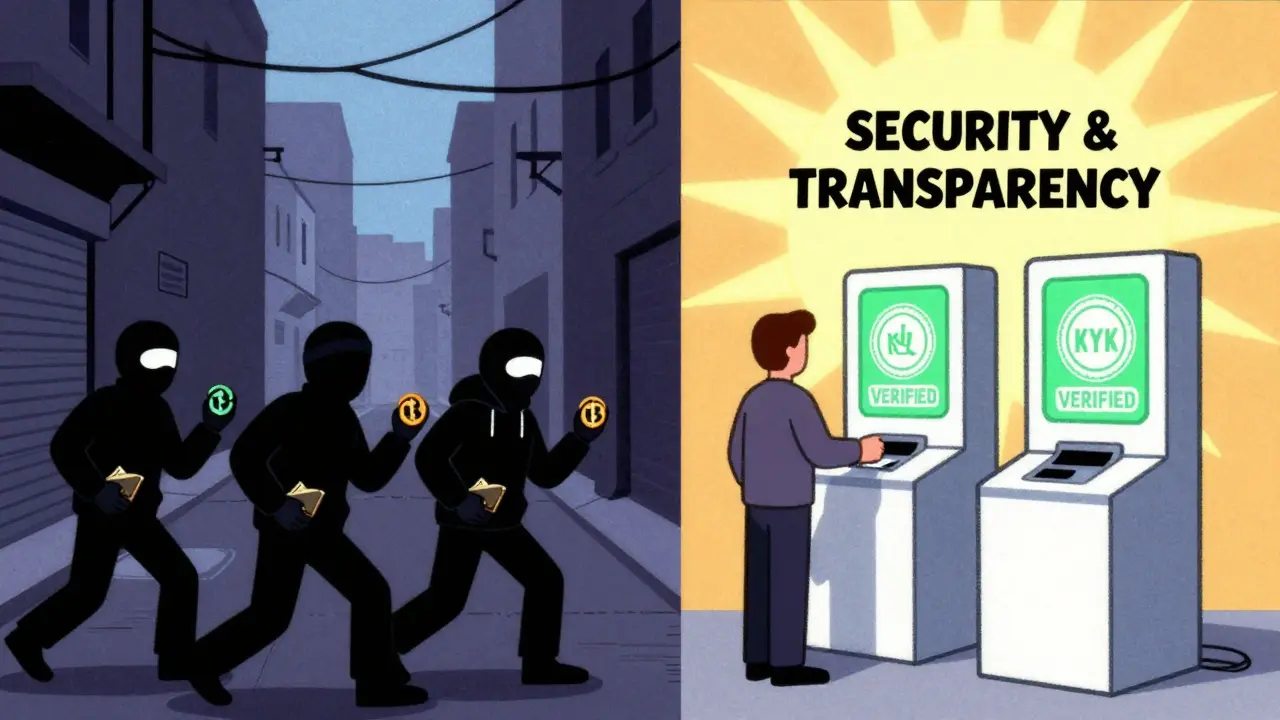
KYC-Know Your Customer-isn’t a new idea. Banks have used it for decades to stop money laundering. But in crypto, it was optional at first. Early adopters loved the anonymity. You could buy Bitcoin with cash, send it across borders, and no one asked who you were. That era is over. By 2025, 92% of centralized crypto exchanges enforced full KYC. The reason? The Financial Action Task Force (FATF) made it clear: crypto platforms are financial institutions. If you’re handling money, you need to know who you’re dealing with. And regulators aren’t bluffing. Between 2019 and 2024, 86% of global enforcement actions against crypto firms were because of failed KYC systems. Binance.US got fined $2.3 million in June 2025 for not verifying high-risk users. That’s not a warning. That’s a wake-up call. The goal isn’t to spy on you. It’s to keep bad actors out. In 2025 alone, over 1,245 sanctioned crypto wallets were flagged globally because they linked to known criminals or terror financiers. Without KYC, those wallets could move millions without a trace. The system isn’t perfect-but without it, the entire industry would be far more dangerous.How KYC Works Today
If you’ve signed up for a crypto exchange in the last year, you’ve probably gone through this:- Uploading a government-issued ID (passport, driver’s license)
- Taking a live selfie or video to prove you’re not using someone else’s ID
- Providing proof of address-like a utility bill from the last 90 days
- Answering questions about where your money came from (especially if you’re depositing large amounts)
The Big Divide: Centralized vs. Decentralized Exchanges
Here’s where things get messy. Centralized exchanges (CEXs) like Coinbase, Kraken, and Binance? They’re 100% KYC-compliant. No KYC? No trading. Period. Decentralized exchanges (DEXs)? Most still let you trade anonymously. Uniswap, PancakeSwap, Curve-they don’t ask for your name. But here’s the catch: they’re not the main game anymore. Chainalysis data shows that less than 12% of total crypto trading volume happens on non-KYC platforms. Why? Because most institutional money won’t touch them. Banks, hedge funds, even crypto-native funds now require full KYC before they’ll even consider interacting with a DeFi protocol. And then there’s the FATF Travel Rule. If you send more than ¥100,000 (about $650 USD) in crypto, the sending platform must share your identity with the receiving platform. Centralized exchanges follow this. DEXs? Most can’t. They’re built on code, not compliance teams. So if you’re moving large sums, you’re forced into KYC platforms anyway.
Regulation Is Getting Real
In 2025, the U.S. passed the GENIUS Act. It created a single federal KYC standard for crypto exchanges. Before that, you had the SEC, CFTC, FinCEN, and 50 state regulators all pushing different rules. Now, if you’re operating in the U.S., you follow one set of rules. That’s a win for businesses-but it also means tighter control. The pending CLARITY Act aims to clarify whether crypto assets are securities or commodities. That’s huge. If Bitcoin is classified as a security, exchanges will need to do even more background checks on users. And starting in 2026, all U.S. crypto users will get a 1099-DA form-like a 1099 for stock trades-requiring full KYC data for every transaction over $10. The EU is even stricter. MiCA (Markets in Crypto-Assets) regulation forces all crypto firms operating in Europe to follow uniform KYC, AML, and transparency rules. No loopholes. No exceptions. Meanwhile, countries like Japan and Singapore have built their own high-tech KYC systems. Some Middle Eastern regulators are even testing blockchain-based digital IDs that store your verified identity on-chain. You log in once, and every exchange you use pulls your identity directly.Privacy vs. Compliance: The Tension
You can’t talk about KYC without talking about privacy. And yes-it’s a real concern. A 2025 survey of 3,500 crypto users found that 76% want clear explanations about how their data is used. But only 41% actually got them. People are frustrated. Reddit threads are full of users who closed accounts because exchanges didn’t tell them how long they’d keep their ID photos. One user wrote: “I understand KYC. But if you’re keeping my passport scan for 10 years, tell me. Don’t just bury it in a 50-page terms of service.” Privacy advocates, like the Electronic Frontier Foundation, warn that aggressive KYC could turn crypto into just another surveillance tool. And there’s truth to that. If every transaction is tied to your identity, you lose the pseudonymity that made crypto revolutionary. But here’s the counterpoint: anonymity doesn’t make you free-it makes you a target. Criminals use anonymous wallets to move stolen funds. Hackers use them to launder ransomware payments. Without KYC, exchanges are forced to shut down. The entire industry would collapse under regulatory pressure.