Global Crypto Exchange Access: Where You Can Trade in 2026
 Mar, 26 2026
The Patchwork Reality of Global Crypto Trading
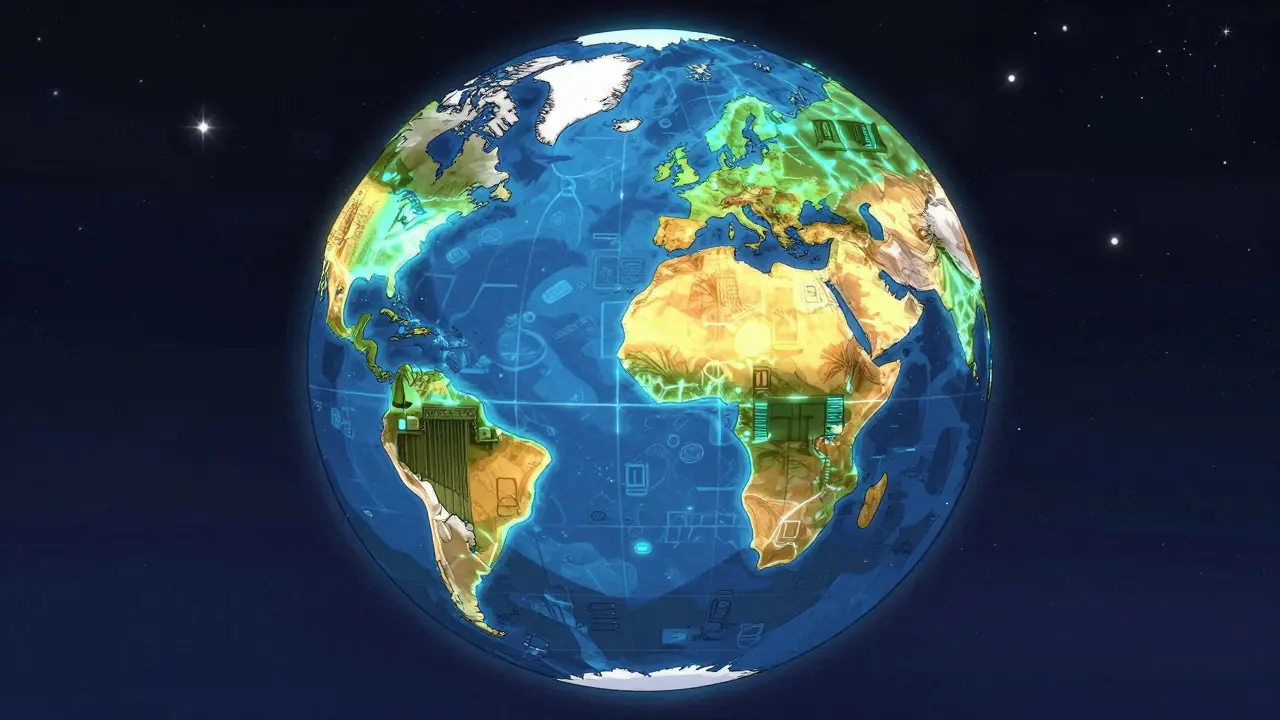
You might assume the internet connects us all equally, but when it comes to buying Bitcoin or Ethereum, your zip code often dictates your options more than your Wi-Fi signal. As we move through 2026, the map of Cryptocurrency Exchange Availability is the degree to which digital asset platforms operate legally and technically within specific geographic borders looks less like a globe and more like a puzzle with missing pieces. Some countries offer open markets, while others have slammed the door shut due to regulatory pressure.
This isn't just about preference; it is about survival for these platforms. The global cryptocurrency exchanges market was valued at USD 48.41 billion in 2025. While projections suggest this will swell to USD 122.63 billion by 2032, the growth is uneven. A trader in Kyiv faces a completely different landscape than one in New York. Understanding these regional nuances prevents wasted time on sign-up forms that ultimately lead nowhere.
Quick Key Takeaways
- Binance dominates globally but maintains separate platforms like Binance.US to comply with specific country laws.
- United States regulations remain the tightest, forcing major players to exit or settle for billions.
- Eastern Europe leads adoption, with Ukraine topping the 2025 Global Crypto Adoption Index despite economic challenges.
- Decentralized Finance (DeFi) offers a backup when centralized exchanges are blocked in your region.
- Spot trading remains the main use case, holding 61.3% of the market share in 2025.
Why Availability Fluctuates Across Borders
Regulatory frameworks act as the gatekeepers for exchange services. In some jurisdictions, governments embrace crypto as a tool for financial inclusion. In others, they view it as a threat to monetary sovereignty. This creates a scenario where availability shifts based on the latest government decree or court ruling.
Take the United States as the primary example. The environment here involves scrutiny from multiple heavy hitters: the Securities and Exchange Commission (SEC), the Department of Justice, and the Treasury Department. In November 2023, a major shift occurred when the world's largest exchange, Binance, agreed to pay a $4 billion settlement with U.S. agencies. This wasn't a minor fee; it was a penalty that committed them to a "complete exit from the United States" under five years of regulatory monitoring.
This settlement highlights a critical point: compliance is not optional. It effectively removed Binance.com from the U.S. market, replacing it with a restricted version, Binance.US. For users in Washington or New York, the tools available on the global site were suddenly inaccessible. Instead, they had to rely on a platform with limited features compared to its international counterpart. This pattern repeats elsewhere. Regulatory uncertainty often forces exchanges to pause operations entirely until legal clarity arrives.
The Giants and Their Regional Strategies
Even the biggest players cannot ignore local rules. Daxue Xiangqian (Changpeng Zhao) stepping down as CEO after pleading guilty shows how personal liability influences corporate strategy. To navigate this, top exchanges split their infrastructure.
Binance still holds roughly 39.8% of the global market share as of 2025, processing nearly $24 billion in daily volume. However, those numbers exclude their regional variants. They run Binance TR specifically for Turkey, Binance.KR for South Korea, and Binance.US for Americans. Each operates almost independently to satisfy local banking and reporting standards.
It is not just Binance doing this. Other contenders like Gate.io is a centralized cryptocurrency exchange launched in 2013 known for supporting hundreds of altcoins hold 9.0% market share and continue to grow, particularly where larger rivals pull back. In October 2025, Gate.io saw a 14.4% month-over-month increase in volume. Meanwhile, Bitget is a social trading platform focusing on copy trading and derivatives ranks third with 7.2% share. These platforms fill the gaps left by stricter regulations on their competitors.
| Exchange Name | Estimated Market Share | Daily Volume Trend | Regional Restriction Level |
|---|---|---|---|
| Binance | 39.8% | $23.97 Billion (High) | Strict in US, Flexible Globally |
| Gate.io | 9.0% | Growing (+14.4%) | Moderate Compliance |
| Bitget | 7.2% | $92.0 Billion (Annualized) | Open to many regions |
| MEXC | 8.6% | Stable | Fewer regional variants |
High Adoption Zones: Where Crypto Thrives
While the U.S. builds walls, other parts of the world build bridges. The 2025 Global Crypto Adoption Index provides a clear picture of where demand outpaces regulation. Ukraine is a country in Eastern Europe with the highest rate of cryptocurrency usage per capita leads the index overall. It ranks first in retail centralized service value received and institutional service value received. Following closely are Moldova is a neighboring nation ranking second in overall crypto engagement and Georgia is a country ranking third with significant crypto wallet integration.
Why these countries? Often, instability drives innovation. When traditional banking systems struggle or inflation erodes savings, people turn to crypto. This trend extends beyond Europe. Hong Kong SAR, Vietnam, and Singapore show high engagement in Asia. Yemen, Jordan, and Venezuela appear in the top rankings, indicating that in places with currency crises, crypto becomes a necessity rather than a hobby.
In these high-adoption zones, exchanges often get more leeway because the utility is proven. If a large portion of the population uses stablecoins for grocery bills, regulators may choose oversight over bans to preserve financial stability. This contrasts sharply with regions like China, where early enthusiasm turned into strict prohibition, forcing exchanges to either close domestic servers or go fully offshore.

Navigating the "No Entry" Signs
If you live in a restrictive region, you aren't always dead in the water. When centralized exchanges like Coinbase or Kraken restrict access based on IP address, users look toward Decentralized Finance (DeFi) is financial services using smart contracts on blockchains without central intermediaries. Unlike Binance or Gate.io, DeFi protocols exist on the blockchain itself. They are not companies with headquarters; they are code running on networks like Ethereum.
This creates a distinct advantage for regional access. If a government blocks an app store download of a centralized exchange, they cannot easily block a decentralized application (dApp). However, there is a catch. Using DeFi requires managing private keys and connecting web wallets like MetaMask. It carries risks of technical error and lack of customer support. If you lose your password on a centralized exchange, support helps you recover. On a dApp, if you lose your seed phrase, the funds are gone forever.
For the average user, Spot Trading is buying and selling assets directly without leverage, holding 61.3% market share remains the safest bet. Even in restricted areas, finding an exchange that supports spot markets is easier than finding one allowing complex derivatives trading. Derivatives attract regulatory heat because of their risk potential. Spot trading moves slower and looks safer to auditors, making it a common compromise in gray-area markets.
Trends Shaping 2026 Availability
Looking ahead, security measures are tightening globally. Multi-factor authentication (MFA) and biometric verification are becoming standard entry requirements, even in regions previously considered lax. This improves safety but adds friction to access. Institutional investor participation is also rising. Banks are now asking for proof of liquidity and audit trails from exchanges. This pushes smaller, non-compliant platforms out of business, leaving fewer options for users in unregulated zones.
Innovation is moving to mobile. Mobile trading applications dominate user preference in emerging markets like Vietnam and Nigeria. Developers are integrating AI-driven analytics to help traders spot volatility. But remember, the technology only matters if the license allows it. If the regulator says "no," AI cannot bypass the law.
We see market shifts, too. Binance's trading volume recently dipped below $500 billion monthly, dropping 18% in April 2025. This decline signals that regulatory pressure can dampen growth even for giants. When the leaders retreat, smaller players like Gate.io step up. Your best move is to monitor local news closely. If a new bill passes regarding digital assets, expect exchanges to update their Terms of Service overnight. Always have a backup plan or alternative method, whether that means a cold wallet or a secondary exchange account.
Frequently Asked Questions
Can I use a VPN to access a crypto exchange banned in my country?
Technically yes, but it is risky. Most reputable exchanges use KYC (Know Your Customer) checks including ID verification and bank statement uploads. If your ID shows a location different from your IP address history, accounts often get flagged and frozen permanently.
Which exchange is most likely to accept global users?
Exchanges like MEXC and Gate.io tend to maintain broader geographic support compared to US-centric platforms like Coinbase. However, availability changes frequently based on sanctions and local licensing.
Is DeFi really anonymous?
Your wallet address is public, but not tied to your name unless you bridge it to a fiat gateway. However, blockchain analytics firms can often trace transactions, so true anonymity is rarely guaranteed anymore.
Does the Binance settlement affect me outside the US?
Generally no. The settlement specifically targeted Binance.US operations. The global site continues to serve users outside the jurisdiction of U.S. regulators, though compliance standards have increased everywhere.
What happens if I move to a restricted country?
Many exchanges allow you to withdraw funds if you verify your new residency, but they may disable deposits or trading features that violate local laws. Always review the updated terms of service upon relocation.