How News Shapes Cryptocurrency Sentiment and Price Moves
 Jan, 16 2026
When a single tweet from a CEO or a regulatory announcement drops, crypto markets can swing 5% in minutes. It’s not magic. It’s news impact on cryptocurrency sentiment-and it’s now one of the biggest drivers of short-term price action. Whether you’re holding Bitcoin or trading altcoins, understanding how news moves markets isn’t optional anymore. It’s survival.
Why News Moves Crypto More Than Anything Else
Unlike stocks or commodities, crypto markets don’t have decades of historical data to rely on. There’s no earnings report to analyze, no Fed meeting minutes to pore over. Instead, traders react to headlines-fast. A rumor about an ETF approval, a country banning crypto, or even a viral post from a well-known influencer can trigger massive buying or selling pressure. A 2025 University of Texas study found that news sentiment accounts for 34.7% of Bitcoin’s short-term price volatility. That’s nearly one-third of all movement. And when it comes to regulatory news, the impact is even sharper: 58.2% of major market panic events are directly tied to regulatory announcements, according to the 2024 Blockchain Regulatory Impact Report. Why? Because crypto is still young. Retail investors make up a huge chunk of the market, and they’re highly responsive to headlines. Institutional players use algorithms that scan news in real time, reacting faster than any human can. So when a headline hits, the market doesn’t just react-it explodes.How Sentiment Analysis Tools Work (And Why They’re Not Perfect)
To keep up, traders now use sentiment analysis tools that scan millions of articles, tweets, and forum posts every day. These tools use AI models like BERT to classify text as bullish, bearish, or neutral. The best ones process data in under 237 milliseconds-fast enough to trigger trades before the price even moves. But here’s the catch: these tools aren’t smart like humans. They can’t understand sarcasm. If someone tweets, “Oh great, another crypto scam,” the algorithm might mark it as positive. Accuracy drops to just 43.8% when dealing with irony or jokes. They also struggle with complex regulations. A new law might say “crypto is legal but subject to KYC rules.” To a machine, that’s just a mix of positive and negative words. Human analysts know it’s a net negative for privacy-focused coins. But the AI doesn’t. Accuracy for interpreting regulatory language hovers around 51.2%, according to ACM 2025 findings. And not all tools are created equal. Traditional financial news platforms like RavenPack only get 54.3% accuracy on crypto-specific events. Meanwhile, specialized platforms like Santiment, TheTIE, and LunarCrush hit 82.6% because they focus only on crypto-native sources-blogs, Telegram channels, crypto Twitter, and blockchain forums. They’re trained on crypto jargon, not Wall Street lingo.Bitcoin vs. Altcoins: The Sentiment Divide
Not all coins react the same way to news. Bitcoin, as the market leader, tends to respond predictably. When positive sentiment spikes, Bitcoin often leads the charge. The top sentiment tools achieve 81.3% accuracy predicting Bitcoin moves-far higher than their 63.7% accuracy on altcoins. Why? Bitcoin has more liquidity, more institutional backing, and more media coverage. Altcoins? They’re more vulnerable to manipulation. A single influencer promoting a new meme coin can trigger a sentiment spike that lasts only hours. And when the hype fades, the price crashes. Meme coins are especially problematic. According to a 2025 Messari report, sentiment tools only get 42.1% accuracy on them. Why? Because their value isn’t based on tech or adoption-it’s based on viral trends. A joke can become a price driver. And no AI can reliably tell the difference between a meme and a movement.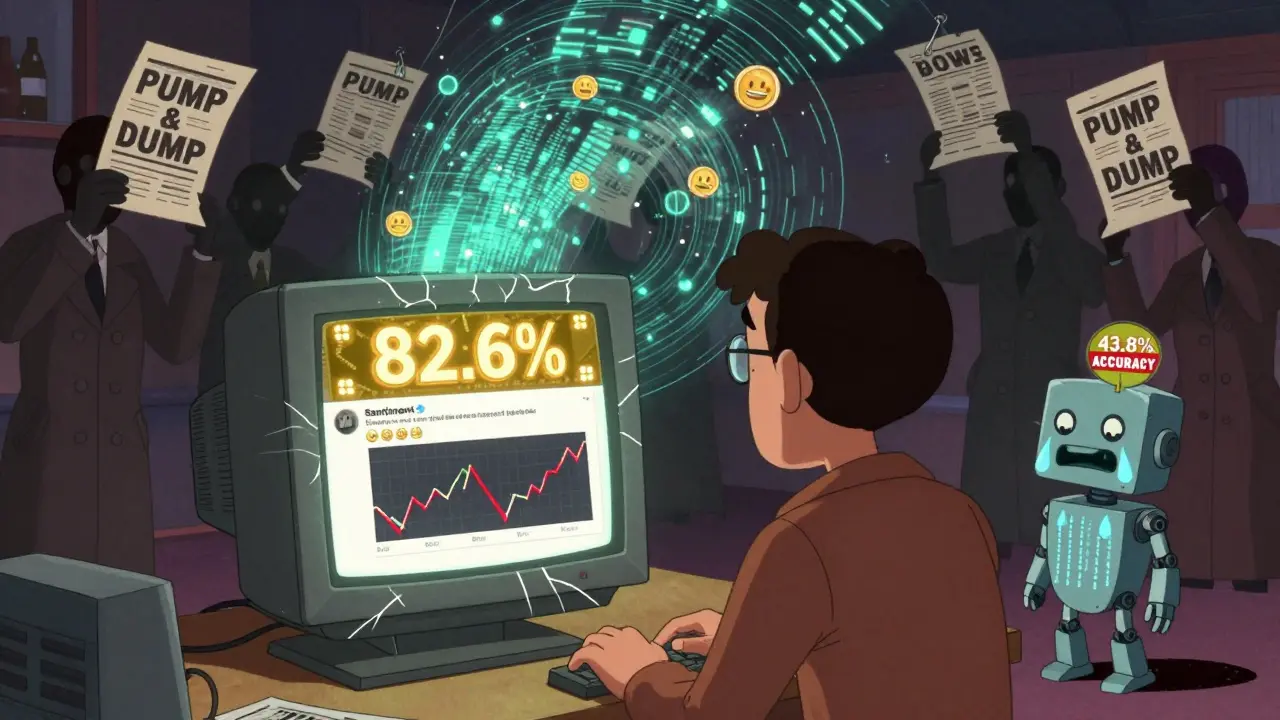
Real Examples: When News Hit-and What Happened
On January 10, 2026, a user named AltcoinSherpa2024 used Santiment’s regulatory alert to exit a $15,000 position four hours before the U.S. Market Structure Bill was postponed. The market dropped 7.2% after the news broke. They avoided a big loss-not because they predicted the outcome, but because they trusted the sentiment signal. But not everyone wins. On January 12, 2026, another trader, HODL4Ever, lost $3,800 after trusting a bullish sentiment signal during the KAITO crash. The problem? The crash happened because X (formerly Twitter) blocked InfoFi’s apps. Sentiment tools didn’t recognize platform-specific censorship as a market event. They saw “KAITO” trending and assumed demand was rising. It wasn’t. Even big players get it wrong. On January 15, 2026, Coinbase CEO Brian Armstrong publicly withdrew support for the Market Structure Bill. Within hours, Bitcoin dipped below $96,000. Sentiment tools flagged the news as negative-but many traders ignored it, assuming it was just political noise. They were wrong. The market reacted fast.Who’s Using This-and Who’s Getting Left Behind
Professional traders managing over $100,000 are using sentiment tools daily. A CryptoCompare survey found they make 23.7% higher returns than those who don’t. But retail traders with accounts under $10,000? They only see a 4.2% boost. Why the gap? It’s not the tools. It’s how they’re used. Beginners often misread sentiment direction. A neutral headline might look like a buy signal if they don’t understand context. A 2026 CoinDesk Academy report found that 38.7% of beginner losses come from misinterpreting polarity. The most successful users combine sentiment data with other signals. They check order books. They watch funding rates. They look at open interest. One Reddit user summed it up: “I only act when Santiment says bullish AND the order book shows big bids piling up.” That’s the real edge.The Hidden Dangers: Fake Sentiment and Manipulation
Here’s the dark side: sentiment can be faked. Pump-and-dump groups pay influencers to flood social media with positive buzz about a low-cap coin. AI tools pick up on the volume and flag it as “strong bullish sentiment.” Traders jump in. The group sells. Price crashes. Chainalysis reported that 19.3% of false signals in 2025 came from this exact tactic. There’s also “sentiment washing.” Some crypto projects buy news coverage from low-quality outlets to inflate their visibility. Sentiment tools can’t tell the difference between a legitimate Bloomberg article and a paid post on a crypto blog with 200 readers. And during low-liquidity periods-like weekends or holidays-sentiment spikes become even more unreliable. A single tweet can move a small-cap coin 20%. But it’s not real demand. It’s noise.
How to Use Sentiment Tools Without Getting Burned
If you’re going to use sentiment analysis, don’t treat it like a crystal ball. Treat it like a warning light.- Use at least two tools. Don’t rely on just one. Santiment and LunarCrush together give you a broader view.
- Always cross-check with on-chain data. If sentiment is bullish but Bitcoin’s active addresses are falling, something’s off.
- Ignore sentiment during exchange maintenance. The January 8, 2026 Binance API outage caused fake spikes across every tool. Don’t trade on that.
- Wait for confirmation. If a news headline triggers a 5% move, don’t chase it. Wait 15-30 minutes. Is the price holding? Is volume increasing? Then consider acting.
- Learn the difference between crypto-specific and legacy sentiment. Only the former matters. A Bloomberg article about inflation won’t move Solana. A CoinDesk report on a new Solana upgrade will.