How to Audit Smart Contracts for Security in 2025
 Dec, 31 2025
Every year, billions of dollars vanish from blockchain protocols-not because of hacks on the network itself, but because of flaws in the code that runs on top of it. Smart contracts are supposed to be trustless, self-executing, and secure. But if they’re poorly written, they become open doors for attackers. In 2024 alone, over $2.2 billion was stolen from DeFi and Web3 platforms due to exploitable smart contract bugs. That’s not a glitch. That’s a systemic failure in how we build and verify code before it goes live.
Why Smart Contract Audits Aren’t Optional Anymore
You can’t just deploy a smart contract and hope for the best. Even the most well-known projects have fallen victim to simple mistakes: reentrancy attacks, overflow errors, unchecked external calls, and improper access controls. These aren’t theoretical risks. They’ve drained wallets, collapsed protocols, and erased years of user trust in minutes. A smart contract audit isn’t a box to check. It’s the last line of defense before real money starts flowing. And in 2025, the stakes are higher than ever. With over $150 billion locked in DeFi protocols, every line of code needs scrutiny. The best time to audit? Before you even think about launching. Not after users start depositing funds.The Five-Stage Smart Contract Audit Process
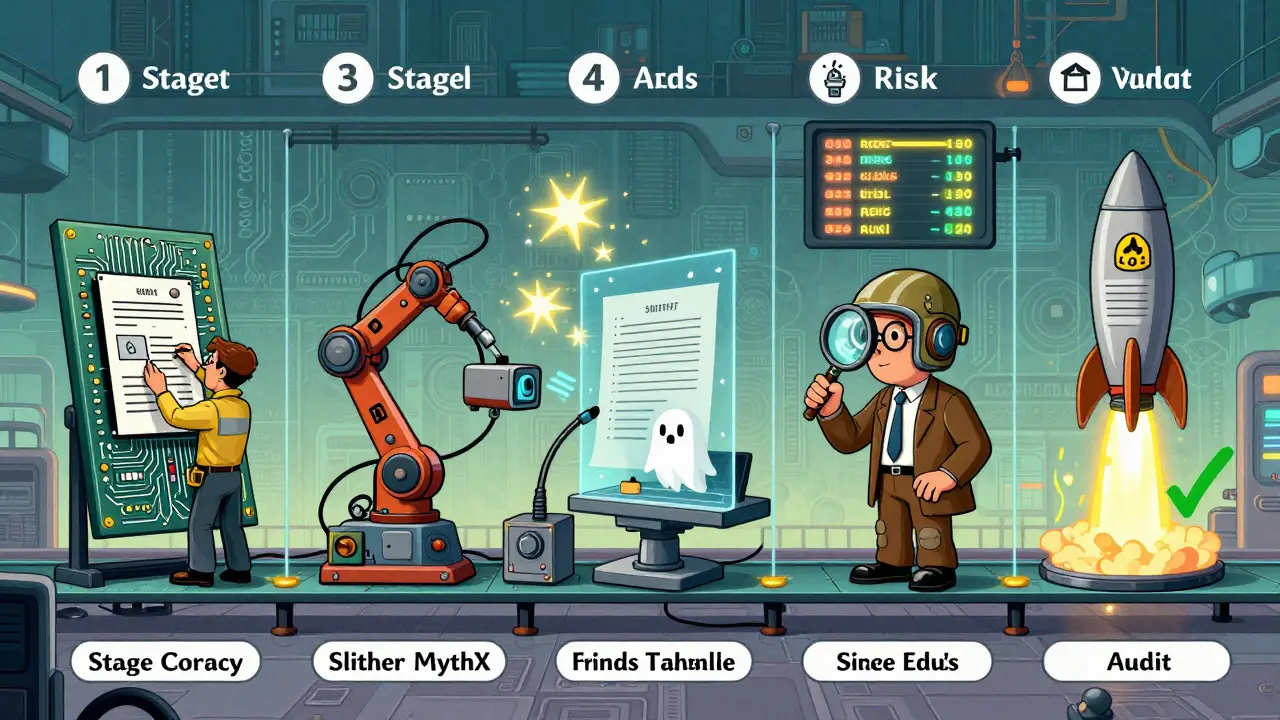
A professional audit doesn’t happen in a day. It follows a structured process that ensures nothing slips through.- Discovery and Scope Definition - Auditors start by understanding the project’s goals. What does the contract do? Who can call which functions? What assets are involved? They map out all modules, dependencies, and integration points. If the team hasn’t documented this clearly, the audit won’t be effective.
- Static and Formal Analysis - Automated tools scan the code for known patterns of vulnerability. Tools like Slither and MythX check for reentrancy, integer overflows, and unchecked external calls. Formal verification tools like Move Prover go further-they mathematically prove that certain properties (like "no one can withdraw more than their balance") always hold true.
- Manual Code Review - This is where human expertise matters most. Automated tools miss logic flaws. A human auditor traces how tokens flow between contracts, checks privilege escalation paths, and asks: "What happens if this function is called 100 times in one transaction?" They look for subtle issues like front-running opportunities or malicious fallback functions.
- Risk Reporting - Findings are ranked by severity: Critical, High, Medium, Low. A critical issue might let anyone drain the entire contract. A low issue might be a coding style inconsistency. Each finding includes a clear explanation, proof of concept, and step-by-step fix.
- Remediation and Re-Audit - The team fixes the issues. Then, the auditors come back. They verify the fixes and check that no new bugs were introduced. This cycle repeats until the contract is clean.
Most audits begin with a code freeze. No new features. No last-minute changes. The codebase is locked. That’s when the real work starts.
Top Tools Used in Smart Contract Audits (2025)
No single tool catches everything. Auditors use a stack of specialized software.- Slither - Open-source static analyzer for Solidity. Detects 92% of known vulnerabilities in controlled tests. Fast, free, and widely adopted.
- MythX - Cloud-based platform combining static and dynamic analysis. Integrates with Hardhat and Truffle. Good for teams without deep security expertise.
- Move Prover - Used for Aptos and Sui contracts. Proves correctness of Move language code using formal methods. Essential for new-generation blockchains.
- Diligence Fuzzing - Generates thousands of random inputs to find edge cases. Finds bugs that no human would think to test.
- Hardhat & Truffle - Development frameworks with built-in testing environments. Auditors use them to simulate attacks before writing reports.
But tools alone aren’t enough. A contract written in Move needs someone who understands Move’s unique safety features. A contract using ERC-4626 vaults needs someone who knows how yield-bearing tokens behave under stress. Tool familiarity isn’t optional-it’s the baseline.
Choosing the Right Audit Firm
Not all audit firms are equal. Some specialize in Ethereum. Others in Solana. A few focus on consensus layer security. Here’s who to look for in 2025:- OpenZeppelin - The go-to for Ethereum-based tokens and DeFi protocols. They helped define ERC standards. Their audit templates are industry benchmarks.
- Trail of Bits - Best for complex, high-value systems. They’ve audited Ethereum 2.0’s deposit contract and other mission-critical infrastructure. Strong in formal verification.
- Sigma Prime - Focused on consensus layer and validator security. If your project interacts with Ethereum’s beacon chain, they’re your team.
If you’re building on Aptos or Sui, make sure the firm has proven experience with Move. Ask for GitHub links to past Move audits. Check their public reports. Don’t settle for a firm that only does Solidity.
Communication matters too. A good auditor gives you clear timelines, explains findings without jargon, and responds quickly. If they ghost you after the contract is deployed, walk away.
The Paradox: Why Audited Contracts Still Get Hacked
Here’s the uncomfortable truth: most major hacks in 2024 happened on contracts that had already been audited. Why?- Multi-protocol interactions - A contract might be safe on its own, but when it talks to another contract (like a price oracle or a lending protocol), unexpected behavior emerges.
- New attack patterns - Attackers are getting smarter. Flash loan arbitrage exploits, cross-chain bridge manipulation, and front-running bots now target logic flaws that no tool has seen before.
- Constant updates - Projects keep adding features. A clean audit today can be outdated tomorrow if new code isn’t re-audited.
- Over-reliance on tools - Teams assume automated scans mean they’re safe. They skip manual review. They don’t test edge cases.
Audit reports are snapshots, not guarantees. The best defense is a layered approach: automated scans + manual review + continuous monitoring + bug bounties.
Real-Time Monitoring and Bug Bounties: The New Standard
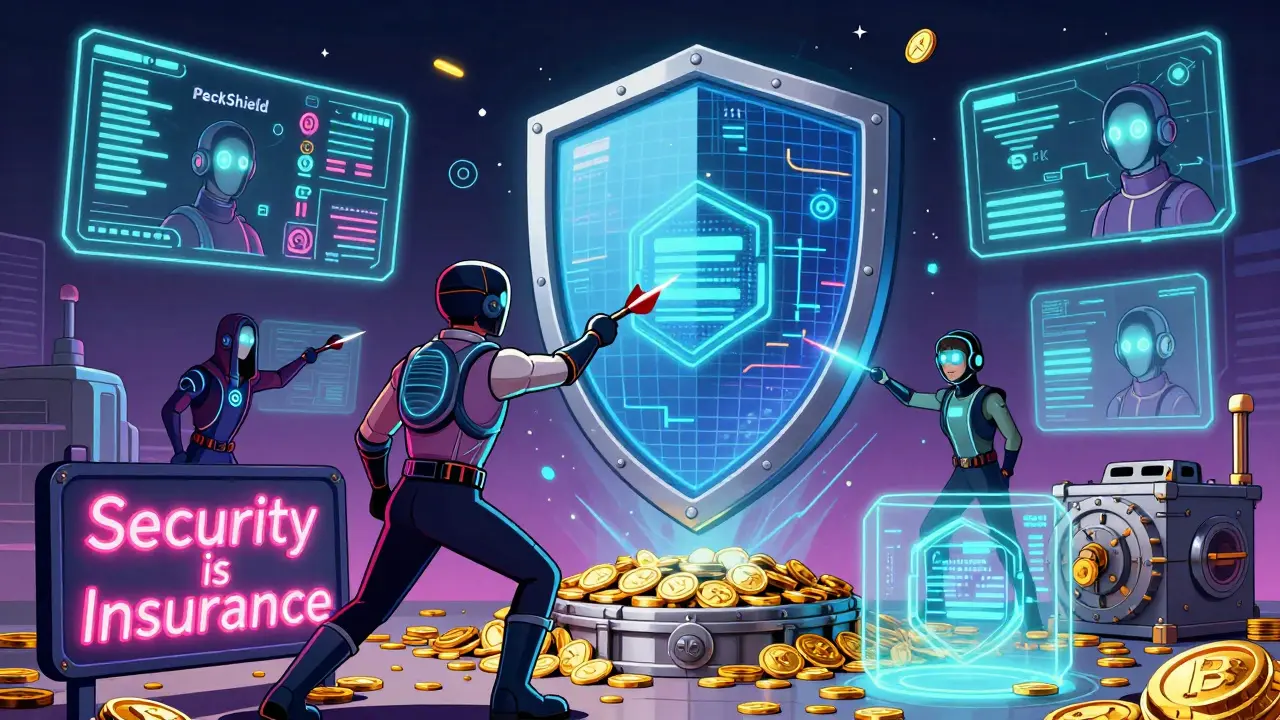
A one-time audit is no longer enough. In 2025, top projects use real-time monitoring tools that watch contracts 24/7. Platforms like PeckShield and CertiK alert teams to suspicious transactions in seconds. Some even auto-freeze funds if an exploit pattern is detected. Bug bounty programs are now mandatory. Immunefi, the leading platform, paid out $65 million to ethical hackers in 2023. A well-structured bounty program turns the community into your security team. Offer clear rules, fair rewards, and fast payouts. A $50,000 bounty for a critical bug is cheaper than losing $2 million.What You Should Do Now
If you’re building a smart contract:- Don’t skip the audit. Even if you’re small.
- Choose an auditor with proven experience in your blockchain’s language (Solidity, Move, Rust).
- Require a code freeze before the audit starts.
- Ask for a sample audit report. See how they explain issues.
- Plan for continuous monitoring after launch.
- Launch a bug bounty program with clear scope and rewards.
Security isn’t a cost. It’s insurance. And in crypto, the premium is worth every dollar.
Future Trends: AI, ZK, and Automated Auditing
The next wave of smart contract security is already here. AI tools now analyze code not just for patterns, but for intent. They can tell if a function was meant to be public or private based on naming and context. Formal verification is expanding to include economic modeling-checking if token incentives encourage honest behavior or create attack surfaces. Zero-knowledge proofs are being used to audit contracts without exposing the code. Imagine proving a contract is secure without revealing how it works. That’s becoming a reality for enterprise and privacy-focused protocols. By 2026, we’ll see AI-driven audit platforms that auto-generate test cases, simulate attacks, and suggest fixes in real time. But human auditors won’t disappear. They’ll shift from checking lines of code to interpreting risk, guiding developers, and making judgment calls that machines can’t.The future of smart contract security isn’t about replacing humans. It’s about giving them better tools to do their job faster and more accurately.
What is a smart contract audit?
A smart contract audit is a detailed security review of blockchain code to find vulnerabilities before the contract goes live. It involves automated scanning, manual code review, formal verification, and penetration testing to ensure the contract behaves as intended and can’t be exploited.
How much does a smart contract audit cost?
Costs range from $10,000 for simple contracts to over $200,000 for complex DeFi protocols. Price depends on code size, complexity, blockchain used, and whether you need formal verification or real-time monitoring support. Most reputable firms charge based on scope, not hours.
Can automated tools fully audit a smart contract?
No. Automated tools like Slither and MythX catch common bugs-reentrancy, overflow, unchecked calls-but they miss logic flaws, economic exploits, and interaction risks between contracts. Manual review by experienced auditors is still essential to find the most dangerous vulnerabilities.
What’s the biggest mistake teams make during audits?
Waiting until the last minute. Many teams delay the audit until they’re ready to launch, then rush changes after findings come in. This leads to rushed fixes and new bugs. The best teams start planning the audit during development, not after.
Do I need an audit if I’m just testing on a testnet?
Yes. Even testnet deployments can be exploited, and the code structure is the same. Fixing bugs on testnet is cheaper and safer than fixing them after mainnet launch. Many auditors offer discounted testnet reviews to help teams catch issues early.
How often should I re-audit my smart contract?
Re-audit after every major update-new features, new integrations, or changes to dependencies. Even small code changes can introduce critical flaws. For high-value contracts, consider quarterly reviews or continuous monitoring with automated alerts.
What’s the difference between a security audit and a code review?
A code review checks for style, structure, and basic logic. A security audit focuses on exploitation potential: how an attacker could break the contract, drain funds, or manipulate outcomes. Security audits use specialized tools and techniques that general code reviews don’t include.
Can I audit my own smart contract?
You can run automated scans and test your code, but true security auditing requires external, unbiased expertise. Developers are too close to their own code to spot blind spots. Independent auditors bring fresh eyes, proven methodologies, and real-world attack experience you won’t have.