How Turkey, UAE, Philippines, and Croatia Got Off FATF’s Grey List - And What It Means for Crypto
 Dec, 4 2025
FATF Grey List Exit Impact Calculator
How This Calculator Works
Enter your current metrics and see potential growth projections based on real data from countries that successfully exited FATF's grey list.
Data sources: Article on FATF grey list removals and official regulatory reports
Projected Growth
Based on historical data from successful grey list exits
Country Success Insights
UAE
Traded $450M in crypto investments in 2024 (triple 2023 levels)
Philippines
Crypto adoption increased from 14% to 27% of adults
Croatia
Transaction volume grew by 210% after removal
Turkey
Daily trading volume hit $1.2B (highest in Eastern Europe)
When the FATF puts a country on its grey list, banks around the world start saying no. Not because they’re being harsh - but because they’re scared. If a financial institution does business with a country flagged by FATF, it risks massive fines, reputational damage, or even being cut off from the global banking system. For crypto companies, that meant freezing accounts, shutting down on-ramps, and losing access to international payments. But in the last two years, four countries - the UAE, the Philippines, Croatia, and Turkey - turned things around. They didn’t just fix paperwork. They rebuilt their systems. And now, crypto businesses are seeing real results.
What FATF’s Grey List Actually Means for Crypto
The Financial Action Task Force isn’t a police force. It’s a global standard-setter. Its 40 Recommendations are the rulebook for stopping money laundering and terrorist financing. When a country fails to meet those rules - especially around knowing who owns companies, tracking crypto transactions, or prosecuting financial crimes - FATF puts it on the grey list. That’s not a punishment. It’s a warning: Fix this, or face consequences.
For crypto, the impact was immediate. Exchanges like Binance, Kraken, and local platforms in these countries couldn’t open bank accounts. Payment processors pulled out. Liquidity dried up. Users couldn’t withdraw to local banks. Some crypto firms shut down entirely. The Philippines, for example, saw its local crypto exchange market shrink by 40% between 2022 and 2024. The UAE had the same problem - despite being a global financial hub, its crypto firms were treated like high-risk outliers.
The UAE: From Grey List to Crypto Hub
The UAE didn’t just clean up its act - it rewrote the rules. In early 2024, FATF removed the UAE from the grey list after it completed a 20-month action plan. The changes weren’t cosmetic. The UAE’s Central Bank and the Securities and Commodities Authority forced all virtual asset service providers (VASPs) to register, implement real-time transaction monitoring, and collect full customer data - including beneficial ownership of wallets. They also created a dedicated crypto enforcement unit.
Before 2023, most crypto firms in Dubai operated in legal gray zones. After the reforms, firms like BitOasis and Rain had to prove they could trace every transaction back to a real person. That meant integrating with local identity systems and using blockchain analytics tools like Chainalysis and Elliptic. The result? Banks started reopening accounts. By mid-2024, five major international banks began offering services to UAE-based crypto firms again. Today, Dubai has over 120 licensed VASPs - more than any other country in the Middle East.
The Philippines: From Chaos to Clarity
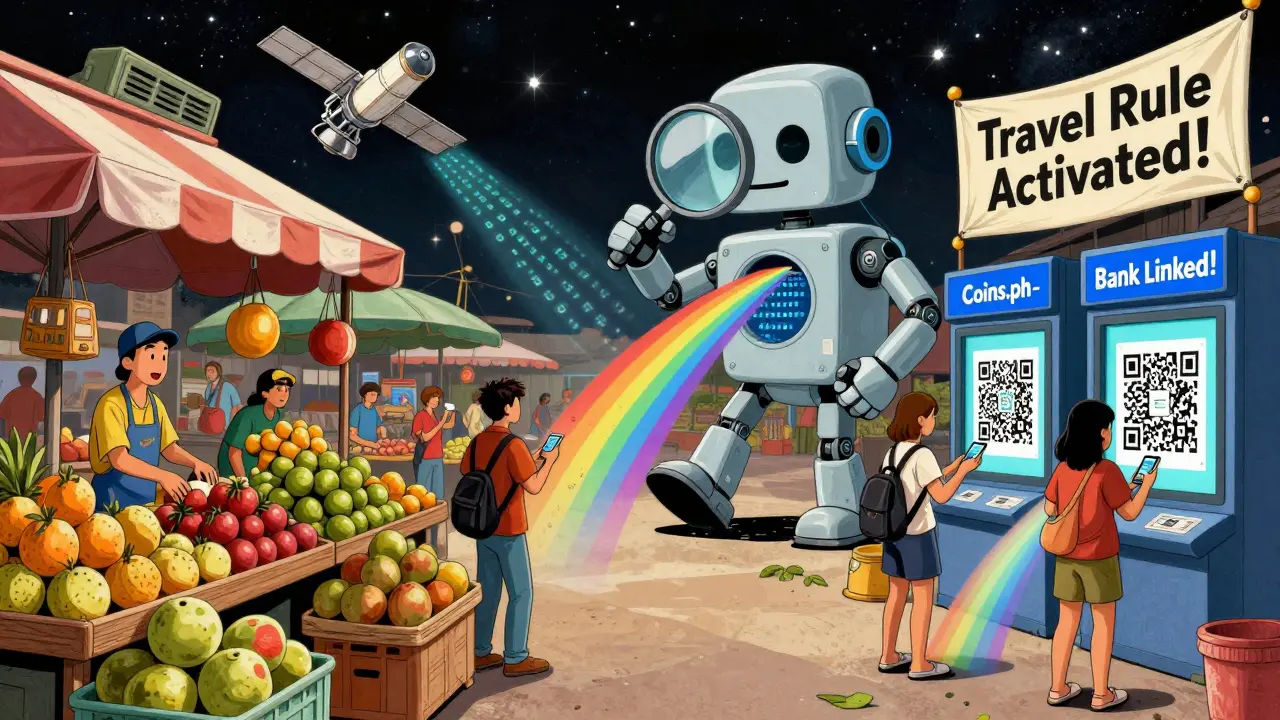
The Philippines was on the FATF grey list for five years. Why? Weak supervision of crypto exchanges, no enforcement against unlicensed operators, and almost no asset recovery from crypto fraud cases. In 2022, the Bangko Sentral ng Pilipinas (BSP) took control. They created a new licensing system: only VASPs that met FATF’s Travel Rule - sending sender and receiver info with every transaction - could operate. They shut down 18 unlicensed platforms in 2023 alone.
By February 2025, FATF confirmed the Philippines had fixed its gaps. The country now has 23 licensed crypto exchanges, up from just 7 in 2022. More importantly, banks are working with them again. Coins.ph, the country’s largest crypto app, went from having zero bank partnerships in 2023 to partnering with BPI and BDO by late 2024. Users can now deposit pesos directly from their bank accounts into their crypto wallets - something that was nearly impossible before.
Croatia: Small Country, Big Regulatory Leap
Croatia’s removal from the FATF grey list in June 2025 was quiet - but powerful. The country had no major crypto exchange, no big blockchain startups. But it had a problem: its financial regulators couldn’t track crypto flows. In 2023, FATF found Croatia had zero enforcement actions against crypto-related money laundering in the previous three years.
So they fixed it. Croatia passed new laws requiring all VASPs to register with the Croatian Financial Services Supervisory Agency (HANFA). They mandated real-time reporting of crypto transactions over €1,000. They trained prosecutors on blockchain forensics. And they partnered with Europol to share data. By early 2025, Croatia had launched its first crypto fraud prosecution - a case involving a fake NFT marketplace that stole over €2 million. That was the final proof FATF needed.
Now, Croatian crypto startups like CryptoPay.hr and BitCroatia are getting EU banking access. They can now process payments in euros without going through third-party intermediaries. For a small economy, that’s a game-changer.

Turkey: The Missing Piece
Turkey isn’t officially off the FATF grey list - yet. But it’s the closest to being removed. In 2024, FATF gave Turkey a new action plan after identifying serious gaps in its crypto oversight. Unlike the others, Turkey didn’t shut down unlicensed exchanges. Instead, it forced them to register. The Capital Markets Board (CMB) now requires all VASPs to use licensed custodians, implement KYC/AML checks, and report suspicious transactions to the Financial Crimes Investigation Board.
By mid-2025, Turkey had registered over 120 crypto platforms - up from just 30 in 2022. The government also started prosecuting crypto fraud cases. In March 2025, a court sentenced a former exchange CEO to 12 years for laundering over $150 million through peer-to-peer trades. That kind of enforcement is what FATF looks for. Turkey’s removal is expected in the next FATF plenary in October 2025.
What This Means for Crypto Businesses
Removing a country from the FATF grey list doesn’t just mean better PR. It means real money. Banks start accepting clients. Payment processors like Stripe and Adyen reopen doors. International investors return. Crypto firms can now expand without jumping through hoops.
In the UAE, crypto startups raised $450 million in 2024 - triple the amount from 2023. In the Philippines, crypto adoption jumped from 14% of adults in 2023 to 27% in 2025, according to Chainalysis. Croatia’s crypto transaction volume grew by 210% in the six months after FATF’s removal. Turkey’s daily crypto trading volume hit $1.2 billion in November 2025 - the highest in Eastern Europe.
And it’s not just about trading. DeFi protocols, NFT marketplaces, and blockchain gaming studios are now setting up offices in these countries. Why? Because they can now access the global financial system without a middleman. No more relying on offshore banks in Cyprus or Malta. No more paying 15% fees to process withdrawals. Just direct, compliant access.

Why This Matters Beyond Crypto
FATF’s success with these countries proves something important: regulation doesn’t kill innovation - bad regulation does. The UAE, Philippines, Croatia, and Turkey didn’t ban crypto. They didn’t over-regulate. They built frameworks that made crypto transparent - not invisible. They treated crypto not as a threat, but as a financial tool that needed rules - not restrictions.
And it worked. Financial inclusion improved. More people opened bank accounts. More small businesses got access to payments. The informal economy shrank. As FATF President Elisa de Anda Madrazo said in June 2025: “Bringing more people into the formal financial sector is crucial to our fight against financial crime.”
These countries didn’t just remove themselves from a list. They rebuilt trust. And that’s what every crypto ecosystem needs.
What’s Next?
As of June 2025, only North Korea, Iran, and Myanmar remain on the FATF blacklist. Twenty-four countries are still on the grey list - including Algeria, Angola, and Bolivia. But the path is clear: register your VASPs, enforce the rules, prosecute fraud, and prove it with data.
For crypto businesses, the message is simple: if you’re in a country still on the grey list, your options are shrinking. If you’re in one that just got off - your window to grow is wide open. The rules have changed. The banks are listening. And the global financial system is finally catching up with crypto - not fighting it.