How Vietnamese Traders Access Crypto Exchanges in 2026
 Jan, 22 2026
Over 21 million people in Vietnam-more than one in five-are holding cryptocurrency. Yet, the government hasn’t legalized crypto as money. There’s no outright ban, but there’s no clear permission either. So how do everyday Vietnamese traders buy Bitcoin, trade Ethereum, or bet on altcoins every day? The answer isn’t simple. It’s a mix of global platforms, local workarounds, and a regulatory system that’s still being written.
The Legal Gray Area
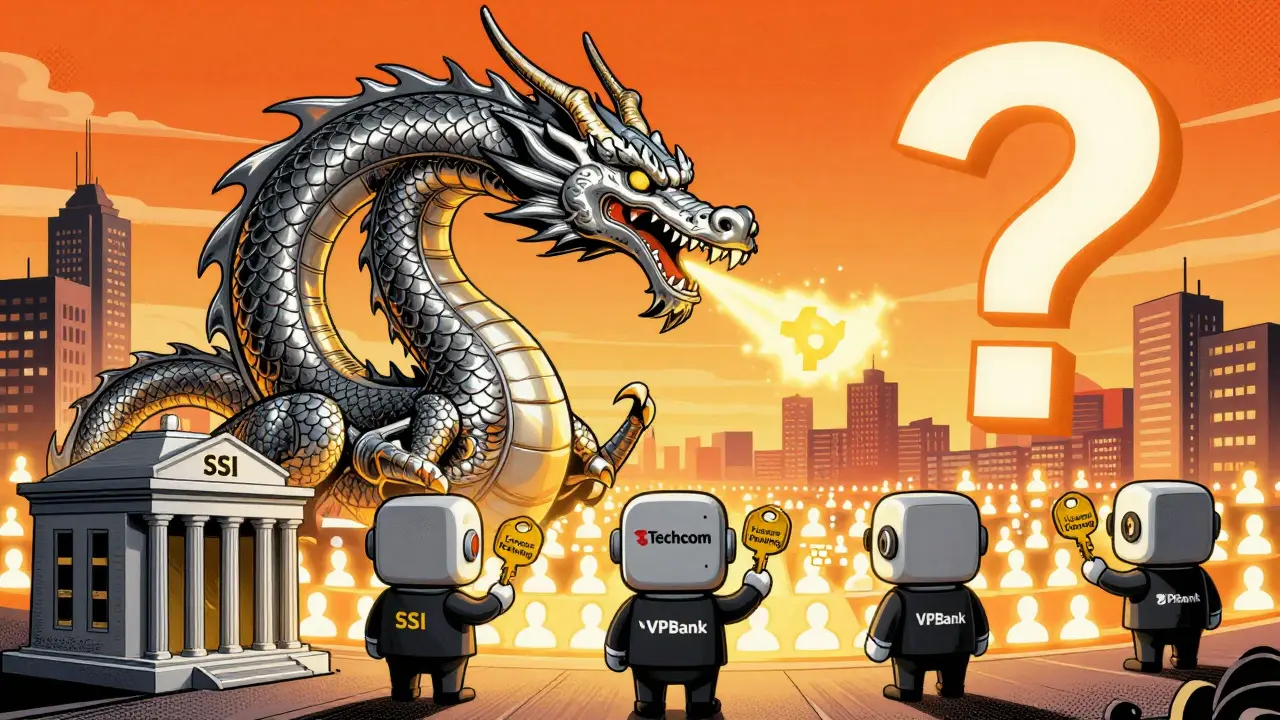
Since 2014, Vietnam’s State Bank has said cryptocurrencies aren’t legal tender. That sounds like a ban, but it’s not. No law says you can’t own or trade them. For over a decade, people traded anyway-through P2P networks, foreign exchanges, and local e-wallets. The government looked the other way until 2025, when it finally stepped in with Resolution 05/2025. This isn’t a full legalization. It’s a five-year pilot program that lets only five exchanges operate legally under strict control.These five licensed exchanges must be Vietnamese-owned, with at least 65% of their capital coming from institutional investors. They need VND 10 trillion (around $380 million) in starting funds. That’s not just high-it’s nearly impossible for startups. Only big banks and established firms like SSI, Techcom, and VPBank even tried to apply. By October 2025, five applications were submitted. But they’re still waiting for approval. Meanwhile, the market didn’t stop.
How Traders Actually Access Exchanges
Most Vietnamese traders don’t wait for licensed platforms. They use global exchanges that made it easy for them. Binance, Bybit, MEXC, Bitget, and HTX are the top five. Why? Because they speak Vietnamese, accept VND, and have local support teams.You don’t need a foreign bank account. You deposit Vietnamese dong directly through:
- Bank transfers (28 banks are connected, including Vietcombank and Techcombank)
- E-wallets like MoMo, ZaloPay, and VNPay
- P2P networks where you trade directly with other Vietnamese users
These platforms use Vietnam’s National Payment Corporation (NAPAS) to process deposits in real time. A VND deposit usually clears in 2-5 minutes. Withdrawals take longer-15 to 30 minutes-because of extra checks.
Every trader must pass KYC. That means uploading your National ID (CMND/CCCD) and doing a live facial scan. The system matches your face against Vietnam’s national database. If your ID photo is blurry or your name doesn’t match exactly, your account gets stuck. Reddit threads and WebTruyen forums are full of people complaining about this. One user spent three weeks trying to verify with OKX because his ID card had a different middle name than his bank account.

Which Exchanges Are Most Popular?
Binance leads by a huge margin. It handles 45% of all crypto trading volume from Vietnam. In October 2025, its daily trading volume in VND hit $2.3 billion. Why? It has the deepest liquidity. The spread on BTC/VND is just 0.08%. That means you pay less to buy and sell. It also runs big promotions-like giving away $5 million in Bitcoin to 250,000 users during its "Vietnam Summer" campaign.Bybit is the king of futures. Over 68% of Vietnamese trading volume on Bybit is in perpetual contracts. Traders love the low fees and clean interface. But withdrawal limits kick in during market crashes. Users report being locked out for hours when Bitcoin drops fast.
OKX stands out for transparency. It publishes monthly proof-of-reserves reports-something no other exchange in Vietnam does. But its customer service is slow. No Vietnamese support. If you have a problem, you wait hours for an English reply.
MEXC and KuCoin attract traders who want new tokens. They list obscure altcoins early. But their VND liquidity is thin. You’ll pay higher spreads and sometimes get stuck with coins you can’t sell.
For beginners, Remitano is simple. It’s a P2P marketplace. You find someone nearby to trade with. No complex charts. Just send VND, get crypto. But it’s risky. In Q3 2025, over 4,200 fraud cases were reported to Vietnam’s National Cyber Security Center. Scammers send fake payment screenshots and disappear.
The Hidden Problems
Even with all the access, Vietnamese traders face real roadblocks.Bank freezes-If you deposit more than VND 100 million ($4,000) in one go, your bank might freeze your account. Banks don’t like crypto. They don’t know how to classify it. So they play it safe. Experts recommend splitting big deposits into smaller amounts under $4,000.
Taxes-Vietnam taxes crypto profits at 22%. But no exchange gives you a tax report. You have to track every trade manually. If you bought Bitcoin on Binance, sold it on Bybit, and traded the profit into Solana on MEXC-you need to calculate gains for each step. Most people don’t. That’s a big risk.
Slow internet-Vietnam’s internet infrastructure isn’t built for high-frequency trading. API response times are 38% slower than in Singapore. If you’re scalping or using bots, you’re at a disadvantage.
Customer service-Binance and Bybit have 24/7 Vietnamese support. Response time: 15 minutes. Kraken? Only English. Average wait: 4 hours. During a market crash, that delay can cost you money.
What’s Next?
The next big change is coming in early 2026. Vietnam will roll out its National Digital Identity system. This replaces the current KYC process. Instead of uploading your ID, you’ll log in using your government-issued digital ID. It’s faster, more secure, and harder to fake. All licensed exchanges must integrate it by Q1 2026.Will local exchanges ever catch up? Probably not soon. The $380 million capital requirement is a wall. Even SSI Digital, the biggest local contender, only raised VND 200 billion ($1.36 million). It’s a drop in the ocean compared to Binance’s resources.
For now, global exchanges dominate. And they’re not going anywhere. They’ve built local payment rails, hired Vietnamese-speaking staff, and adapted to the culture. They’re not waiting for regulation. They’re working around it.
The real question isn’t how traders access exchanges today. It’s whether the government will ever let them do it openly. Right now, Vietnam is betting on control-not freedom. Five licenses. Five banks. Five chances. But with 21 million users already trading, the system is already broken. The question is: will it bend, or will it break?
What Traders Should Do Right Now
If you’re in Vietnam and want to trade crypto, here’s what works in 2026:- Start with Binance. It’s the most reliable for VND deposits and withdrawals.
- Use MoMo or ZaloPay for small deposits under VND 50 million ($2,000) to avoid bank flags.
- Complete KYC with your official CCCD (new ID card). Make sure your name matches your bank account exactly.
- If you’re trading futures, use Bybit. But never put more than 10% of your capital at risk.
- Track every trade in a spreadsheet. Use a free tool like Koinly or CoinTracker to calculate your 22% tax.
- Avoid Remitano unless you’re trading under VND 10 million and know the person.
- Join Vietnamese crypto Telegram groups like "Crypto Vietnam Official"-they warn about scams and exchange outages.
The market is growing fast. By 2027, experts predict 30 million Vietnamese will hold crypto. But the rules are still being written. Stay flexible. Stay informed. And never trust a platform just because it says it’s "Vietnam-approved."
Is it legal to trade crypto in Vietnam in 2026?
It’s not illegal, but it’s not officially legal either. The government launched a five-year pilot program in January 2025 that allows only five licensed exchanges to operate. Until those licenses are granted, most traders use global platforms like Binance and Bybit. Trading crypto personally isn’t banned, but operating an exchange without a license is.
Can I use Binance in Vietnam?
Yes, Binance is the most widely used platform in Vietnam. It supports VND deposits via bank transfers, MoMo, and ZaloPay. It has a Vietnamese-language interface, local customer support, and handles over 45% of the country’s crypto trading volume. It’s not officially licensed yet, but it’s the most reliable option available.
How do I deposit VND into a crypto exchange?
You can deposit Vietnamese dong through bank transfers (28 banks are supported), e-wallets like MoMo and ZaloPay, or P2P trading. Most exchanges integrate with NAPAS, Vietnam’s national payment network, so deposits usually clear in 2-5 minutes. Avoid large single transfers over VND 100 million ($4,000) to prevent bank account freezes.
Do I have to pay taxes on crypto in Vietnam?
Yes. Vietnam taxes crypto profits at 22%. No exchange provides tax reports, so you must track every trade manually. Use tools like Koinly or CoinTracker to calculate gains across platforms. Failing to report could lead to penalties if the government starts enforcing tax rules.
Why do some exchanges reject my ID verification?
Most rejections happen because your National ID (CMND/CCCD) details don’t match your bank account name or photo. The system checks your face against Vietnam’s national database. If your ID photo is outdated, blurry, or your name has a typo, verification fails. Make sure your CCCD is the latest version and matches your bank records exactly.
Will Vietnamese exchanges ever replace Binance and Bybit?
Unlikely in the near term. The government requires VND 10 trillion ($380 million) in capital to launch a licensed exchange. Only state-backed banks can afford that. Local startups have been priced out. Even the biggest local players like SSI Digital only raised $1.36 million. Global exchanges have the liquidity, tech, and user trust to stay dominant for years.