Identity Verification to Prevent Sybil Attacks in Blockchain Networks
 Jan, 24 2026
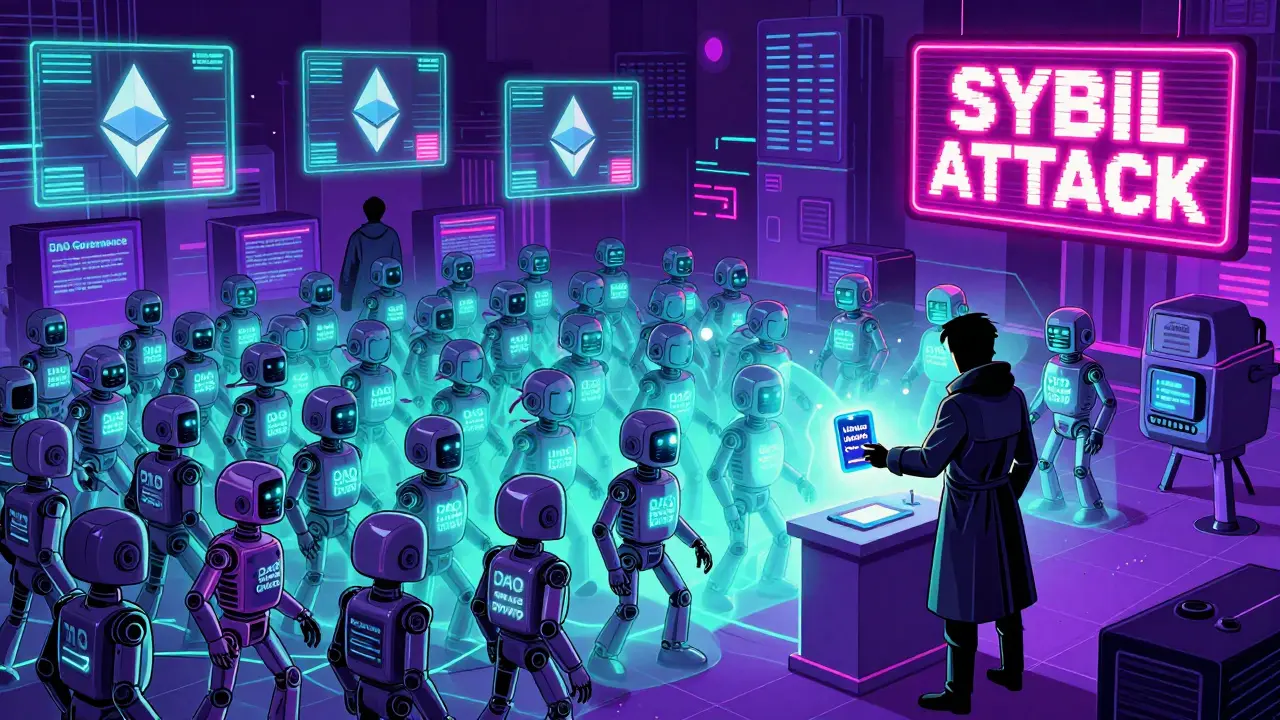
Imagine a voting system where anyone can create a thousand fake identities and each one gets a vote. That’s what a Sybil attack does to blockchain networks. It’s not science fiction-it’s happened. In DeFi, DAOs, and airdrop systems, bad actors have used bots to claim hundreds of tokens by pretending to be hundreds of different people. Without identity verification, these attacks are easy, cheap, and devastating.
What Exactly Is a Sybil Attack?
A Sybil attack happens when one person controls many fake identities on a decentralized network. The name comes from the 1973 book Sybil, about a woman with multiple personalities. In blockchain, it means one attacker runs dozens, hundreds, or even thousands of fake nodes or wallet addresses to manipulate outcomes. This works because most public blockchains like Ethereum or Bitcoin are permissionless. You don’t need to prove who you are to join. You just need a wallet. That’s great for freedom-but terrible for fairness. If you’re running a DAO and 70% of the votes come from bots pretending to be real users, the community’s voice is drowned out. Real-world examples? In 2022, Optimism’s airdrop was flooded with bot accounts. The team had to spend months clawing back tokens. Formo, a verification platform, found that over 60% of early claims on some airdrops came from the same IP addresses-clear signs of automation. Without identity checks, these systems are just open targets.Why Identity Verification Is the Most Direct Fix
The simplest way to stop Sybil attacks is to make sure each identity is tied to one real person. That’s identity verification. It doesn’t mean you need to hand over your passport to the whole world. It just means proving you’re not a bot. There are two main types of verification:- Direct validation: You prove your identity to a trusted third party-like uploading a government ID or verifying your phone number.
- Indirect validation: Someone you already trust vouches for you. Think of it like a reference letter, but on-chain.
How Identity Verification Compares to Other Methods
You might wonder: Why not just use proof-of-stake or proof-of-work instead? Those are the big names in blockchain security. But they have big flaws.- Proof-of-work (like Bitcoin) needs massive energy. It’s slow and environmentally heavy.
- Proof-of-stake (like Ethereum) favors the rich. If you have more coins, you get more voting power. That’s not democracy-it’s wealth concentration.
- Reputation systems take months to build trust. A new DAO can’t wait a year before it can vote safely.

Real-World Trade-Offs: Privacy vs. Security
This isn’t a simple yes-or-no choice. It’s a balancing act. Enterprise blockchains-like those using Hyperledger Fabric-love identity verification. They’re built for banks, governments, and supply chains. They need accountability. For them, it’s a no-brainer. The Linux Foundation’s 2023 survey found 91% of enterprise users said it cut Sybil attacks dramatically. But retail users? Many hate it. In Reddit threads, people complained about spending 17 minutes on Optimism’s verification just to claim a few dollars in tokens. One user wrote: “I joined crypto to escape banks, not to hand my ID to another middleman.” And it’s not just about annoyance. People in countries without national IDs, or without stable internet, get locked out. A Formo study found 21.4% of failed verifications were due to inconsistent ID formats or poor mobile coverage in rural areas. That’s exclusion by design. The Electronic Frontier Foundation (EFF) warns that collecting identity data creates honeypots. If a company storing your ID gets hacked, you’re not just losing tokens-you’re exposed to identity theft. That’s why the new wave of solutions focus on privacy-first verification. W3C’s Verifiable Credentials 2.0, released in February 2024, lets you prove you’re a real person without showing your name, birthdate, or passport number. You just prove “I’m not a bot.”How It’s Being Used Today
You’re already seeing identity verification in action-even if you didn’t notice.- DAOs: Most new governance systems now require a verified identity to vote. GitcoinDAO and others use Proof of Humanity, a system where users submit a video of themselves saying a phrase. Others use Civic or Microsoft ION.
- DeFi airdrops: Projects like Arbitrum and Optimism now filter out bot wallets before distributing tokens. Without this, 80%+ of rewards would go to automated scripts.
- Token-gated communities: Discord servers, NFT clubs, and private forums now check your verified identity before letting you in. No more fake accounts spamming or scamming.

What It Takes to Implement
If you’re building a blockchain project and want to stop Sybil attacks, here’s what you need to know:- Time: Using a third-party API like Civic or Formo? You can integrate it in 4-6 weeks. Building your own system with zero-knowledge proofs? Expect 12-16 weeks.
- Skills: You’ll need developers who know Solidity or Rust, plus someone familiar with W3C Verifiable Credentials and DID (Decentralized Identifiers).
- Cost: Most APIs charge per verification. At scale, it’s cheaper than losing millions to bot claims.
- Compliance: You’re dealing with laws in 28+ countries. GDPR, KYC, AML rules vary. A 2023 report found 73% of projects struggled with this.
The Future: Privacy-Preserving Verification
The future isn’t about forcing everyone to show their ID. It’s about proving uniqueness without revealing identity. Ethereum’s EIP-725 and EIP-735 are already in testing. They let users create on-chain identities that can be verified without exposing personal data. Pilot programs show 89% effectiveness at blocking Sybil attacks while keeping users anonymous. By 2026, Forrester predicts 60% of enterprise blockchains will use some form of identity verification. Public chains? They’ll use hybrid models-partial verification combined with cryptoeconomic tricks like quadratic voting or reputation weighting. The big challenge? No system yet solves all three: Sybil resistance, privacy, and permissionless access. That’s the trilemma. But we’re getting closer.What You Should Do Now
If you’re a user: If you’re joining a DAO or claiming an airdrop, expect verification. It’s not perfect, but it’s better than losing your share to bots. If you’re a builder: Don’t ignore Sybil attacks. Start small. Use a proven API. Test with real users. Collect feedback. Privacy matters-but so does fairness. If you’re skeptical: Ask for privacy-preserving options. Push for zero-knowledge proofs. Demand open-source tools. Don’t accept KYC unless it’s necessary and minimal. Identity verification won’t make blockchain perfect. But without it, decentralization is just a playground for the clever and the automated. And that’s not the future we signed up for.What is a Sybil attack in blockchain?
A Sybil attack is when one person creates many fake identities-like hundreds of wallet addresses or nodes-to gain unfair control over a decentralized network. This can skew voting in DAOs, hijack airdrops, or manipulate consensus mechanisms. It’s possible because most blockchains allow anyone to join without proving who they are.
How does identity verification stop Sybil attacks?
Identity verification ensures each participant is a unique human by linking their account to verified personal data-like a government ID, phone number, or biometric check. This makes it costly and difficult to create fake identities. Platforms like Civic and Formo use encryption and zero-knowledge proofs to confirm uniqueness without exposing private details.
Is identity verification the same as KYC?
Not always. KYC (Know Your Customer) typically means collecting full personal data like name, address, and ID for regulatory compliance. Identity verification for Sybil prevention only needs to prove uniqueness-sometimes without any personal info at all. Zero-knowledge proofs can verify you’re one person without revealing who you are.
Why don’t all blockchains use identity verification?
Because it conflicts with the core idea of permissionless, anonymous participation. Bitcoin and Ethereum were built to let anyone join without approval. Adding identity checks can exclude people without official documents, raise privacy concerns, and undermine censorship resistance. Many prefer cryptoeconomic methods like proof-of-stake instead.
Can identity verification be hacked or bypassed?
Yes, but it’s harder than creating bots. Attackers can spoof SMS codes, fake IDs, or use stolen documents. That’s why top systems combine multiple signals: device fingerprinting, behavioral analysis, biometrics, and on-chain history. No system is perfect, but modern solutions have 98%+ accuracy in distinguishing humans from bots.
What are the best identity verification tools for blockchain?
Leading tools include Microsoft ION (for enterprise), Civic (user-friendly APIs), Formo (for DeFi and airdrops), and Proof of Humanity (open-source, privacy-focused). For new projects, start with a trusted third-party API. For maximum privacy, look for solutions using W3C Verifiable Credentials and zero-knowledge proofs.
Will identity verification become mandatory in crypto?
In regulated spaces-like DeFi lending or institutional blockchains-yes. The EU’s Digital Identity Wallet law and similar rules globally are pushing for it. But in public chains like Bitcoin or Ethereum, it’ll remain optional. The trend is toward hybrid models: optional verification for better rewards, while keeping full anonymity for basic use.