INX Crypto Exchange Review: Regulated Trading for Security Tokens and Major Cryptocurrencies
 Dec, 11 2025
Accredited Investor Eligibility Checker
Determine if you qualify to trade security tokens on INX. INX requires accredited investor status for security token trading. This tool helps you understand if you meet the U.S. SEC requirements.
What is an Accredited Investor?
To trade security tokens on INX, you must be an accredited investor. This means you either:
- Have earned over $200,000 annually (or $300,000 jointly with a spouse) for the last two years
- Have a net worth exceeding $1 million (excluding your primary residence)
Verify Your Accredited Investor Status
INX Security Token Trading Requirements
To trade security tokens on INX, you must:
- Be an accredited investor as defined by the SEC
- Complete INX's KYC verification process (takes 3-5 business days)
- Verify your identity with government ID and financial documentation
Most crypto exchanges are built for speed, volume, and speculation. INX is not one of them. If you're looking for a platform that lets you trade Bitcoin and Ethereum like Binance or Coinbase, you’ll find INX too slow, too limited, and too serious. But if you want to trade SEC-registered security tokens - tokenized stocks, real estate, or private equity - INX is one of the only places in the world where you can do it legally and safely. This isn’t a platform for day traders. It’s built for investors who care about compliance, transparency, and long-term asset ownership.
What Makes INX Different?
INX isn’t just another crypto exchange. It’s a regulated financial platform that combines traditional securities law with blockchain technology. Unlike Coinbase or Kraken, which only handle cryptocurrencies, INX allows you to trade both digital coins and tokenized real-world assets. These aren’t speculative memecoins. They’re legal financial instruments backed by actual companies, properties, or revenue streams - and they’re registered with the U.S. Securities and Exchange Commission (SEC).
INX was the first blockchain company ever to complete a registered public offering in the U.S., raising $85 million in August 2020. That’s not a marketing claim - it’s a legal milestone. The platform operates under SEC Regulation ATS, Regulation D, Regulation A+, and Regulation S. That means every token listed on INX has passed federal scrutiny. For institutional investors, this is a game-changer. No more guessing if a token is a security. With INX, you know it is - and that it’s legal.
Cryptocurrencies Available on INX
INX supports seven major cryptocurrencies: Bitcoin (BTC), Ethereum (ETH), Litecoin (LTC), Avalanche (AVAX), Zcash (ZEC), Ripple (XRP), and Solana (SOL). That’s it. No Dogecoin. No Shiba Inu. No obscure altcoins. If you’re hoping to trade hundreds of tokens like on Binance, you’ll be disappointed.
But here’s why that’s not necessarily a bad thing. INX isn’t trying to be a speculative casino. It’s a regulated marketplace. By limiting its crypto offerings to established, high-market-cap assets, the platform reduces risk and increases trust. You won’t find pump-and-dump coins here. What you will find is a clean, focused environment where the emphasis is on security, not hype.
Security Token Trading: INX’s Real Strength
This is where INX shines - and where no other crypto exchange comes close. The platform lists security tokens representing real assets. For example, you can buy tokenized shares in a New York apartment building through RealT, or invest in private credit deals from Goldfinch. These aren’t theoretical. They’re actual ownership stakes, documented on the blockchain and legally enforceable.
Unlike traditional private equity or real estate investments, which lock your money away for years, INX lets you trade these assets 24/7. That’s revolutionary. Normally, private assets trade only during business hours, with limited buyers and sellers. On INX, you can sell your tokenized real estate stake at 3 a.m. on a Sunday - and get a fair price from another investor.
As of October 2025, 47 companies have issued security tokens through INX’s platform. The global security token market was worth $6.2 billion in Q3 2025, and INX holds about 18.3% of that market. That’s a small slice of the overall crypto pie, but a massive lead in its niche.
Trading Features and Tools
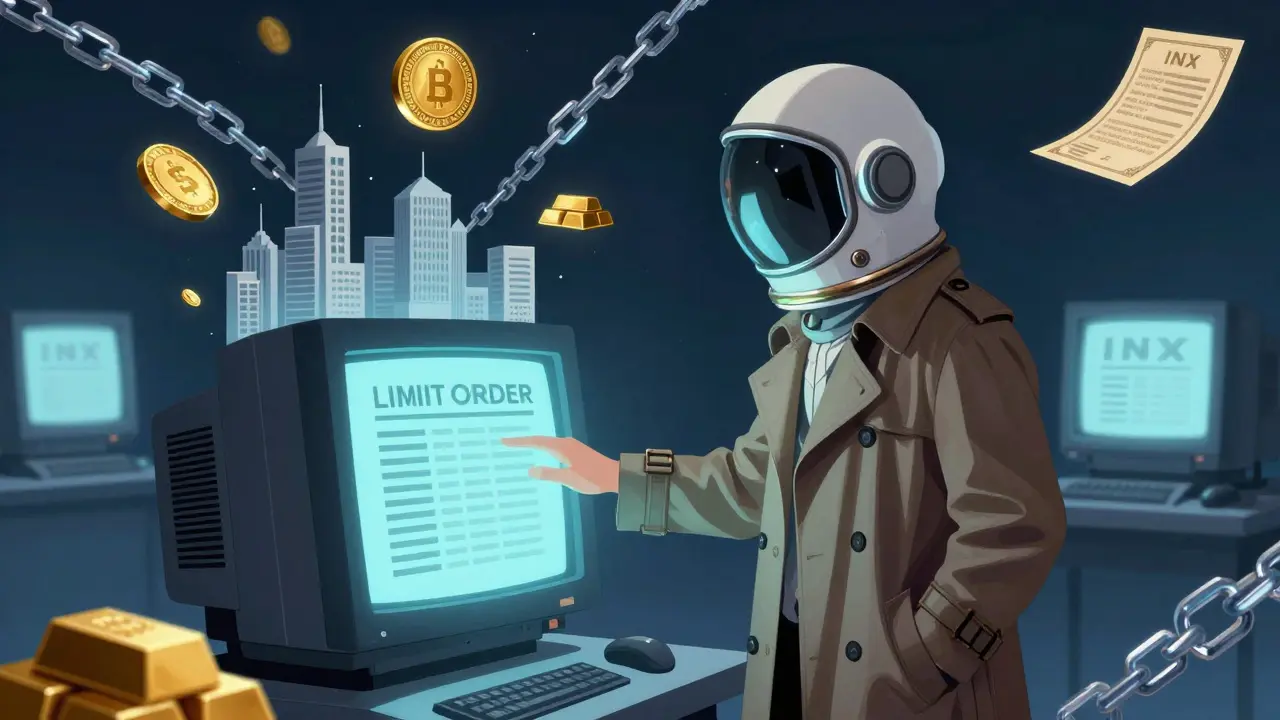
INX offers basic but reliable trading tools. You can place limit, market, stop-limit, and stop-market orders. The interface uses TradingView for charts, so you get candlestick patterns, technical indicators, and depth charts. The mobile app is clean and responsive, with a unified portfolio view that shows both your crypto and security tokens in one place.
But don’t expect advanced features. There’s no margin trading. No leverage. No futures. No perpetual contracts. INX doesn’t allow borrowing or shorting. That’s intentional. The platform was designed to avoid the reckless speculation that’s plagued other exchanges. If you’re looking to double your money overnight with 10x leverage, look elsewhere.
Transaction fees can be paid in USD, BTC, or ETH, but exact rates aren’t published. Based on user reports, trading fees are around 0.2-0.5% per trade, depending on volume. For security tokens, issuance fees range from 3-7% of the total offering size - but that’s paid by the company issuing the token, not the trader.
Security and Custody
INX takes security seriously. All assets are held by BitGo Trust Company, Inc., a qualified custodian regulated under U.S. banking law. Funds are stored in a mix of hot and cold wallets with multi-signature technology. This setup meets Rule 206(4)-2 under the Investment Advisers Act of 1940 - the same standard used by Wall Street firms.
INX also uses a sequential transaction processing system, meaning trades are handled one after another instead of in parallel. This reduces the risk of exploits and double-spending, but it can slow things down during high-volume periods. In August 2025, INX announced it was integrating with the Avalanche blockchain to improve throughput - a direct response to criticism from experts like Dr. Sarah Chen of MIT, who warned that the old system could bottleneck during market spikes.
Regulation and Compliance
INX is headquartered in New York and holds a DLT license from the Gibraltar Financial Services Commission. It’s one of only two platforms globally - alongside tZERO - with full SEC registration for security token trading. That’s not just a badge. It’s a legal barrier to entry. No other exchange can legally offer the same assets without going through the same multi-year, multi-million-dollar approval process.
SEC Commissioner Hester Peirce called INX “essential for the maturation of digital asset markets” in March 2025. That’s high praise from someone who’s spent years pushing for clearer crypto regulations. For accredited investors, financial advisors, and institutions, INX offers a rare legal pathway into digital assets without crossing regulatory lines.
Who Is INX For?
INX is not for everyone. If you’re a retail trader who likes to swing trade altcoins, chase trends, or use leverage, you’ll find INX too slow, too limited, and too boring.
But if you’re:
- An accredited investor looking to diversify into tokenized real estate or private equity
- A financial advisor needing compliant tools to recommend digital assets to clients
- An institution seeking a regulated platform for token issuance or custody
- Someone who values legal clarity over speculative gains
- then INX is one of the best options on the market.
What’s Missing?
INX has clear weaknesses. Trading volume is low - around $5-7 million daily, compared to $15-20 billion on Binance. That means wider bid-ask spreads (0.5-1.0% vs. 0.1-0.2% on larger exchanges) and less liquidity for large orders. One user reported 0.8% slippage on a $50k ETH trade - unacceptable for professional traders.
The crypto selection is tiny. No Cardano. No Polkadot. No Chainlink. If you want to hold more than seven coins, you’ll need another exchange.
The KYC process takes 3-5 business days, longer than most crypto platforms. You’ll need to verify your identity and, if you want to trade security tokens, prove you’re an accredited investor. That means showing proof of income or net worth - something you won’t need on Binance or Kraken.
User Experience and Support
INX has a 4.1/5 rating on Trustpilot based on 87 verified reviews. Users praise the “Smart Contract Guarantee” feature, which provides transparent, verifiable transaction records. The mobile app scores 4.3/5 on the Apple App Store, with 1,247 ratings.
Customer support is available 24/7 via chat and email. Chat responses average 12 minutes; emails take about 4.5 hours. That’s faster than most traditional brokerages.
The community is small but active. The official Discord server has 12,500 members. The subreddit r/INXPlatform has 8,200 subscribers. There’s no massive Reddit army or TikTok hype machine - just serious investors talking about real assets.
What’s Next for INX?
INX has a clear roadmap. By Q2 2026, it plans to:
- Expand its crypto list to 15 major coins
- Add staking for proof-of-stake assets like ETH and SOL
- Launch a dedicated institutional API with FIX protocol support
Analysts at Bernstein Research predict INX could hit $50 million in annual revenue by 2027 - mostly from security token issuance fees, not trading commissions. Delphi Digital expects INX to capture 15-20% of the global security token market by 2026.
The bigger picture? As governments worldwide move toward clearer digital asset regulations, platforms like INX will become more valuable - not less. The SEC’s evolving stance, especially after the 2024 Grayscale ruling, signals that compliance is now a competitive advantage.
Final Verdict
INX isn’t trying to be the biggest crypto exchange. It’s trying to be the most trustworthy. It sacrifices volume, speed, and variety to deliver something rarer: legal certainty. For most retail traders, that’s not worth it. But for investors who care about owning real assets, backed by law and transparency, INX is unmatched.
If you’re ready to move beyond speculation and into regulated, tokenized ownership - INX is one of the few platforms that lets you do it safely, legally, and with confidence.
Is INX a legitimate crypto exchange?
Yes, INX is fully legitimate. It’s the first blockchain company to complete a registered public offering in the U.S. and operates under multiple SEC regulations, including Regulation ATS and Regulation A+. It also holds a DLT license from Gibraltar’s financial regulator. Unlike unregulated exchanges, INX is subject to federal oversight and audit.
Can I trade Bitcoin on INX?
Yes, you can trade Bitcoin (BTC), Ethereum (ETH), Litecoin (LTC), Avalanche (AVAX), Zcash (ZEC), Ripple (XRP), and Solana (SOL). That’s seven major cryptocurrencies. INX doesn’t list altcoins or memecoins - its focus is on regulated assets, not speculation.
What are security tokens, and why does INX offer them?
Security tokens represent ownership in real-world assets like stocks, real estate, or private company equity. They’re issued under SEC regulations and are legally recognized as securities. INX offers them because it’s one of the only platforms allowed to list and trade these assets 24/7. This gives investors liquidity in traditionally illiquid markets.
Does INX offer margin trading or leverage?
No. INX does not offer margin trading, leverage, futures, or perpetual contracts. This is by design. The platform avoids high-risk derivatives to maintain regulatory compliance and protect investors from speculative losses.
How long does KYC take on INX?
Standard KYC verification takes 1-2 business days. If you want to trade security tokens, you’ll need to prove you’re an accredited investor - which adds 2-3 more days. The process requires government ID and proof of income or net worth, depending on your region.
Is INX better than Coinbase or Binance?
It depends on your goals. If you want to trade hundreds of coins, use leverage, or chase short-term gains, Coinbase or Binance are better. If you want to invest in tokenized real estate, private equity, or other SEC-registered assets with legal clarity, INX is the only viable option. They serve completely different markets.
Can non-U.S. users trade on INX?
Yes, INX accepts users from over 100 countries. However, access to security tokens is restricted to accredited investors under U.S. rules. Non-U.S. users can still trade the seven supported cryptocurrencies, but security token access depends on local regulations and investor accreditation status.
What’s the future of INX?
INX plans to expand its crypto list to 15 coins, add staking for PoS assets, and launch an institutional API by mid-2026. With the global security token market projected to grow at 38.7% annually through 2030, INX is positioned to dominate its niche. Its regulatory moat makes it hard for competitors to replicate.