Liquidity Pool Token Ratios: How DeFi Balance Works
 Apr, 24 2026
Ever wondered why you have to deposit exactly equal amounts of two different coins when adding liquidity to a decentralized exchange? Or why your balance looks strange after a massive price swing? It all comes down to liquidity pool token ratios. These aren't just random numbers; they are the mathematical heartbeat of Decentralized Finance (DeFi), determining everything from the price of a token to how much profit you make as a provider.
At its core, a Liquidity Pool is a smart contract-based collection of cryptocurrency funds that allows users to trade assets without needing a traditional middleman or order book . Instead of waiting for a buyer and seller to agree on a price, the pool uses a formula to set the price automatically. If the ratio of tokens in that pool shifts, the price moves. This is the fundamental engine behind the entire DeFi ecosystem.
The Classic 50/50 Split: The Constant Product Formula
Most people start with the standard 50/50 ratio. This is the hallmark of the Automated Market Maker (or AMM), a protocol that uses mathematical formulas to price assets automatically based on the ratio of tokens in a pool . Platforms like Uniswap is one of the largest decentralized exchanges using the constant product formula to maintain liquidity , SushiSwap, and PancakeSwap rely heavily on this model.
The magic happens through a formula: x * y = k. In this equation, x and y are the quantities of the two tokens, and k is a constant value that must never change. Here is how that works in the real world: if you deposit $1,000 of ETH and $1,000 of USDC, you've created a 50/50 value ratio. When a trader comes along and buys ETH using USDC, they add USDC to the pool and remove ETH. Because the pool now has more USDC and less ETH, the ratio shifts, and the price of ETH goes up to keep k constant.
This means the pool doesn't need an external price feed from an exchange like Coinbase. The price is discovered naturally by the ratio of assets available. If a lot of people buy a token, the ratio tips, the price spikes, and eventually, arbitrageurs step in to sell that token back into the pool to profit from the difference, bringing the ratio back toward the global market average.
Beyond the 50/50: Weighted Pools and Custom Ratios
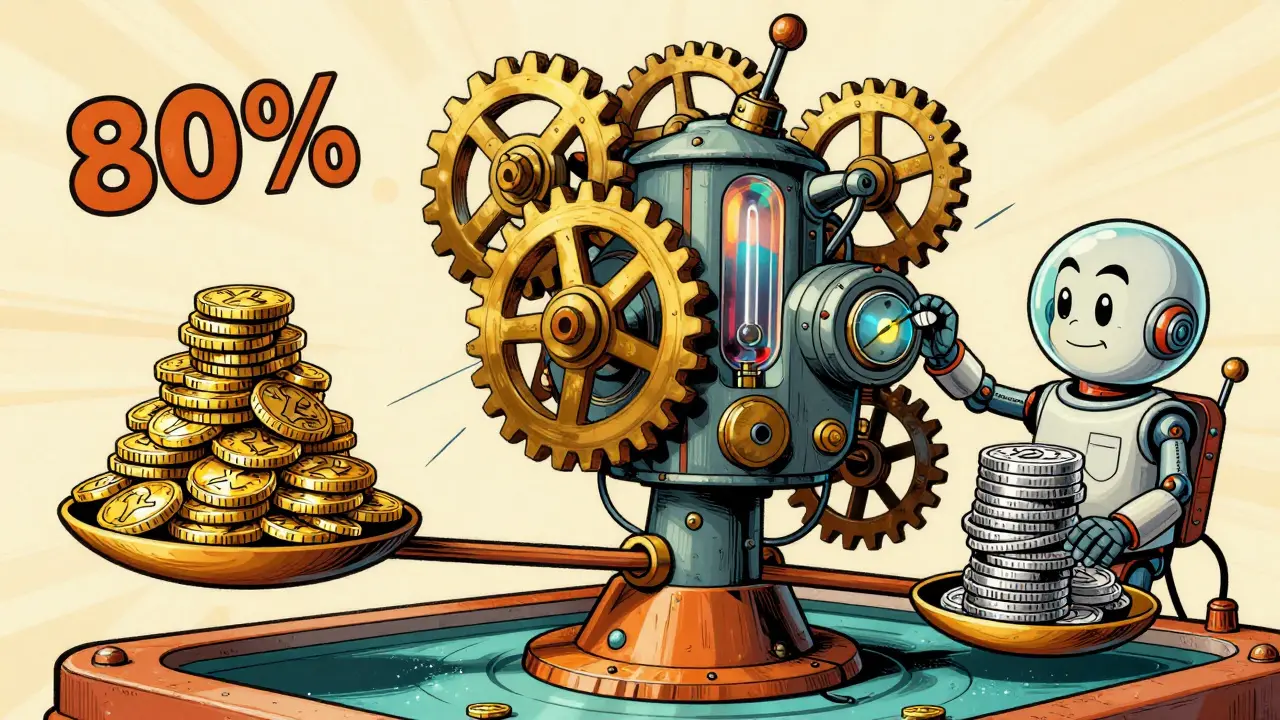
For a long time, 50/50 was the only game in town. But that's not always ideal. Imagine you want to hold a portfolio that is 80% Bitcoin and 20% an altcoin. Forcing a 50/50 ratio would mean selling half your Bitcoin just to provide liquidity. This is where Balancer is a DeFi protocol that pioneered weighted pools, allowing liquidity providers to set custom token ratios comes in.
Weighted pools allow for ratios like 80/20 or even multi-token baskets (e.g., 40/30/20/10). This is a huge deal for treasury management. By using an 80/20 ratio, a provider has less exposure to the volatility of the smaller asset, which significantly reduces the impact of price swings. It turns a liquidity pool into a sort of automated index fund.
| Model | Common Ratio | Best For | Price Impact |
|---|---|---|---|
| Constant Product | 50/50 | General trading pairs | Higher on large trades |
| Weighted Pools | Custom (e.g., 80/20) | Portfolio diversification | Balanced by weights |
| Stable-Swap | Near 1:1 | Stablecoins (USDC/DAI) | Very Low (low slippage) |
Slippage and the Impact of Ratio Depth
When we talk about ratios, we have to talk about depth. This is often measured as Total Value Locked (or TVL), the total amount of assets deposited in a liquidity pool . The larger the TVL, the more stable the token ratio is when a trade happens.
If a pool only has $1,000 and you trade $500 worth of tokens, you are drastically changing the ratio. This results in slippage-the difference between the expected price of a trade and the price at which the trade actually executes. In a tiny pool, a single large trade can send the price skyrocketing or crashing because the ratio is so sensitive. In a pool with $100 million, that same $500 trade is a drop in the bucket, and the ratio barely budges, meaning the trader gets a price very close to the market rate.
Concentrated Liquidity: Precision Ratios
The newest evolution is Concentrated Liquidity is a mechanism that allows LPs to provide liquidity within a specific price range rather than across the entire curve . In a standard pool, your money is spread from a price of $0 to infinity. Most of that money never actually gets used because tokens rarely trade at extreme prices.
With concentrated liquidity, you can tell the pool: "Only use my funds if ETH is between $2,200 and $2,600." This concentrates your token ratio into a narrow band. If the price stays in that range, you earn way more fees than a standard 50/50 provider because your capital is working much harder. However, the risk is higher: if the price moves outside your chosen range, your position becomes 100% of the less valuable asset, and you stop earning fees entirely until the price moves back into your band.
LP Tokens: Your Receipt for the Ratio
When you deposit your assets, you don't just leave them there; you get LP Tokens is digital receipts that represent a user's proportional share of a liquidity pool's assets . For example, if you provide liquidity on PancakeSwap is a decentralized exchange on the BNB Chain that uses LP tokens to track provider shares , you might receive a CAKE-BNB LP token.
These tokens are essential because they track your percentage of the total pool. Since the actual number of tokens in the pool is always changing as people trade, the LP token acts as a claim on a proportion of the pool rather than a fixed amount of coins. When you're ready to leave, you burn (destroy) your LP tokens, and the smart contract calculates the current ratio to give you your original assets plus your share of the trading fees.

The Danger Zone: Impermanent Loss
The biggest risk with token ratios is Impermanent Loss is the temporary loss of funds experienced by liquidity providers when the price ratio of deposited tokens changes . This happens because the AMM always tries to maintain the ratio.
Imagine you provide ETH and USDC. If the price of ETH doubles, the pool's ratio becomes unbalanced. Arbitrageurs will buy the "cheap" ETH from the pool until the pool ratio matches the market price. While your total portfolio value still goes up, it will be less than if you had just held the ETH in your wallet. The loss is "impermanent" because if the price ratio returns to exactly where it was when you deposited, the loss disappears. But if you withdraw while the ratio is skewed, that loss becomes permanent.
To fight this, experienced providers often look for pools with correlated assets. For instance, Curve Finance is a DeFi platform specializing in stable-swap pools for assets with similar values, like different stablecoins allows you to pair USDC with DAI. Since both are pegged to $1, the ratio almost never changes, and the risk of impermanent loss is nearly zero.
Does a 50/50 ratio mean I always have equal amounts of tokens?
Not exactly. A 50/50 ratio refers to the value of the tokens at the time of deposit. As people trade, the actual quantity of each token changes to maintain the mathematical balance. You might start with 1 ETH and 2,000 USDC, but after a price increase in ETH, you might end up with 0.8 ETH and 2,500 USDC.
What happens if a token in a pool goes to zero?
This is the worst-case scenario for a liquidity provider. Because the AMM must maintain the ratio, it will effectively sell your "good" asset to buy more of the crashing asset. If one token goes to zero, your LP position will eventually consist entirely of that worthless token.
Can I change the ratio of my funds after depositing?
No, you cannot change the ratio of an existing pool. To move from a 50/50 pool to an 80/20 pool, you must withdraw your assets by burning your LP tokens and then redepositing them into a different pool with the desired weights.
Why do some pools have higher fees than others?
Fees are usually set by the protocol or the liquidity providers themselves. Pools with highly volatile ratios often have higher fees to compensate providers for the increased risk of impermanent loss.
Is concentrated liquidity better than standard liquidity?
It depends on your skill level. Concentrated liquidity is far more capital-efficient, meaning you can earn more fees with less money. However, it requires active management. If the price leaves your chosen range, you earn zero fees and are left holding the asset that dropped in value.
Next Steps for New Providers
If you're just starting, avoid the temptation to jump into high-yield pools with unknown tokens; these often have wildly unstable ratios and high impermanent loss. Instead, try a stablecoin pair on Curve to see how LP tokens work without the stress of price volatility. Once you're comfortable, move to a major pair like ETH/USDC on Uniswap. If you're feeling adventurous and have a strong opinion on where a token's price is headed, only then should you try concentrated liquidity.