Oracle Data Verification Methods: How Enterprise Data Integrity Works in Cloud Systems
 Mar, 1 2026
When you're managing financial records, patient data, or supply chain logs across thousands of systems, a single typo can ripple into millions of dollars in losses. That's why Oracle built its data verification methods-not as an afterthought, but as a core engine inside every major cloud application. These aren't just tools. They're automated guardians that check every number, address, and transaction before it gets stored, moved, or acted upon.
What Oracle Data Verification Actually Does
Oracle’s data verification isn’t about checking if a file exists. It’s about asking: Is this phone number real? Is this bank account number valid? Is this patient ID matching the correct medical record? The system compares incoming data against trusted reference sources-like government postal databases, financial institution codes, or clinical trial registries-and flags mismatches in real time.
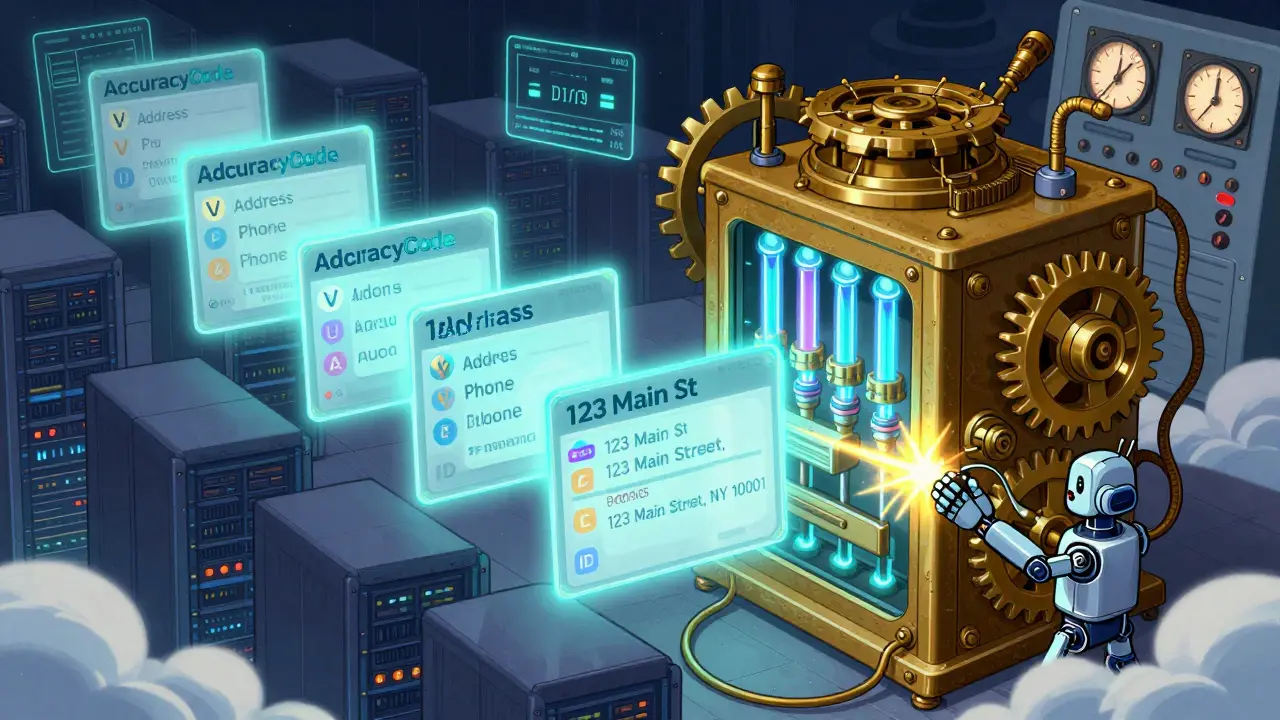
Take address verification. If a customer enters "123 Main St, New York," Oracle doesn’t just accept it. It checks against the USPS database, finds that the correct format is "123 Main Street, New York, NY 10001," and automatically corrects it. But it doesn’t stop there. It logs exactly what changed: Was it a spelling fix? A missing ZIP? A completely wrong city? There are 11 specific status codes that tell you precisely what happened. Code 3 means a small change-like "St." to "Street." Code 8 means a large change-like "Los Angeles" to "San Francisco." You don’t just get a green checkmark. You get a full audit trail.
How It Works Under the Hood
Behind the scenes, Oracle’s verification engine runs in three modes:
- Verify (Best Match): 1 to 1 - Returns one exact match. Used when you need certainty, like verifying a tax ID.
- Verify (Allow Multiple Results) - Returns several possible matches when input is unclear. Useful for international addresses where formats vary.
- Search: 1 to Many - Lets you scan across countries. A company with global operations might use this to find all branches of a supplier in Asia, Europe, and North America.
Each verification result comes with an AccuracyCode-V for Verified, P for Partially Verified, U for Unverified, A for Ambiguous, and C for Conflict. This lets systems automatically decide what to do next. If a record is marked 'C' (Conflict), it’s blocked from processing until a human reviews it. If it’s 'V', it flows straight into reporting or billing.
These checks happen at scale. One large bank processed 800,000 transaction records in under an hour using Oracle’s tools. That’s 220 records per second, each checked against multiple global standards. No manual review needed.
Industry-Specific Verification
Not all data is the same. A bank needs different checks than a hospital.
In finance, Oracle Banking Transaction Verification doesn’t just validate account numbers. It checks API headers, endpoint URLs, and digital signatures in real time. If a payment request comes from an unrecognized server, it’s rejected before it leaves the system. Bank of America cut payment errors by 75% after implementing this in 2023.
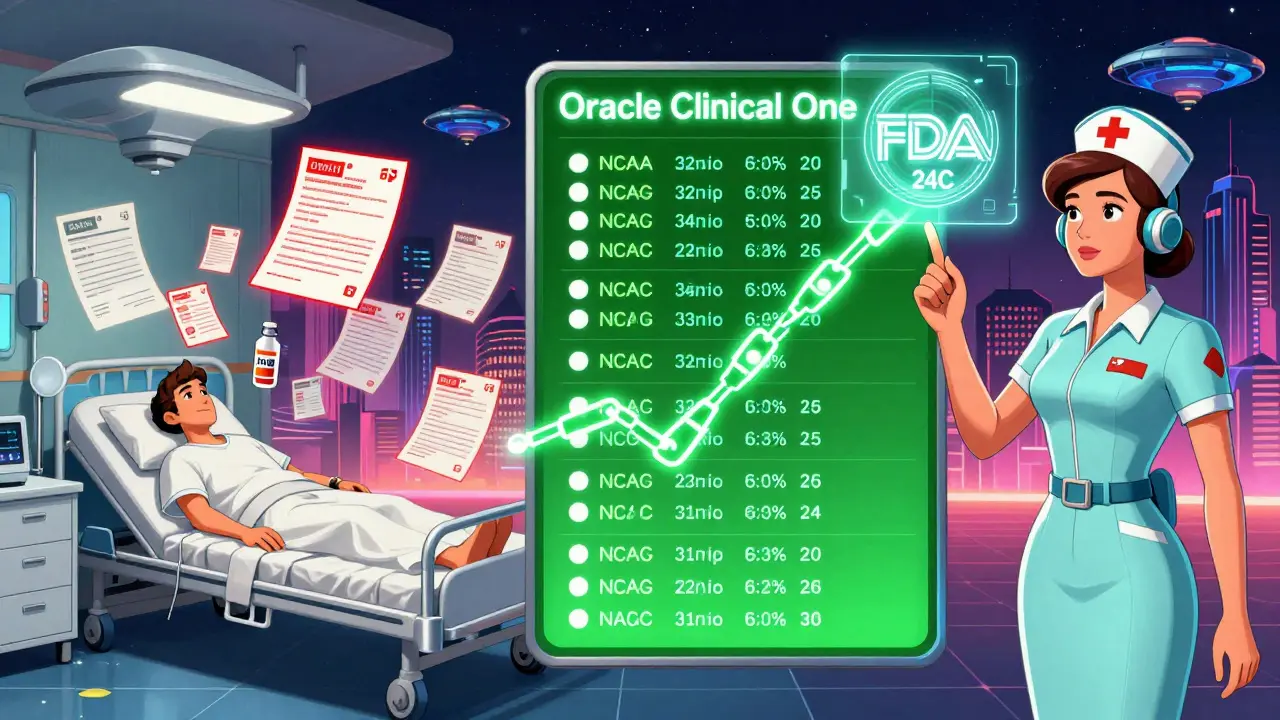
In healthcare, Oracle Clinical One uses Source Data Verification (SDV). Instead of checking every single data point in a clinical trial-which could mean reviewing 50,000 entries-SDV focuses only on critical variables: patient consent forms, drug dosages, adverse events. This cuts verification time by 60-70%. Pfizer’s trial team reported a 40% faster resolution of data queries after switching to SDV.
Manufacturers use it for supply chain tracking. If a part number from a supplier doesn’t match the catalog in Oracle Fusion, the system halts the shipment and flags it. No more wrong parts ending up in assembly lines.
Why Oracle Beats the Competition
Tools like Informatica and Talend can connect to almost anything. But they’re generalists. Oracle’s tools are specialists.
When you’re using Oracle Fusion Cloud ERP, Financials, or SCM, the verification system is already built in. You don’t need to install plugins or write custom scripts. Out of the box, 95% of validation rules work without configuration. Informatica might let you connect to 150 systems, but if you’re running Oracle Cloud, you’ll spend weeks tweaking integrations. Oracle? You click a button, assign permissions, and it just works.
Here’s the trade-off: Oracle’s strength is deep integration. Its weakness is flexibility. If your data lives mostly in Snowflake or AWS, Oracle’s tools struggle. Gartner found that 32% of users with non-Oracle data warehouses had integration headaches. Oracle’s address verification hits 85-90% accuracy globally-but local providers like Loqate hit 95%+ in Japan or Brazil. So if your business is mostly outside North America and Europe, you’ll need a backup.
Real-World Setup: What You Need to Do
Setting this up isn’t drag-and-drop. But it’s not rocket science either.
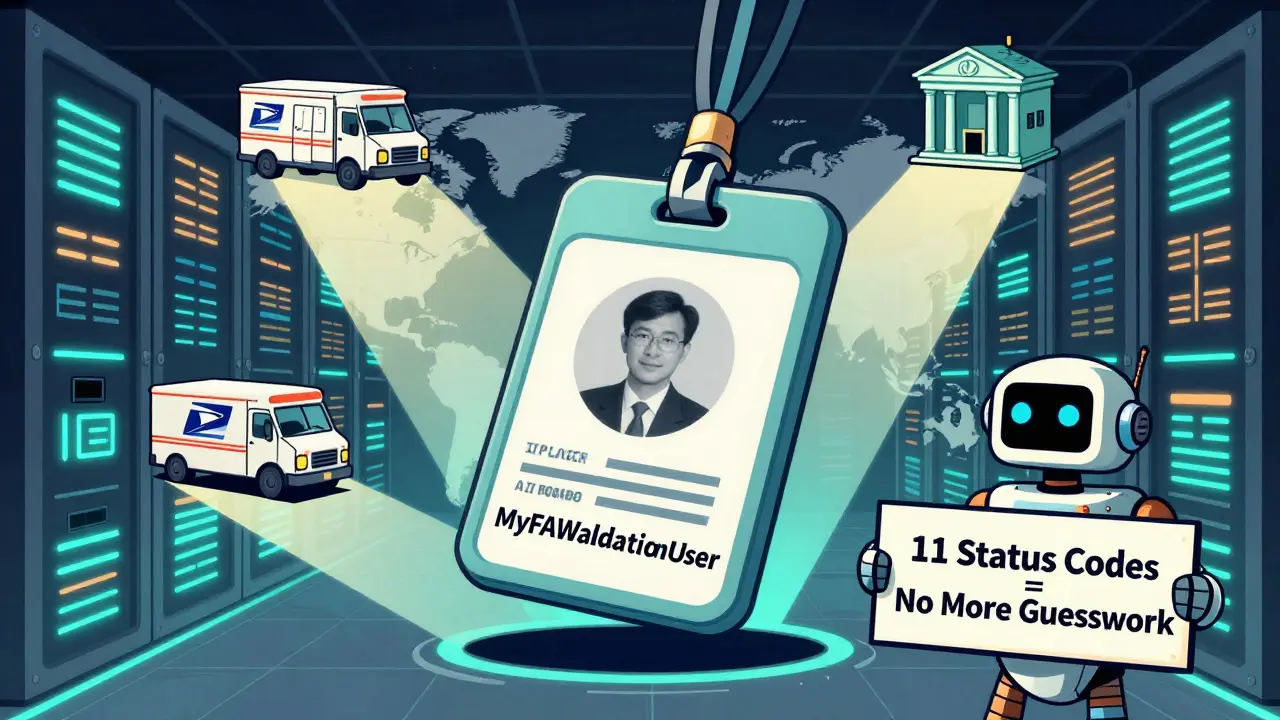
- Create a dedicated validation user: MyFAWValidationUser. No special characters. No spaces. Just letters and numbers.
- Grant this user identical access in both Oracle Fusion Data Intelligence and your main Oracle Cloud apps.
- Go to Console > Data Validation > Source Credentials and link your data sources.
- Build a validation set: Choose which columns to compare (e.g., Customer ID, Address, Phone Number).
- Set the schedule: Daily, weekly, or monthly checks.
One common mistake? Trying to validate data from before the pipeline’s initial extract date. Oracle’s system ignores it. You’ll get false negatives. Always start from the first data load date. Oracle’s own documentation warns this in section 3.2.1-and it’s one of the top 3 issues in their support forums.
Pain Points and Fixes
People love the detail. They hate the setup.
Problem: Data type mismatches. A source system stores phone numbers as text. The target expects integers. The system flags 10,000 records as errors-when it’s just a format issue.
Solution: Use custom SQL transformations to convert data types before verification. Oracle Support says 38% of implementations hit this. It’s fixable.
Problem: Password rules. The validation user can’t have special characters. That breaks company security policies.
Solution: Use a service account with a simple password, then lock it down with role-based access controls. One Fortune 500 company spent three months resolving this with their IAM team.
Problem: Error messages are vague. "Validation failed" doesn’t help.
Solution: Use the 11 status codes. Drill into each flagged record. The system tells you exactly why. If you’re not reading those codes, you’re missing half the value.
The Future: AI and Blockchain
Oracle isn’t resting. In May 2024, Fusion Data Intelligence 22B added AI-powered suggestions. If a record fails verification, the system now says: "Try correcting ZIP code to 90210. Similar addresses found in 87% of cases." It auto-suggests fixes for 65% of common errors.
And in Q3 2024, Oracle Clinical One 24C will introduce blockchain-based verification trails for clinical trial data. Every change to a patient’s lab result, every correction, every approval will be timestamped and immutably recorded. Not because blockchain is trendy-but because regulators demand it. The FDA and EMA now require tamper-proof audit logs for drug trials. Oracle is building that in.
By 2025, Oracle plans to use generative AI to auto-generate validation rules. Tell the system: "Verify all patient IDs match insurance databases." It’ll write the rule, test it, and deploy it. No manual configuration.
Who Should Use This?
If you’re running Oracle Cloud Applications-ERP, Financials, Supply Chain, or Clinical One-you’re already paying for this. Not using it is like buying a Ferrari and never turning the key.
If you’re in healthcare, finance, or manufacturing, and you handle sensitive data across multiple systems, this isn’t optional. It’s compliance. It’s risk management. It’s saving money.
If your data lives mostly outside Oracle’s ecosystem? Look at Informatica or Talend. But if Oracle is your core platform? You’re not just getting a tool. You’re getting a data integrity backbone.
What are the 11 verification status codes in Oracle?
Oracle uses 11 status codes to describe how data was validated: 0 (Verified Exact Match), 1 (Verified Multiple Matches), 2 (Verified Matched to Parent), 3 (Verified Small Change), 4 (Verified Large Change), 5 (Added), 6 (Identified No Change), 7 (Identified Small Change), 8 (Identified Large Change), 9 (Empty), and 10 (Unrecognized). These aren’t just labels-they tell you exactly what changed, why, and whether it was corrected automatically or flagged for review.
Can Oracle verify international addresses?
Yes, but with limits. Oracle’s Address Verification processor works best for North American and European formats, achieving 85-90% accuracy. In regions like Asia, Latin America, or Africa, accuracy drops because local postal systems aren’t fully integrated. For example, Japan’s address system or Brazil’s CEP codes often need third-party tools like Loqate for 95%+ accuracy. Oracle supports 180+ countries, but doesn’t guarantee perfect results everywhere.
How does Oracle compare to Informatica for data verification?
Informatica supports over 150 connectors and works well in mixed environments (AWS, Snowflake, SAP). Oracle supports about 50+ but integrates 95% out-of-the-box with Oracle Cloud apps. If you’re all-in on Oracle, Oracle’s tools are faster and simpler. If you use multiple platforms, Informatica gives more flexibility-but you’ll spend more time configuring rules.
Is Oracle Data Verification only for large enterprises?
Technically, no-but practically, yes. The setup requires dedicated users, cross-environment permissions, and training. Smaller companies often don’t have the data volume or compliance needs to justify the effort. But if you’re processing over 10,000 records a day and handle regulated data (healthcare, finance, payments), even mid-sized firms benefit. Oracle’s 2023 case studies show adoption in companies with 500-2,000 employees in regulated industries.
What happens if validation fails?
It depends on your rules. You can set it to block the data entirely, flag it for review, or allow it with a warning. In financial systems, failures usually block transactions. In marketing databases, they might just trigger a notification. The system doesn’t auto-correct everything-it gives you control. That’s intentional. You don’t want the system silently changing a customer’s payment method without approval.
Do I need special training to use Oracle Data Verification?
Yes, but not deep technical training. Oracle’s certification program says experienced data analysts need 40-60 hours to master custom validation sets. Most users learn the basics in 10-15 hours. The real challenge isn’t clicking buttons-it’s understanding the 11 status codes and AccuracyCode logic. Many teams struggle because they don’t train users to read the reports, not because the tool is hard to use.
Can Oracle verify blockchain data?
Not directly. But starting in Q3 2024, Oracle Clinical One 24C will use blockchain to log verification trails for clinical trial data. This means every correction, approval, or data change gets a permanent, tamper-proof record. It’s not verifying blockchain data-it’s using blockchain to verify Oracle data. This is a major shift: using blockchain as an audit log, not a data source.
Is Oracle Data Verification used in cryptocurrency or Web3?
Not as a core feature. Oracle’s tools are designed for enterprise databases-not public blockchains. But some financial institutions use Oracle to verify customer data onboarding for crypto exchanges. For example, a bank using Oracle to validate a client’s identity before allowing them to trade Bitcoin. So while Oracle doesn’t verify blockchain transactions, it verifies the people and entities interacting with them.