Quadratic Voting in Crypto: How Decentralized Governance Really Works
When a blockchain community votes on a proposal, quadratic voting, a voting system where each additional vote costs more than the last, designed to balance influence among participants isn’t just a fancy math trick—it’s a fix for the broken one-token-one-vote model. In most DAOs, if you hold 10% of the tokens, you get 10% of the power. That sounds fair until you realize one whale with 30% of the supply can override 700 small holders. DAO voting, the process by which token holders decide on protocol changes, funding, or upgrades often ends up controlled by a few wallets. Quadratic voting flips that: you can vote 10 times, but it costs you 100 voting credits, not 10. It’s like saying, "You can speak louder, but you’ll pay for every extra decibel."
This isn’t theory. Projects like Gitcoin have used quadratic voting to fund public goods since 2019, letting thousands of small donors pool influence without letting big players drown them out. It’s also why some newer DAOs ditch simple token-weighted votes entirely. blockchain governance, the system of rules and processes that guide decision-making in decentralized networks needs more than just math—it needs fairness. If your DAO’s treasury gets spent on a project only the top 5 holders care about, you’re not decentralized. You’re just a corporation with a blockchain logo. Quadratic voting doesn’t eliminate whales, but it makes it expensive for them to push agendas no one else supports. It rewards broad participation, not just big wallets.
But it’s not perfect. Some users find the math confusing. Others argue it still favors those who can afford to buy more credits. And if a project ties voting power to something other than tokens—like reputation, activity, or time—it gets even trickier. That’s why you’ll see decentralized democracy, a governance model where decision-making power is distributed among participants, not concentrated in central authorities experiments popping up in places like Ethereum L2s and NFT communities. Some use quadratic voting with identity verification. Others combine it with sybil-resistant mechanisms. The goal? To make sure every voice matters, not just the loudest one.
What you’ll find in the posts below isn’t just a list of articles. It’s a collection of real-world examples where governance failed, succeeded, or got hacked. You’ll see how airdrop voters tried to game systems, how exchanges quietly influenced token votes, and why some projects moved away from voting entirely. No fluff. No hype. Just what happened, why it mattered, and what it teaches you about power in crypto. If you’ve ever wondered who really controls the blockchain you’re using, these posts will show you.
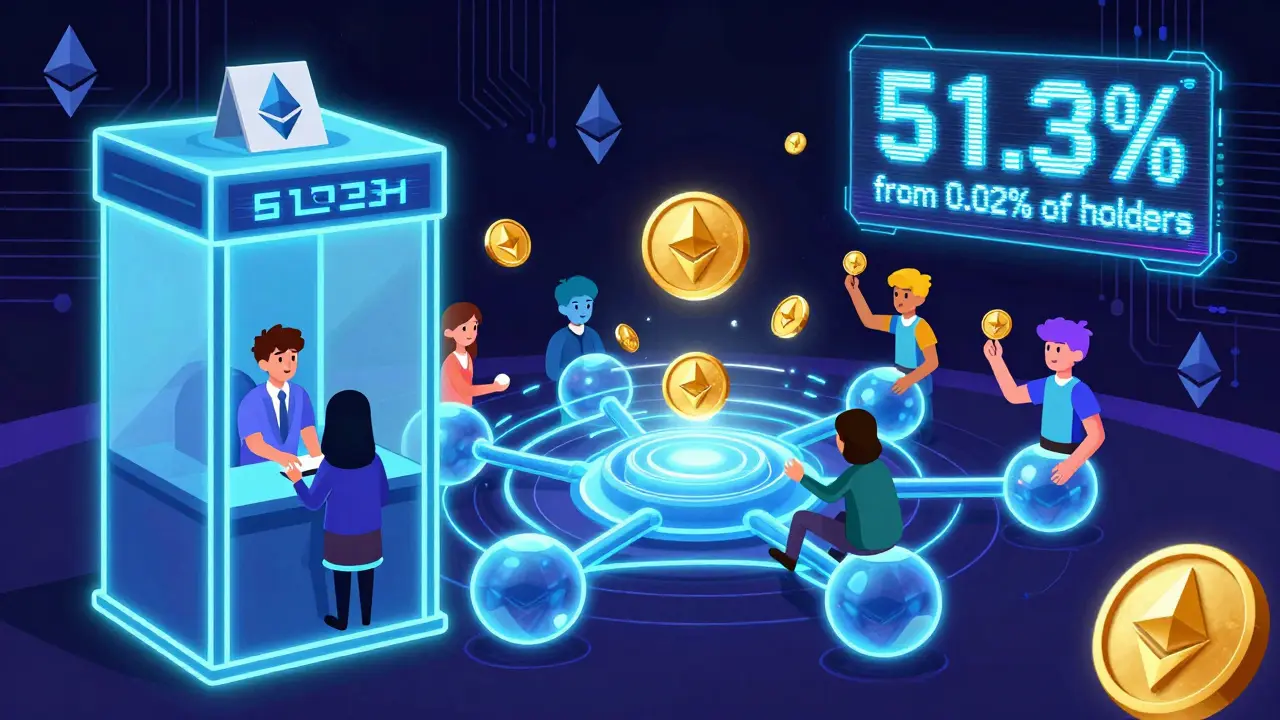
Governance token systems let token holders vote on blockchain protocol changes, but most use flawed models that favor wealthy holders. Learn how token-based, quadratic, liquid, and other voting mechanisms work-and what’s being done to fix them.
More