US CBDC Development Halted: Why There Won't Be a Digital Dollar
 Jan, 7 2026
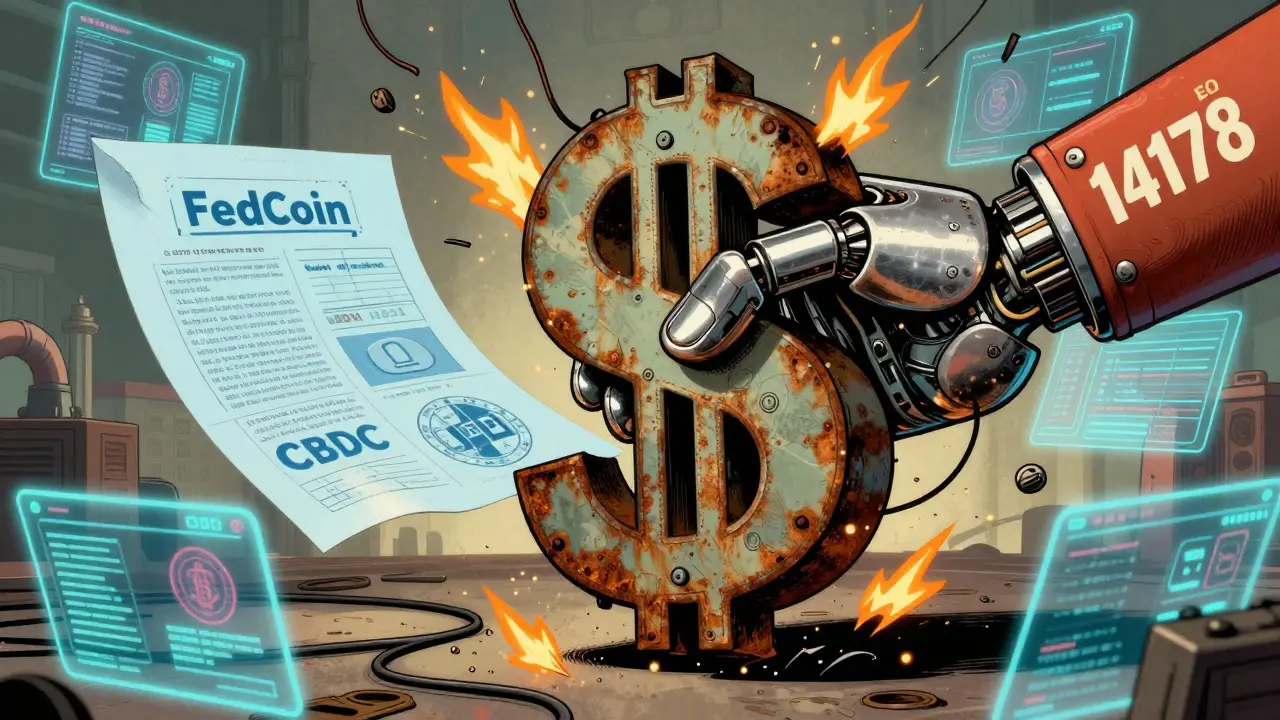
The United States had a chance to lead the world into the next era of money. Instead, it walked away. In early 2025, President Donald Trump signed Executive Order 14178, shutting down every government effort to create a digital dollar. Not delayed. Not paused. Halted. No more research. No more pilots. No FedCoin. The digital dollar is officially dead in the U.S.
This wasn’t a surprise to everyone. For years, the Federal Reserve had been quietly testing the waters. They ran experiments. Studied designs. Talked to banks. Worked with the Treasury Department on an interagency team that included the White House, the National Security Council, and the Office of Science and Technology Policy. But all that work vanished overnight. Federal Reserve Chair Jerome Powell made it clear: he won’t issue a CBDC while he’s in charge. That’s not a delay. That’s a final decision.
Meanwhile, the rest of the world is moving fast. As of early 2025, 134 countries are working on central bank digital currencies. Fifty-three are already running live pilots. Eleven have fully launched theirs. China’s digital yuan is in daily use by millions. The European Central Bank is pushing ahead with its digital euro pilot. Even smaller nations like Jamaica and Nigeria are already using their CBDCs to pay farmers and small businesses. The U.S. is now the only major economy not just behind-but actively blocking progress.
Why? The official reason is privacy. The Trump administration argued that a government-backed digital currency could become a tool for mass surveillance. They pointed to the 26 million financial reports banks filed with the government in 2022 alone-reports on everything from large cash deposits to suspicious transfers. The fear was real: if every dollar spent online was traceable, monitored, and programmable, the government could freeze payments, restrict purchases, or even track where people shop. That’s not theoretical. It’s how some authoritarian regimes operate.
But the real issue isn’t just surveillance. It’s control. A digital dollar could have let the government send stimulus checks directly to people’s wallets, with conditions-like only usable for groceries or energy bills. It could have cut out intermediaries like Visa and Mastercard, slashing transaction fees. It could have made cross-border payments faster and cheaper than SWIFT. It could have given the U.S. financial system a new layer of resilience. Instead, the U.S. chose to let private companies fill the gap.
That’s where Fnality International comes in. This private consortium, backed by State Street and other big banks, is building a digital USD that runs on blockchain. It’s not a CBDC. It’s a stablecoin. It’s not backed by the Federal Reserve. It’s backed by reserves held in traditional banks. And it’s designed for institutions-not regular people. State Street admits that without a sovereign digital dollar, institutional investors will struggle to fully embrace tokenized assets like bonds or real estate on blockchain. They’re trying to build a bridge, but it’s not the same as having the government’s own currency.
The European Union is betting big on its digital euro. They’re testing how it works with smart contracts, automated tax payments, and real-time settlement between banks. Their goal? To keep the euro relevant in a world where money moves at the speed of code. But even they’re facing public resistance. Only one in three Europeans say they’d actually use the digital euro. Why? Because they don’t trust the government to manage it well. Or because they’re happy with their apps. Or because they don’t see the point. The lesson? Technology alone doesn’t win adoption. People need to believe in it.
The U.S. decision creates a dangerous asymmetry. While other countries are building digital public infrastructure, America is outsourcing its future to private firms. That’s risky. Private stablecoins aren’t regulated like banks. They can fail. They can freeze accounts. They can change terms overnight. The U.S. government used to be the anchor of global finance. Now, it’s leaving the door open for others to set the rules.
And the cost? It’s not just economic. It’s strategic. When China launches its digital yuan for cross-border trade with Africa and Latin America, it’s not just moving money-it’s moving influence. When India rolls out a CBDC to bring unbanked farmers into the formal economy, it’s not just digitizing payments-it’s expanding economic freedom. The U.S. isn’t just missing out on a new payment system. It’s missing out on shaping the future of global finance.
Some argue the U.S. is being smart. Let the private sector innovate. Avoid government overreach. Let Bitcoin and Ethereum handle the digital money space. But that’s a fantasy. Bitcoin doesn’t settle payments in real time. Ethereum can’t handle 10,000 transactions per second reliably. And neither is backed by the full faith and credit of the U.S. government. Stablecoins might fill the gap-but they’re not a replacement. They’re a workaround. And workarounds don’t build systems. They patch them.
The world is moving toward digital money. The question isn’t whether it will happen. It’s who will lead it. The U.S. had the tech, the capital, the institutions. It had everything. But it chose fear over foresight. Now, it’s watching from the sidelines as other nations build the financial future-without it.