What Are Digital Signatures in Cryptocurrency? A Plain-English Guide
 Nov, 4 2026
You just sent $500 worth of Bitcoin to a friend. You hit send, waited a few seconds, and the money landed in their wallet. But how did the network know it was actually you? How did it know you didn't accidentally type an extra zero? And why can't your friend claim they never received it?
The answer isn't a password you typed or a fingerprint scan on your phone. It's something far more elegant and secure: a digital signature. If you've ever wondered what happens under the hood when you move crypto, this is the core mechanism that makes it all possible. Without digital signatures, cryptocurrency as we know it wouldn't exist. They are the mathematical proof that replaces the bank teller, the notary, and the handwritten receipt.
What Exactly Is a Digital Signature?
Digital Signature is a cryptographic technique used to verify the authenticity and integrity of digital messages or documents. Unlike a scanned image of your handwriting, which anyone can copy and paste onto a fake check, a digital signature is unique to the specific data being signed and the person signing it. If you change even one character in the message after signing, the signature becomes invalid immediately.
Think of it like a wax seal on an envelope. In the old days, if the seal was broken, you knew someone had opened the letter. A digital signature works similarly but with math instead of wax. It proves two things simultaneously: first, that the sender is who they say they are (authentication), and second, that the content hasn't been tampered with since it was sent (integrity).
In the world of cryptocurrency, this concept is non-negotiable. Because blockchains are decentralized-meaning no central authority like a bank keeps track of who owns what-the system needs a way to trust transactions without trusting people. Digital signatures provide that trust through mathematics.
The Key Pair: Private and Public Keys
To understand how digital signatures work, you need to grasp the concept of asymmetric cryptography. This sounds technical, but it’s actually quite intuitive once you break it down. Asymmetric cryptography relies on two keys that are mathematically linked but function differently:
- Private Key: This is your secret code. It stays on your device (or hardware wallet) and is never shared. It acts like your personal stamp or signature pen. Only you possess it.
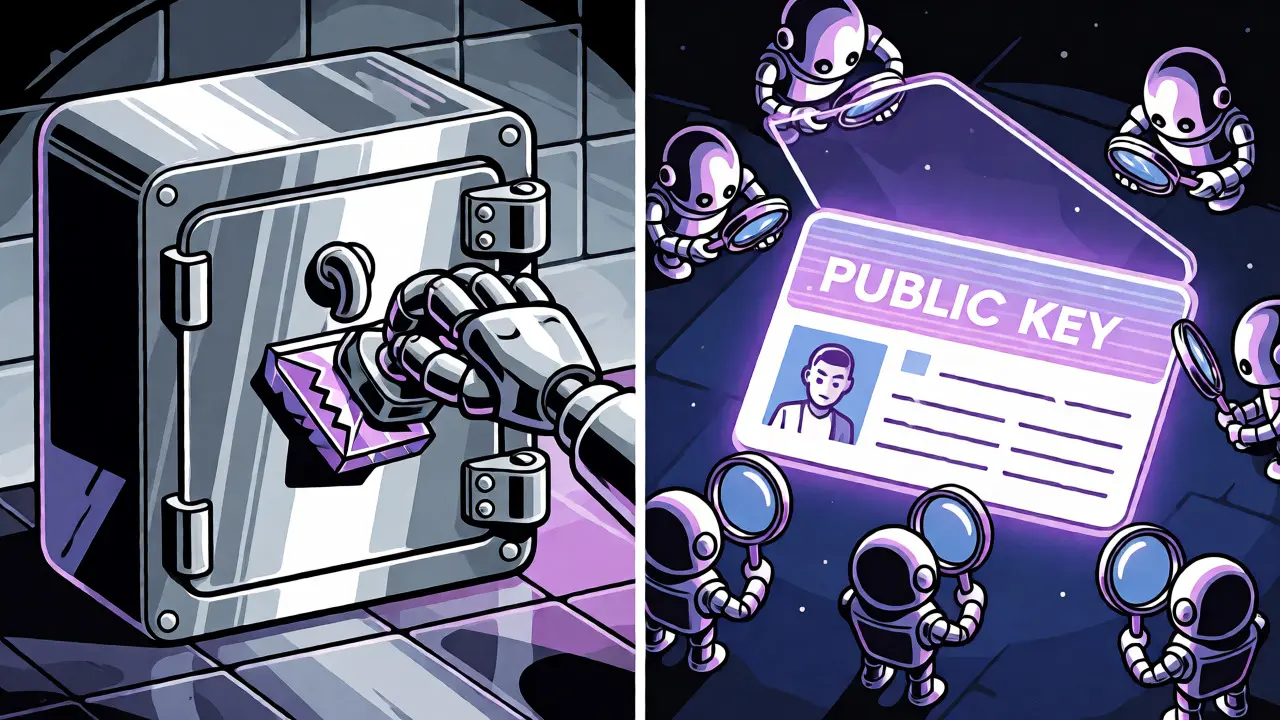
- Public Key: This is derived from your private key but is completely different in appearance. You share this openly with everyone on the network. It acts like your ID card or account number. Anyone can see it, but seeing it doesn’t let them act as you.
Here is the critical rule: You use your private key to create a signature, and others use your public key to verify that signature. You never reveal your private key during the transaction. This allows you to prove ownership without exposing the secret that controls your funds.
If you lose your private key, you lose access to your crypto forever. There is no "forgot password" link on the blockchain. If someone steals your private key, they can sign transactions on your behalf, effectively stealing your funds. The security of your entire portfolio rests on keeping that private key safe.
How the Signing Process Works Step-by-Step
When you initiate a cryptocurrency transaction, several complex mathematical operations happen in milliseconds. Let’s walk through what occurs when you send Bitcoin from your wallet to another address.
- Transaction Creation: Your wallet creates a data packet containing details like the amount to send, the recipient’s address, and the source of the funds.
- Hashing: The wallet takes this data packet and runs it through a hashing algorithm (like SHA-256 for Bitcoin). This produces a fixed-length string of characters called a "hash." Think of this hash as a unique fingerprint of your specific transaction. If you change the amount from 1 BTC to 1.0001 BTC, the hash changes completely.
- Signing: Your wallet uses your private key to encrypt this hash. This encrypted hash is the digital signature. Because only your private key could produce this specific encryption, the signature serves as proof that you authorized this exact transaction.
- Broadcasting: The wallet sends the original transaction data, the digital signature, and your public key to the blockchain network.
- Verification: Network nodes (computers running the blockchain software) take your public key and use it to decrypt the signature. If the decrypted result matches the hash of the transaction data they calculated themselves, the signature is valid. If it doesn’t match, the transaction is rejected.
This process ensures that no one can alter the transaction details while it’s traveling across the internet. If a hacker intercepts your transaction and tries to change the recipient address, the hash will change. When the network verifies the signature against the new hash, the decryption won’t match, and the transaction fails.
Why Digital Signatures Are Essential for Trustless Systems
Traditional finance relies on intermediaries. If I send you money via PayPal, PayPal vouches for me. If I write a check, the bank verifies my signature against their records. These systems require you to trust a third party.
Cryptocurrency removes the middleman. It operates in a "trustless" environment, meaning participants don’t need to trust each other personally; they only need to trust the code. Digital signatures enable this by providing three critical security properties:
| Property | Meaning in Crypto | Real-World Impact |
|---|---|---|
| Authentication | Proves the sender owns the private key associated with the sending address. | Prevents impersonation. No one else can spend your coins. |
| Integrity | Ensures the transaction data hasn’t changed since signing. | Stops man-in-the-middle attacks where hackers alter amounts or addresses. |
| Non-repudiation | The sender cannot deny having sent the transaction. | Creates an immutable audit trail. You can’t claim "I didn't send that" later. |
Non-repudiation is particularly important for legal and accounting purposes. Once a transaction is included in a block and confirmed, it is mathematically bound to your identity (via your public key). You can’t argue later that someone else hacked your computer and signed it, unless you can prove your private key was compromised before the transaction occurred.
Elliptic Curve Digital Signature Algorithm (ECDSA)
While the concept of public and private keys is universal, the specific math behind it matters. Most major cryptocurrencies, including Bitcoin and Ethereum, use a variant of digital signatures called the Elliptic Curve Digital Signature Algorithm (ECDSA).
Older systems like RSA rely on factoring large prime numbers, which requires very long keys (e.g., 2048 bits) to be secure. ECDSA, however, achieves similar security levels with much shorter keys (256 bits for Bitcoin). This efficiency is crucial for blockchain because smaller signatures mean smaller transaction sizes, which reduces fees and speeds up verification.
Bitcoin specifically uses the secp256k1 curve, a standardized set of mathematical parameters. Ethereum also uses ECDSA but has recently introduced support for BLS signatures (Boneh-Lynn-Shacham), which allow for more efficient verification when many signatures need to be checked at once-a feature useful for scaling solutions.

Common Pitfalls and Best Practices
Understanding the theory is great, but real-world usage involves risks. Here are the most common mistakes users make regarding digital signatures and private keys:
- Reusing Addresses: While you can reuse a Bitcoin address, it’s better privacy practice to generate a new receiving address for every transaction. Each address corresponds to a unique public/private key pair.
- Ignoring Nonce Values: In some algorithms, a "nonce" (number used once) must be random. If the same nonce is used twice with the same private key, attackers can reverse-engineer your private key. This actually happened in a famous Sony PlayStation 3 hack!
- Phishing Wallets: If you connect your wallet to a malicious website, you might be asked to sign a transaction that looks harmless but grants unlimited spending rights. Always read what you are signing.
- Backup Failures: Since the signature depends entirely on the private key, losing your seed phrase (the backup of your private key) means losing your ability to sign future transactions. Write it down on paper or metal; don’t just save it in a text file on your desktop.
Conclusion: The Math Behind the Money
Digital signatures are not just a technical detail; they are the foundation of value transfer in the digital age. They replace the social contract of banking with the certainty of mathematics. When you sign a transaction, you aren’t just clicking a button-you are performing a cryptographic act that permanently alters the state of the global ledger.
As you continue exploring blockchain technology, remember that every coin spent, every smart contract executed, and every NFT minted relies on this simple yet powerful mechanism: a private key creating a unique proof that a public key can verify. Mastering this concept gives you a deeper appreciation for why blockchain is considered secure, transparent, and irreversible.
Can I change my digital signature after sending a transaction?
No. Once a transaction is broadcasted to the network and verified, the digital signature is locked in place. If you want to change the details, you must create and sign a completely new transaction. The original signature remains part of the permanent history on the blockchain.
Is my private key exposed when I make a transaction?
No, your private key is never transmitted over the network. Only the transaction data, the resulting digital signature, and your public key are broadcasted. The network uses the public key to verify the signature without ever needing to see the private key.
What happens if I lose my private key?
If you lose your private key (and its backup seed phrase), you lose the ability to create new digital signatures. Since only the private key can authorize the movement of funds, those coins become permanently inaccessible. There is no recovery process in most decentralized networks.
Are digital signatures legally binding?
In many jurisdictions, including the US and EU, digital signatures created using strong cryptography are legally recognized as equivalent to handwritten signatures. However, the enforceability often depends on whether the parties agreed to use electronic records and whether the signature method was reliable for the purpose intended.
Do all cryptocurrencies use the same digital signature algorithm?
Most major ones like Bitcoin and Ethereum use variants of ECDSA. However, newer chains may use different algorithms. For example, Monero uses EdDSA (Edwards-curve Digital Signature Algorithm) for faster verification, and Solana uses Ed25519. The underlying principle of public/private key pairs remains the same across these implementations.