What is 404-GEN (SN17)? A Deep Dive into Bittensor's 3D AI Token
 Apr, 9 2026
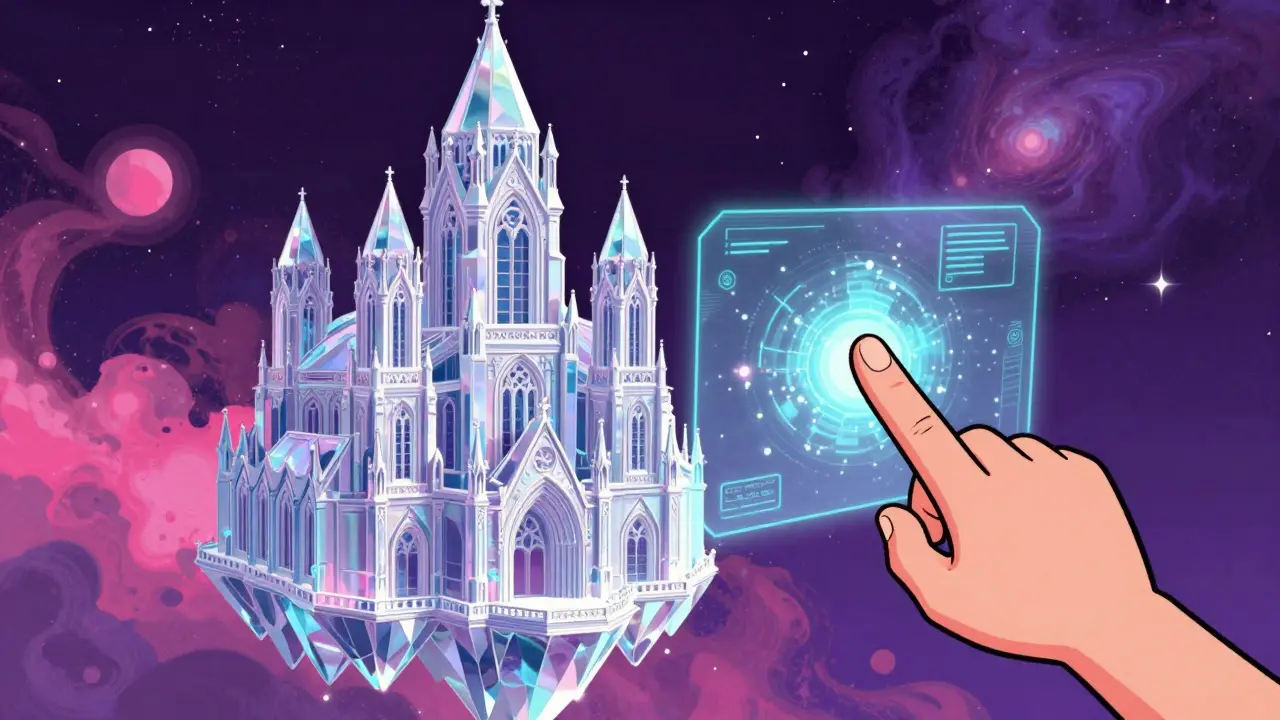
Imagine typing "a gothic cathedral made of floating crystals" into a search bar and instantly getting a high-quality, usable 3D model for a video game. That is the promise of 404-GEN is the native utility token for Bittensor Subnet 17 (SN17), a decentralized network focused on text-to-3D AI generation. Also known as SN17 or Gen 404, it launched in October 2025 to change how we build virtual worlds.
Unlike many AI tokens that just rent out GPU power, SN17 is hyper-focused. It creates a permissionless marketplace where miners generate 3D assets and validators ensure they actually look good. Whether you are an indie game dev or a VR enthusiast, this project aims to remove the steep learning curve of manual 3D modeling.
How SN17 Actually Works
To understand SN17, you have to understand the Bittensor ecosystem. Bittensor is like a giant brain made of different "subnets," each specializing in a different AI task. Subnet 17 is the 3D specialist. It doesn't just use one method to make models; it blends several cutting-edge technologies:
- Gaussian Splatting: A method that allows for incredibly fast rendering, making 3D scenes feel fluid rather than chunky.
- Neural Radiance Fields (NeRFs): These help the AI understand how light hits an object from different angles.
- 3D Diffusion Models: The "creative engine" that turns a text prompt into a rough 3D shape.
- Point-Cloud approaches: A way of mapping a 3D space using a set of data points in a coordinate system.
In this system, miners provide the heavy-duty computing power to generate these assets. Validators then step in to grade the quality. If a miner produces a high-quality 3D model, they are rewarded with SN17 tokens. This creates a competitive loop that constantly pushes the AI to get better.
The Tokenomics: Supply and Value
The scarcity of the token is a major talking point for investors. The maximum supply is capped at 21,000,000 SN17 tokens. However, there is a bit of a mystery regarding how many are actually available. Depending on who you ask, the circulating supply varies wildly. CoinGecko reported about 1.25 million tokens in early 2026, while other trackers like Holder.io suggested closer to 4 million.
This discrepancy often leads to massive price swings. You might see the price listed at $2.67 on one platform and over $10 on another. This happens because the token isn't listed on major exchanges like Binance for trading-it's mostly traded on smaller venues like the Subnet Tokens exchange. When liquidity is low, a few large trades can send the price on a rollercoaster ride.
| Feature | 404-GEN (SN17) | Render (RNDR) | Fetch.ai (FET) |
|---|---|---|---|
| Primary Focus | Text-to-3D Asset Generation | GPU Rendering Power | Autonomous AI Agents |
| Market Cap (Approx) | Under $15 Million | ~$2.1 Billion | Multi-Billion |
| Network Role | Subnet of Bittensor | Independent Network | Independent Network |
| Exchange Access | Very Limited | High (Major Exchanges) | High (Major Exchanges) |

Is It Actually Useful? Real-World Use Cases
The true test of any utility token is whether people actually use the product. For a small indie game studio, SN17 is a game-changer. In a documented case study from January 2026, a small team managed to generate over 200 3D objects in just 48 hours. Without this AI, that would have taken a human artist weeks of tedious work.
However, it isn't perfect. If you need a photorealistic architectural render for a luxury skyscraper, you'll probably find the current version of Gen 404 lacking. Traditional NeRF implementations still beat it when it comes to absolute precision and realism. It's great for "game-ready" assets and rapid prototyping, but not yet ready for high-end architecture.

The Risks and Red Flags
Investing in SN17 isn't without danger. There are a few red flags that any cautious buyer should note. First, the trading volume is suspicious. An investigation by Decrypt in early 2026 suggested that a huge chunk of the volume on some exchanges might be "wash trading"-essentially bots trading with themselves to make the coin look more popular than it is.
Second, the developer activity has been spotty. Some critics point to GitHub commits that have gone quiet for months at a time. Third, the barrier to entry for helping the network is high. If you want to run a validator node, you can't just use a basic laptop. You'll need a rig with 32GB of RAM and an NVIDIA GPU with at least 8GB of VRAM, which can cost you between $1,200 and $1,800 just for the hardware.
Looking Ahead: Project Atlas and the Metaverse
Despite the volatility, the team is planning something called "Project Atlas" for the second quarter of 2026. This upgrade aims to introduce real-time collaborative 3D modeling. The goal is to integrate directly with Unity and Unreal Engine, the two most popular game engines in the world. If they pull this off, the token's utility would skyrocket because it would move from a niche experiment to a professional tool.
There is also a potential legal silver lining. The SEC has hinted that tokens with clear utility-like those that power a specific AI service-might face fewer regulatory hurdles than those that look like pure speculative investments. This could give SN17 a safer path forward compared to some of the more ambiguous "meme-AI" coins.
Where can I buy 404-GEN (SN17)?
Currently, SN17 has very limited exchange availability. It is primarily traded on the Subnet Tokens exchange. Be cautious, as the lack of major exchange listings often leads to high price volatility and lower liquidity.
What is the difference between SN17 and Render (RNDR)?
Render is a massive network for GPU rental-it provides the raw power to render a frame. SN17 is a specialized AI subnet that actually *creates* the 3D model from a text prompt. One provides the tool (compute), the other provides the result (the asset).
What hardware do I need to be a validator?
To run a validator node for Subnet 17, you generally need an 8-core CPU, 32GB of RAM, and an NVIDIA GPU with at least 8GB of VRAM. This typically requires a dedicated workstation costing around $1,200 to $1,800.
Is the token supply limited?
Yes, the maximum supply is capped at 21,000,000 SN17 tokens, similar to the hard cap of Bitcoin, which is intended to create long-term scarcity as the network grows.
Does Gen 404 actually work for high-end art?
It depends on the goal. It is excellent for creating basic 3D objects quickly for games or VR. However, for photorealistic architectural visualization, professional tools and traditional NeRF implementations still outperform the current version of the subnet.