What is Auki (AUKI)? A Guide to the Posemesh Protocol
 Apr, 4 2026
At its core, Auki crypto coin isn't just another speculative asset; it is the fuel for a massive infrastructure project. The team believes that since about 70% of the global economy still relies on physical labor and locations, AI that can actually "see" and understand the physical world could triple the total addressable market for artificial intelligence. Essentially, they are building the nervous system for the next 100 billion devices hitting the planet.
The Tech Behind the Coin: Understanding the Posemesh
You can't talk about Auki without talking about the Posemesh. If Auki is the currency, the Posemesh is the engine. The Posemesh is a decentralized machine perception network that allows devices to share a collaborative understanding of physical space.
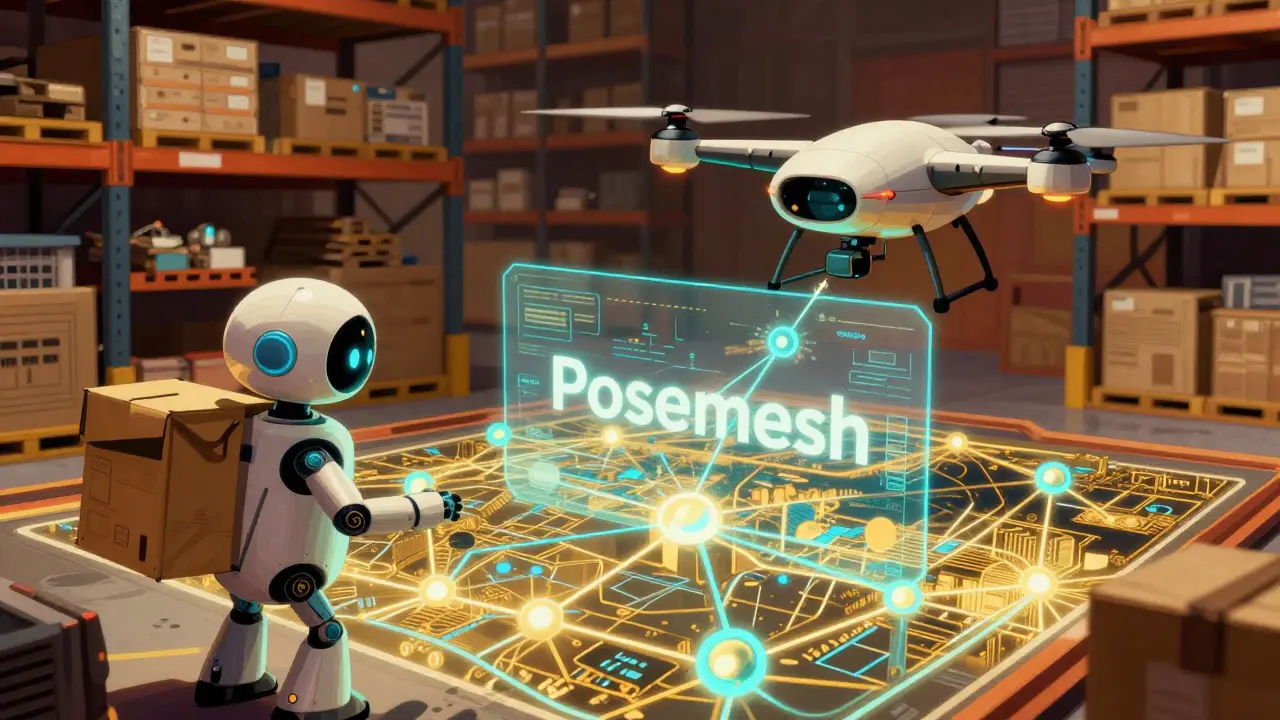
Normally, if you have an AR app, the device has to map the room on its own. With the Posemesh, that spatial data is shared. This means if one robot maps a warehouse, another robot arriving later already knows the layout because the data exists on a decentralized ledger. This creates a shared augmented reality space where digital objects stay exactly where you put them, regardless of who is looking at them or which device they are using.
The system operates as a DePIN (Decentralized Physical Infrastructure Network). Instead of a single company like Google or Apple owning the map of the physical world, the network is distributed. This prevents a single point of failure and ensures that the data remains transparent and secure through blockchain verification.
What Does the AUKI Token Actually Do?
The AUKI token is the utility layer of this entire ecosystem. It isn't just for trading on exchanges; it has specific jobs to do within the network. First, it handles the economics of spatial data. If a device needs high-quality spatial information to navigate a room, it uses AUKI to access those resources.
One of the most interesting concepts here is the idea of "posemesh domains." Think of these as virtual real estate. If you own a physical storefront or a gallery, you can essentially create a digital layer over that space. Using AUKI, users can purchase these domains to host shared AR experiences, like a virtual art gallery where the paintings are pinned to specific physical walls for everyone to see.
Beyond utility, the token is used for governance, giving holders a say in how the network evolves. Because it's built on the Base platform (the Coinbase-backed Layer 2), transactions are faster and cheaper than they would be on the main Ethereum chain, making micro-payments for spatial data actually viable.
| Attribute | Value / Detail |
|---|---|
| Max Supply | 10 Billion AUKI |
| Blockchain Platform | Base (Coinbase Ecosystem) |
| Primary Use Case | Spatial Data Exchange & Domain Ownership |
| All-Time High | $0.0605 |
| Network Category | DePIN / AI / Robotics |
Real-World Use Cases: More Than Just Theory
It's easy to get lost in the technical jargon, but what does this actually look like in practice? Auki Labs has already experimented with apps that allow users to decorate physical rooms using NFTs in shared AR. In a typical setup, if you place a digital sculpture in your living room, only you see it. With the Posemesh, that sculpture is anchored to the physical coordinates of your room. Anyone else with the app can walk in and see that same sculpture in the exact same spot.
Looking further ahead, the applications for Robotics are huge. For a fleet of delivery robots to work efficiently, they can't all spend the first ten minutes of every trip "learning" the sidewalk. They need a shared map. Auki provides the infrastructure for these robots to contribute to and draw from a global, decentralized map of the world.
This also ties into the Peaq Ecosystem, focusing on the "Machine Economy." When machines start providing services (like autonomous taxis or delivery drones), they need a way to handle payments and location data without a central middleman taking a massive cut. AUKI facilitates this machine-to-machine interaction.
Market Performance and Future Outlook
The price of AUKI has seen the typical volatility of a newer project. After its launch in August 2024, it hit a high of $0.0605 before settling into a wider range. Currently, prices hover around the $0.006 to $0.011 mark depending on the exchange you check. This discrepancy is common for tokens trading across multiple decentralized and centralized markets like Uniswap and MEXC.
If you're looking at the long-term horizon, predictions suggest a slow but steady climb. Analysts expect a minimum value of around $0.0107 by 2026, with some projections suggesting a climb toward $0.012 by 2036. However, these numbers depend entirely on adoption. The real catalyst won't be more traders, but more devices. If smart glasses become a daily staple like smartphones, the demand for spatial data-and therefore AUKI-will skyrocket.

Potential Risks and Pitfalls
No project is without risk. The biggest challenge for Auki is the hardware gap. The Posemesh is incredible, but it requires devices with sophisticated sensors (LiDAR, high-end cameras) to truly function. If the adoption of AR glasses slows down, the network's utility stays limited.
There is also the issue of data privacy. While the network is decentralized, mapping the physical world in high detail raises questions about who owns that data and how it's stored. Auki's use of blockchain for integrity helps, but regulatory scrutiny on spatial data is an uphill battle that the project will eventually have to face.
Is Auki a safe investment?
Like all low-cap cryptocurrencies, AUKI is high-risk and high-reward. It is tied to the success of the Posemesh protocol and the adoption of AR hardware. You should only invest what you can afford to lose, keeping in mind the volatility seen since its 2024 launch.
Where can I buy AUKI tokens?
AUKI is available on several platforms. You can find it on decentralized exchanges like Uniswap and centralized exchanges such as MEXC. Always double-check the contract address on the Base network to avoid scams.
What is the difference between Auki and a standard map?
A standard map (like Google Maps) tells you where a building is. The Posemesh tells a machine exactly how to navigate the interior of that building, where the furniture is, and how to interact with objects in 3D space in real-time, all while sharing that data with other devices.
How does Auki use the Base blockchain?
Auki uses Base as its foundation to take advantage of lower transaction fees and faster speeds. Since the Posemesh requires many small transactions for data exchange, a Layer 2 solution like Base is essential for the network to be scalable.
What is the maximum supply of AUKI?
The maximum supply is capped at 10 billion tokens. This limit helps prevent infinite inflation and gives the token a defined scarcity model as the network grows.
Next Steps for New Users
If you're new to the ecosystem, the best way to start is by exploring the Auki Labs' early apps. Trying out the shared AR experiences gives you a feel for how the Posemesh actually functions. If you're looking to hold the token, make sure you have a wallet compatible with the Base network.
For the more technical crowd, keep an eye on the integration with the Peaq ecosystem. The convergence of DePIN and Robotics is where the real value will be unlocked. Watch for announcements regarding new hardware partnerships, as a single deal with a major glasses or robot manufacturer could be the catalyst that pushes AUKI toward its all-time high again.