What is IncomRWA (IRWA) Crypto Coin? A Clear Breakdown of Its Purpose, Yields, and Real-World Backing
 Mar, 9 2026
When you hear about crypto projects promising stable returns, most of them sound too good to be true. High APYs from DeFi farms? They often crash when the token supply floods the market. Treasury yields? Too low to matter. Then there’s IncomRWA (IRWA) - a cryptocurrency that doesn’t rely on speculation or token inflation. Instead, it backs its yields with real trade invoices. If you’ve ever wondered how crypto can be tied to actual business transactions instead of just digital hype, IncomRWA offers one of the clearest examples.
What Exactly Is IncomRWA (IRWA)?
IncomRWA, or IRWA, is a cryptocurrency token built on the Ethereum and Base blockchains. It’s not just another altcoin. It’s designed as a gateway between traditional finance and decentralized finance - a bridge, if you will, between the real economy and blockchain. The project started as Nexade but rebranded to IncomRWA in 2021 to better reflect its mission: tokenizing real-world trade assets.
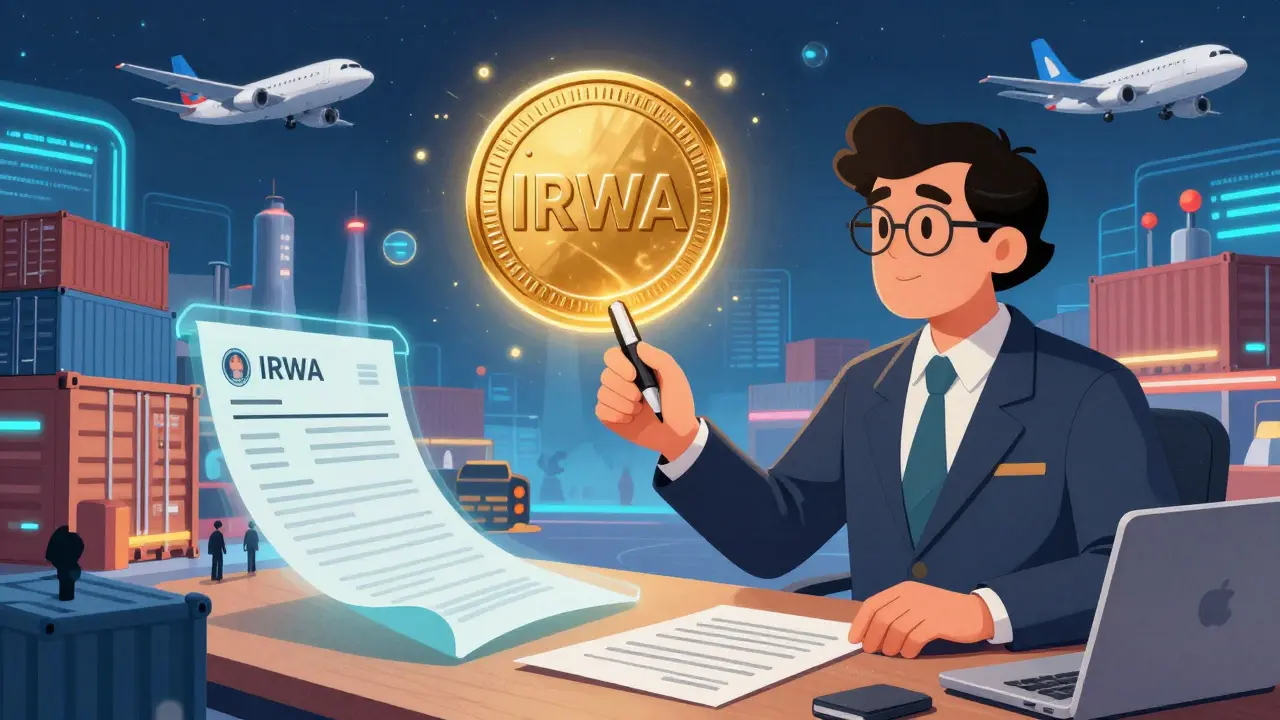
The core idea is simple: businesses around the world sell goods on credit. They get invoices - promises of payment from buyers - that take 30 to 90 days to settle. These invoices are valuable, but they’re locked in slow, paper-heavy systems. IncomRWA buys these invoices, turns them into digital tokens, and lets crypto users earn interest from the payments. The returns come not from printing more tokens, but from actual business transactions.
How Does IRWA Generate Returns?
Unlike most DeFi projects that pay yield by issuing new tokens (which eventually dilutes value), IncomRWA uses real revenue. When you stake your IRWA tokens, you’re essentially lending money to a pool that buys trade receivables - invoices from real companies shipping goods globally. As those invoices get paid, the payments flow back to stakers as USDT (Tether), a stablecoin pegged to the U.S. dollar.
The annual percentage yield (APY) is advertised at around 15%. That’s not a guess. It’s based on historical data from invoice financing markets, where similar deals typically yield between 10% and 20%. The staking terms are fixed: 30, 60, or 90 days. Once you lock in, your return is locked in too. Even if Bitcoin crashes or Ethereum spikes, your yield stays the same because it’s tied to invoice payments, not crypto prices.
Here’s what makes this different: most crypto yield platforms are like betting on a horse race - you win if the market goes up. IncomRWA is like renting out a building - you get paid whether the stock market is up or down.
Tokenomics: Supply, Chains, and Structure
IncomRWA has a fixed total supply of 100 million tokens. No more will ever be created. This is important because it means the value of the token isn’t diluted by inflation - a common problem in DeFi. The $iRWA token serves two purposes: it’s a utility token you need to stake, and it’s a governance token that lets holders vote on future upgrades.
The token runs on two blockchains:
- Ethereum - the original chain, with high security and broad wallet support.
- Base - Coinbase’s Ethereum layer-2, offering lower fees and faster transactions. The contract address is 0x833f...c750c1F.
This dual-chain setup gives users flexibility. If Ethereum gas fees spike, you can move to Base. If you want maximum security for long-term holding, Ethereum is the safer bet.

Market Status as of March 2026
As of early March 2026, IRWA is trading around $0.0179. Prices vary slightly across exchanges:
- Bitget: $0.01642
- LIVECOINWATCH: $0.017968
- CoinCarp: $0.0182
The 24-hour trading volume is just $66,699. That’s low. It means there’s not much liquidity. If you try to sell a large amount, you might struggle to find buyers - or you might have to accept a lower price. The market cap sits at roughly $1.82 million, which is tiny compared to major DeFi projects like Aave or Compound.
This low volume isn’t necessarily a bad sign - it’s common for niche protocols. But it does mean you need to be careful when entering or exiting your position. Don’t expect to buy $10,000 worth and flip it the next day.
How to Buy and Stake IRWA
Buying IRWA isn’t as simple as ordering on Coinbase. It’s only available on decentralized exchanges (DEXs) like Uniswap, SushiSwap, and through Binance’s Web3 Wallet. Here’s how to do it:
- Get a wallet that supports Ethereum and Base chains - MetaMask or Binance Wallet work well.
- Buy ETH or USDT on a centralized exchange like Binance or Kraken.
- Transfer ETH or USDT to your wallet.
- Connect your wallet to a DEX like Uniswap or the IncomRWA staking portal.
- Swap your ETH or USDT for IRWA tokens.
- Go to the IncomRWA staking dashboard and lock your IRWA into a liquidity pool for 30, 60, or 90 days.
Once staked, you’ll earn USDT automatically. No need to claim it - it’s deposited daily. The process is straightforward if you’ve staked before on DeFi platforms. If you’re new, expect a learning curve. The official GitBook documentation walks you through each step, though it’s not the most polished guide out there.
How It Compares to Other RWA Projects
IncomRWA isn’t the only project trying to tokenize real-world assets. But it’s one of the few focusing exclusively on trade finance. Other projects like Ondo Finance tokenize U.S. Treasury bonds. Maple Finance lends to businesses. Centrifuge uses real estate and invoices - but in a more fragmented way.
Here’s how IncomRWA stacks up:
| Project | Asset Class | Yield Type | Staking Term | Market Cap (Est.) |
|---|---|---|---|---|
| IncomRWA | Trade Receivables (Invoices) | Fixed 15% APY in USDT | 30-90 days | $1.82M |
| Ondo Finance | U.S. Treasury Bonds | ~5% APY in USDC | Variable | $420M |
| Maple Finance | B2B Loans | 8-12% APY | Variable | $280M |
| Centrifuge | Real Estate, Invoices | Varies by pool | Variable | $110M |
IncomRWA stands out because of its predictable yield and fixed terms. Ondo offers safety but lower returns. Maple is bigger but less transparent about underlying assets. IncomRWA’s edge? It’s simpler, more targeted, and less complex.

Community, Security, and Risks
The IncomRWA community is small. You’ll find their Twitter account (@incomrwa_io) and Telegram group, but there aren’t many active discussions. Reddit has almost no threads about it. That’s a red flag for some - but not necessarily a dealbreaker. Many successful crypto projects started with tiny communities.
Security-wise, there’s no public audit report available. The team says they’re working on enhancing scalability and security, but as of now, users rely on Ethereum and Base’s built-in protections. That’s okay for a small-scale project - but it’s not ideal. You’re trusting the code, not a third-party audit.
The biggest risk? Liquidity. If the project gains traction, the price could rise. If it stalls, the price could drop. And because trading volume is low, you might not be able to sell when you want to.
Future Plans: What’s Next for IRWA?
The team has outlined a roadmap that includes:
- Launching a full DeFi platform with lending and borrowing features.
- Expanding partnerships with invoice providers in Asia, Europe, and Latin America.
- Introducing a "vote-to-earn" system where stakers earn extra tokens for participating in governance.
- Improving wallet integration with more platforms like Trust Wallet and Phantom.
There’s also a press release dated October 9, 2025 - which, given today’s date is March 9, 2026, suggests either the release was delayed or it was published early. Either way, it signals that the team is actively promoting growth. Whether they deliver on these promises remains to be seen.
Is IncomRWA Worth It?
If you’re looking for a high-risk, high-reward crypto gamble, IncomRWA isn’t for you. It’s not going to make you 10x your money overnight.
But if you want a way to earn real, predictable, non-crypto-correlated returns - backed by actual business transactions - then it’s one of the few projects that makes sense. The 15% APY isn’t magic. It’s math. Trade invoices pay. Companies pay their bills. And now, you can earn from that.
It’s not perfect. Low liquidity, no audit, small community. But it’s one of the most honest crypto projects out there. No hype. No token inflation. Just real-world cash flow, on-chain.
What is the total supply of IRWA?
IncomRWA has a fixed total supply of 100 million tokens. No new tokens will be created, which helps avoid inflation and keeps the value more stable over time.
Can I stake IRWA on centralized exchanges like Binance?
No. You can only stake IRWA through the official IncomRWA staking platform using a decentralized wallet like MetaMask or Binance Web3 Wallet. Centralized exchanges don’t offer staking for IRWA.
Is IRWA backed by real assets?
Yes. The yields generated from staking IRWA come from real-world trade invoices - payments owed to businesses from global sales. These invoices are purchased and securitized by the protocol, making the returns tangible and not based on token speculation.
Why is the trading volume for IRWA so low?
IRWA is still a small, niche project. It’s not listed on major exchanges, and most users are either early adopters or those specifically interested in RWA protocols. Low volume means less liquidity, so large trades can impact the price. This is common for new DeFi projects before they gain traction.
Is IRWA safe to invest in?
There’s no guarantee of safety in crypto. IRWA’s model is more grounded than most - it uses real invoices - but there’s no public smart contract audit, and the team hasn’t disclosed full financial backing details. Only invest what you can afford to lose. Treat it like a high-yield savings account, not a lottery ticket.
What blockchain networks does IRWA run on?
IRWA operates on both Ethereum and Base. Ethereum offers strong security, while Base (run by Coinbase) provides lower fees and faster transactions. You can interact with the protocol on either chain depending on your needs.