What is Pundi X (Old) (NPXS)? Token Utility, Price Crash & Current Status
 May, 22 2026
Imagine walking into a coffee shop and paying for your latte with Bitcoin. You pull out your phone, show a QR code, and the transaction clears instantly. No credit card fees, no middlemen, just pure digital value exchange. This was the bold promise of Pundi X, a project that aimed to bring cryptocurrency payments to everyday retail stores. But if you’ve looked at the charts recently, you might be scratching your head. The token, now known as Pundi X (Old) or NPXS, has seen its value plummet from an all-time high of nearly $0.78 to fractions of a cent. What happened? Is it still useful? And should you care?
To understand where Pundi X stands today, we need to look past the red candles on the chart and examine the actual technology, the business model, and the harsh realities of the crypto market in 2026.
Key Takeaways
- Pundi X (NPXS) is a utility token designed for point-of-sale (POS) crypto payments via the XPOS hardware device.
- The token suffered a massive decline from its 2024 peak, currently trading below $0.0001 with low liquidity.
- The project pivoted partially toward AI initiatives while maintaining its original payment infrastructure.
- NPXS is primarily used for advertising revenue sharing and merchant incentives within the Pundi X ecosystem.
The Core Idea: Bridging Crypto and Retail
Cryptocurrency adoption hit a wall early on. People loved the idea of owning Bitcoin, but spending it was a nightmare. You couldn’t buy groceries with it easily. Fees were high, transactions were slow, and merchants didn’t know how to handle the volatility. Enter Pundi X. Founded by Richard Heart, the project launched in 2018 with a clear mission: make crypto spendable in physical stores.
The centerpiece of this vision was the XPOS device. Think of it like a Square terminal or a PayPal Zettle, but built specifically for blockchain. It’s a sleek, touchscreen point-of-sale system that connects directly to multiple blockchains. When a customer wants to pay, they open their mobile wallet, generate a QR code, and scan it at the register. The XPOS processes the payment instantly and prints a receipt. Simple, right?
But here’s the catch: the XPOS isn’t just a payment processor. It’s also an advertising platform. Merchants can sell ad space on the screen when it’s idle. Customers can earn rewards. It was designed to create a self-sustaining ecosystem where everyone benefits from using crypto in real life.
Understanding the NPXS Token
If XPOS is the hardware, then NPXS is the fuel. Originally, the project had a different token structure, but after a major migration, NPXS became the primary utility token. Here’s what it actually does:
- Advertising Revenue: When merchants run ads on the XPOS screens, they pay in NPXS. A portion of these fees goes back to the token holders through a burn mechanism or staking rewards.
- Merchant Incentives: To get stores to adopt the system, Pundi X offers subsidies. Merchants who use XPOS receive NPXS rewards to offset setup costs and encourage usage.
- Payment Processing: While customers can pay with various cryptocurrencies like Bitcoin or Ethereum, NPXS is often used for smaller micro-transactions or fee discounts within the network.
The tokenomics are aggressive. The total supply is capped at 258.5 billion NPXS, with about 91% already circulating. That means there’s very little room for new issuance, which theoretically limits inflation. However, such a large supply also means each individual token represents a tiny slice of the pie.
The Price Collapse: From Hype to Dust
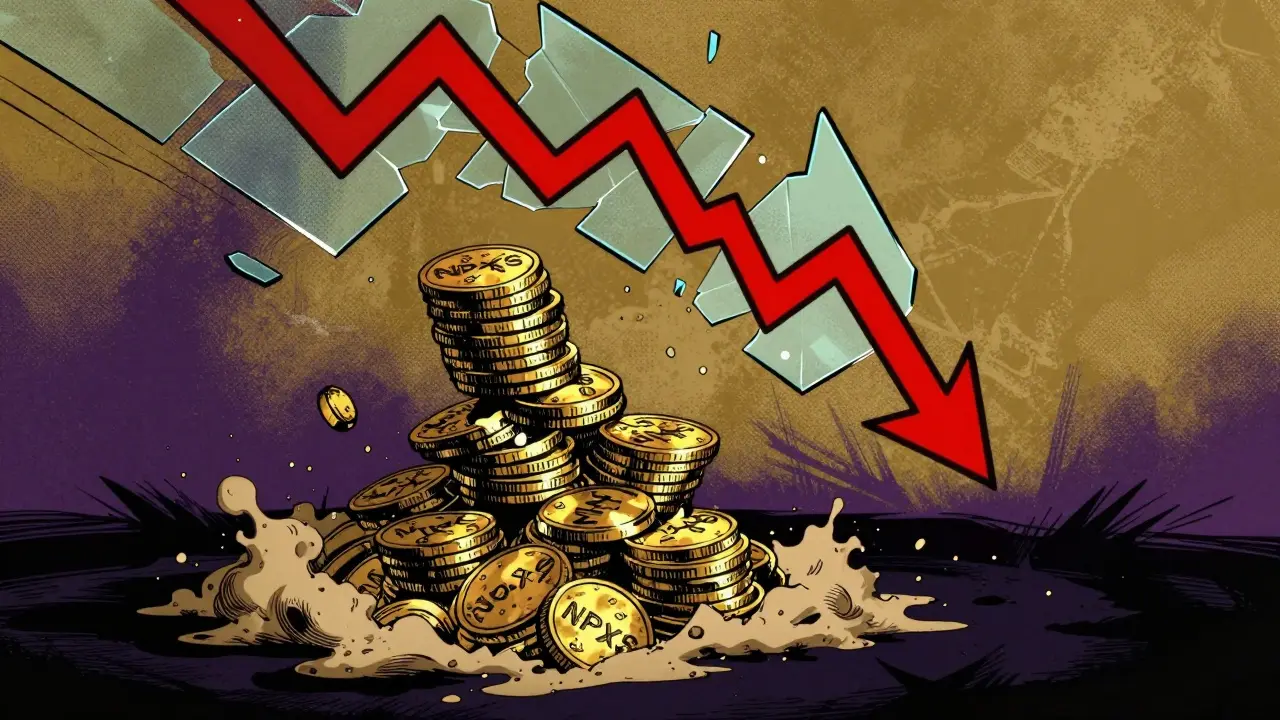
Let’s talk numbers, because they tell a brutal story. Back in April 2024, NPXS hit an all-time high of $0.78. At that price, the market cap was substantial, and investors were bullish on the future of retail crypto payments. Fast forward to May 2026, and the price hovers around $0.000094. That’s a drop of over 99%. For context, if you bought $1,000 worth of NPXS at the peak, it would now be worth less than a dollar.
| Metric | Value |
|---|---|
| Current Price | ~$0.000094 |
| All-Time High | $0.78 (April 2024) |
| Market Cap | ~$22.27 Million |
| 24h Volume | ~$456 (Low Liquidity) |
| Circulating Supply | 236.5 Billion NPXS |
Why did this happen? Several factors converged. First, the broader crypto market went through cycles of boom and bust. Second, competition intensified. Companies like Coinbase Commerce and BitPay improved their offerings, making it easier for merchants to accept crypto without needing specialized hardware. Third, regulatory pressures mounted globally, making it harder for projects focused on fiat-to-crypto gateways to operate freely.
Perhaps most critically, user adoption never scaled as expected. While thousands of XPOS devices were deployed, particularly in Asia, the daily transaction volume remained modest compared to giants like Visa or even traditional mobile payment apps. Without massive network effects, the utility of the token diminished in the eyes of investors.
Technical Infrastructure and Blockchain Support
Despite the price struggles, the underlying tech stack remains interesting. The XPOS device doesn’t rely on a single blockchain. Instead, it integrates with multiple networks to maximize compatibility. Initially, it leaned heavily on the NEM blockchain, which was popular in Asian markets. Today, it supports:
- Ethereum (ERC20): For smart contract interactions and DeFi integrations.
- Binance Smart Chain (BEP20): Offering lower fees and faster transactions.
- TRON (TRC20): Popular for stablecoin transfers like USDT.
- Bitcoin: Direct BTC payments via Lightning Network or wrapped versions.
This multi-chain approach allows merchants to accept whatever currency their customers prefer. If someone wants to pay in Tether (USDT), the system handles it seamlessly. If another customer prefers native Bitcoin, that works too. The XPOS acts as an aggregator, simplifying the complexity of blockchain interoperability for the average store owner.
The Pivot to AI: Pundi AI
In recent years, Pundi X realized that relying solely on payment hardware wasn’t enough. The landscape changed rapidly. So, they diversified. Enter Pundi AI. The company announced plans to build decentralized artificial intelligence tools, aiming to democratize access to AI development. Their argument mirrors the ethos of Bitcoin: prevent big tech monopolies from controlling AI, just as blockchain prevents banks from controlling money.
This pivot signals a shift in strategy. While the XPOS devices continue to operate, the narrative has expanded. Investors are now watching not just for retail adoption metrics, but also for progress in the AI sector. Whether this will revitalize interest in NPXS remains to be seen, but it shows the team is adapting rather than sitting still.

Where Can You Buy NPXS?
Finding NPXS today is tricky due to delistings from major exchanges. Most trading activity happens on decentralized platforms. Currently, the primary venue is Uniswap V2 on the Ethereum network, where the NPXS/WETH pair accounts for nearly 100% of volume. There are also sporadic listings on smaller exchanges like BitBNS, but liquidity is thin. Be prepared for wide bid-ask spreads and potential slippage if you try to trade significant amounts.
Risks and Considerations
Before considering any involvement with NPXS, keep these risks in mind:
- Liquidity Risk: With daily volumes under $500, exiting a position quickly without crashing the price is difficult.
- Adoption Uncertainty: Despite years of effort, widespread merchant adoption hasn’t materialized globally.
- Regulatory Exposure: As governments tighten rules on crypto payments, projects like Pundi X face compliance hurdles.
- Competition: Traditional fintech solutions are improving rapidly, eroding the unique value proposition of dedicated crypto POS systems.
Conclusion: Is Pundi X Dead?
Not necessarily dead, but certainly dormant. The technology works. The XPOS devices exist. The token has utility within its niche. However, the market has moved on. For NPXS to recover, it needs a catalyst-whether that’s a breakthrough in AI integration, a sudden surge in retail crypto demand, or favorable regulatory changes. Until then, it remains a speculative asset with high risk and limited upside potential for most investors.
What is the difference between Pundi X and NPXS?
Pundi X is the name of the company and the ecosystem. NPXS is the ticker symbol for the specific utility token used within that ecosystem. Sometimes people refer to the old token as "Pundi X (Old)" to distinguish it from newer iterations or related tokens like PURSE.
Can I still use XPOS devices today?
Yes, the XPOS hardware continues to function and process transactions. However, finding merchants who actively use them may vary by region, with higher concentration in parts of Asia.
Why did NPXS price drop so much?
The price drop resulted from a combination of market-wide crypto downturns, lack of mass merchant adoption, increased competition from traditional fintech, and investor loss of confidence following failed growth projections.
Is NPXS a good investment in 2026?
NPXS is considered a high-risk, speculative asset. With extremely low liquidity and a 99% drop from its peak, it lacks the fundamentals for safe investing. Only allocate funds you can afford to lose entirely.
How does Pundi AI relate to NPXS?
Pundi AI is a new initiative by the same company behind Pundi X. While NPXS primarily serves the payment ecosystem, the AI division aims to decentralize AI development. Success in AI could potentially drive renewed interest in the parent company and its tokens.