What is UCBI Banking (UCBI) Crypto Coin? Identity, Risks & Reality
 Oct, 29 2026
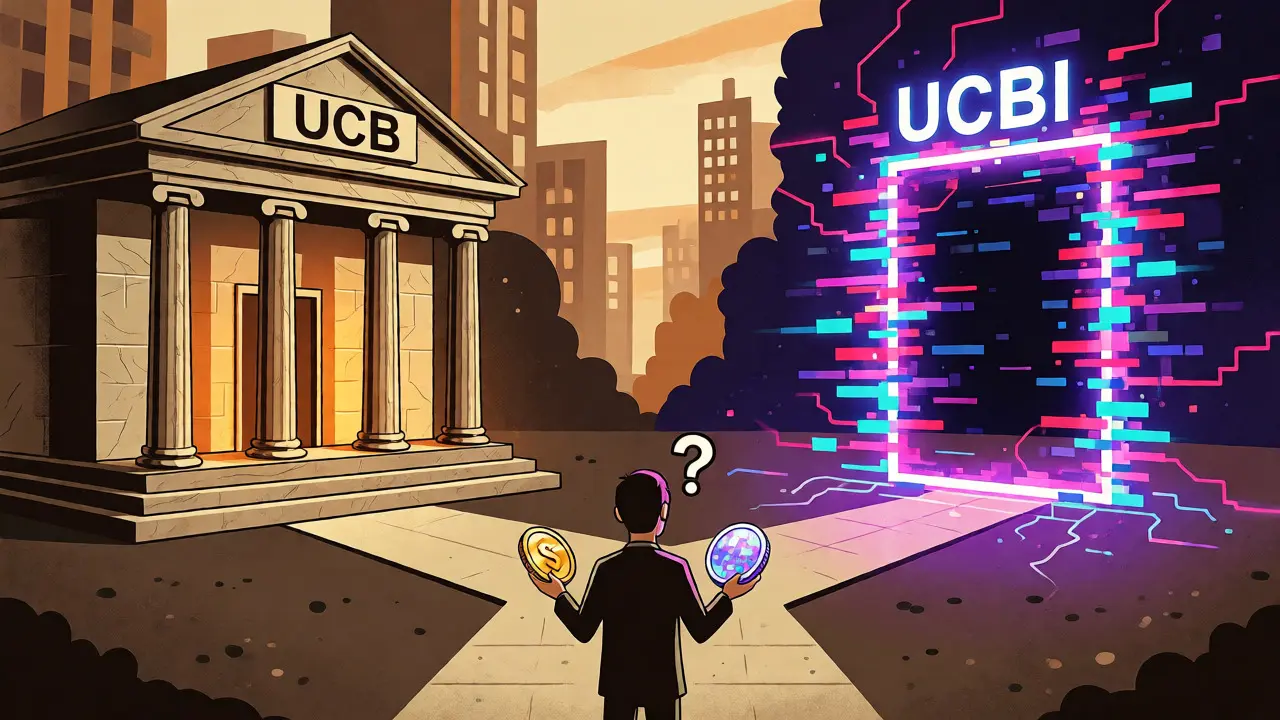
Imagine searching for a banking stock and accidentally buying a digital token with the same ticker. That’s the trap many investors fall into with UCBI Banking. It sounds like a traditional financial institution, but it’s actually an Ethereum ERC-20 cryptocurrency token that has nothing to do with the well-known U.S. bank holding company. If you’re seeing headlines about "UCBI" and wondering if you should buy in, stop right there. The difference between a regulated bank share and this speculative crypto asset is massive.
This article breaks down exactly what UCBI Banking is, why its name causes so much confusion, and whether its promises of "DeFi infrastructure" hold water. We’ll look at the hard data on-chain, the extreme concentration of holders, and the red flags you need to spot before sending any Ethereum to its contract address.
The Name Game: UCBI vs. UCB
Here is the first major hurdle: ticker confusion. For years, United Community Banks, Inc. traded on the Nasdaq under the symbol UCBI. But in August 2024, the bank moved to the New York Stock Exchange and changed its ticker to UCB. This left the old "UCBI" ticker available, and a separate crypto project grabbed it.
So, when you see "UCBI," ask yourself: Is this the bank or the token?
- United Community Banks (NYSE: UCB): A real, SEC-regulated financial institution offering loans, deposits, and wealth management. It has FDIC insurance and audited financial statements.
- UCBI Banking (Crypto Token): An ERC-20 token on the Ethereum blockchain. It is not a bank, does not offer FDIC insurance, and is not owned by United Community Banks.
Holding the crypto token gives you zero claim on the bank’s assets. You don’t get voting rights in the bank, and you certainly don’t get a savings account. The similarity in names is likely intentional marketing, leveraging the trust associated with traditional banking brands.
Technical Identity: What’s On-Chain?
If you dig into the blockchain data, UCBI Banking reveals itself as a relatively simple smart contract. It isn’t a complex Layer-2 solution or a high-frequency trading protocol. It’s an ERC-20 token deployed with older Solidity code.
| Attribute | Value / Detail |
|---|---|
| Contract Address | 0x2adba23Cf1252dE095aCEd801e758b369EC10426 |
| Token Standard | ERC-20 (Ethereum) |
| Decimals | 8 |
| Max Supply | 12,000,000 UCBI |
| Compiler Version | Solidity v0.4.24 (Legacy) |
| Holder Count | ~160 (as of recent snapshots) |
Notice the compiler version. Solidity 0.4.x is quite old in crypto terms. Modern projects typically use versions 0.8.x for better safety features against integer overflows and other vulnerabilities. While the developers have claimed a security audit by Cyberscope in April 2026, the use of legacy code raises eyebrows regarding best practices. Always verify the contract address directly on Etherscan before interacting, as copycat tokens are common.

Utility Claims vs. Reality
The project’s website describes UCBI Banking as a "Blockchain Infrastructure & Digital Asset Treasury." They talk big about DeFi, cross-border liquidity, and tokenized financial instruments. Sounds impressive, right? But here’s the catch: can you actually use it?
Most utility claims for small-cap tokens like this remain theoretical. The project mentions a "UTF Fund" (UCBI Treasury Fund) and DAO-style governance, but there is no public evidence of a working banking application, measurable transaction throughput, or a documented user base. Unlike established DeFi protocols where you can lend, borrow, or swap immediately with clear yield rates, UCBI’s ecosystem feels more like a promise than a product.
Think of it this way: If a startup told you they were building the next Visa but only showed you a logo and a whitepaper, would you wire them millions? UCBI Banking is currently in that early, speculative stage. The "staking" and "governance" features are advertised, but without transparent, audited contracts and active community participation, these features may not be fully operational or meaningful.
Market Data and Liquidity Red Flags
Data consistency is a huge issue with UCBI. Different platforms report wildly different numbers for market cap and circulating supply. This inconsistency often signals thin liquidity and potential manipulation.
For instance, one data provider might show a market cap of $39 million based on a price multiplied by total supply. Another might show zero circulating market cap because they don’t recognize the circulating supply figures provided by the team. When market data conflicts this badly, it’s hard to determine the true value of the asset.
Liquidity is another concern. There is a PancakeSwap v3 pool for UCBI/USDC, but exchange volume is often reported as zero or negligible. Low volume means large sell orders could crash the price instantly. If you try to exit your position during a market dip, you might find no buyers, leading to significant slippage or inability to sell.
Extreme Holder Concentration
This is perhaps the biggest risk factor. Blockchain analysis shows that UCBI is extremely concentrated. In recent snapshots:
- The top 10 wallets held approximately 98.86% of the total supply.
- A single wallet held over 35% of all tokens.
- The Gini coefficient (a measure of inequality) was near 0.96, indicating extreme disparity in holdings.
Why does this matter? Because price control rests in very few hands. If one or two whales decide to dump their holdings, retail investors will suffer immediate losses. True decentralization requires a broad distribution of tokens among many independent users. With only ~160 holders, UCBI looks less like a decentralized network and more like a club with a private ledger.
Is It a Scam or Just Speculative?
It’s tempting to label anything with low transparency as a scam. However, UCBI Banking appears to be a legitimate on-chain asset-it exists, transfers work, and the contract is verified. The issue isn’t necessarily fraud, but rather opacity and hype.
There are no known regulatory actions against the token, but neither is it licensed as a bank or investment fund. The promotional materials mention "instant withdrawals" and "daily giveaways," which are classic marketing tactics for newer tokens trying to attract retail attention. Treat these claims with skepticism until proven by consistent, verifiable user experiences.
If you are considering investing, view UCBI as a high-risk, speculative bet. Do not treat it as a safe store of value or a replacement for traditional banking services. Its future depends entirely on whether the team can deliver actual products and expand its holder base beyond those initial ten wallets.
Is UCBI Banking related to United Community Banks?
No. United Community Banks, Inc. is a traditional bank that trades on the NYSE under the ticker UCB. UCBI Banking is a separate cryptocurrency token on the Ethereum blockchain. They share a similar name history but have no legal or operational affiliation.
Can I open a bank account with UCBI Crypto?
No. Holding the UCBI token does not give you access to traditional banking services like checking accounts, loans, or FDIC-insured deposits. It is a digital asset used within its specific, largely theoretical DeFi ecosystem.
Where can I buy UCBI Banking tokens?
UCBI is primarily traded on decentralized exchanges (DEXs) like PancakeSwap via Ethereum networks. It is not listed on major centralized exchanges like Binance or Coinbase for direct trading, though some informational pages may exist. Always verify the contract address before swapping.
What are the main risks of investing in UCBI?
The primary risks include extreme holder concentration (top 10 wallets own nearly all tokens), low liquidity making it hard to sell, inconsistent market data across platforms, and unverified utility claims. Additionally, the token uses older smart contract technology.
Does UCBI have a maximum supply?
Yes, the maximum total supply of UCBI Banking is capped at 12,000,000 tokens. However, circulating supply figures vary significantly between data providers, which affects perceived market capitalization.