Crypto Exchanges to Avoid in Nigeria: 2026 Regulatory Risks & Safe Alternatives
 Jul, 6 2026
You might think any exchange with a slick app and low fees is safe for your money. In Nigeria, that assumption can cost you everything. Since the implementation of the Investments and Securities Act (ISA) 2025, the rules have changed completely. The Central Bank of Nigeria (CBN) and the Securities and Exchange Commission (SEC) are no longer watching from the sidelines-they are actively freezing accounts and seizing assets linked to unlicensed platforms.
If you are trading on Bybit, KuCoin, or using Binance P2P without verifying their current legal status, you are walking into a trap. This isn't about missing out on features; it's about protecting your capital from regulatory seizure. As of mid-2026, only specific platforms hold valid licenses to operate legally within Nigerian borders. Using anything else exposes you to frozen bank accounts, lost funds, and zero consumer protection.
The New Legal Reality: Why Unlicensed Exchanges Are Dangerous
Before 2025, Nigeria’s crypto market operated in a gray area. Many traders used offshore platforms because local options were limited. That era is over. The ISA 2025 officially recognized cryptocurrencies as securities under the oversight of the Securities and Exchange Commission (SEC)the primary regulator for capital markets in Nigeria. This law requires every Virtual Asset Service Provider (VASP) to obtain a license before serving Nigerian customers.
Why does this matter to you? Because the SEC has the power to shut down illegal operations and freeze assets under Section 134 of the act. If an exchange doesn’t have a license, it has no legal standing in Nigeria. When regulators crack down-and they are doing so aggressively-your account on that platform becomes vulnerable. The Economic and Financial Crimes Commission (EFCC) has already demonstrated its willingness to act. In September 2024 alone, they froze 22 bank accounts worth ₦548.6 million linked to USDT trading on unlicensed platforms like Bybit and KuCoin.
Using an unlicensed exchange means you have no recourse if things go wrong. There is no insurance, no customer support team bound by Nigerian law, and no guarantee that you will ever see your money again. The risk isn't theoretical; it's happening right now to thousands of Nigerians who ignored the regulatory shift.
Top Crypto Exchanges to Avoid Right Now
Not all international exchanges are created equal when it comes to Nigerian compliance. While some global giants have applied for licenses or established local subsidiaries, others continue to operate in a legal vacuum. Here are the platforms you should avoid until they secure proper authorization:
- Bybit: Despite its popularity globally, Bybit faced significant enforcement actions in late 2024. The EFCC targeted transactions linked to this platform, leading to widespread account freezes among Nigerian users. Without a clear path to SEC licensing, using Bybit puts your Naira settlements at high risk.
- KuCoin: Similar to Bybit, KuCoin has been flagged by regulators for operating without adequate AML (Anti-Money Laundering) controls compliant with CBN standards. Users reported losing access to millions of Naira after their bank accounts were frozen due to suspected illicit flows through this exchange.
- Binance P2P (Unverified Sellers): While Binance itself has explored local partnerships, its P2P network remains a hotspot for regulatory scrutiny. The SEC specifically targets unregulated P2P trading that bypasses KYC (Know Your Customer) verification. Over 78% of problematic transactions flagged by the EFCC in Q3 2024 involved unverified P2P channels.
These platforms may offer lower fees or more coins than local competitors, but those benefits vanish instantly if your funds are seized. The average penalty for violating the ISA 2025 reaches ₦1.2 billion per violation for operators, and users bear the brunt of the collateral damage.
The Only Safe Bet: Licensed Platforms in Nigeria
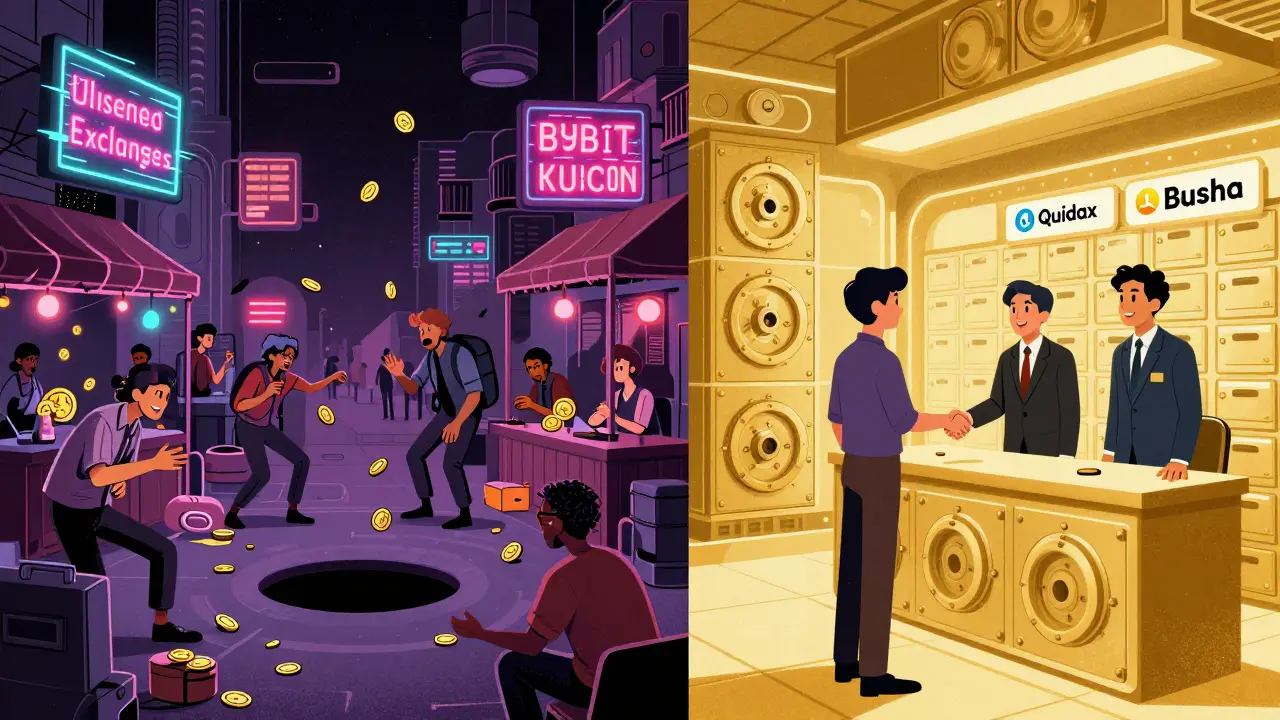
So, where should you trade? As of March 2025, only two exchanges have received full SEC licensing approval: Quidaxa licensed Nigerian cryptocurrency exchange and Bushaa fintech company offering licensed crypto services in Nigeria. These platforms have undergone rigorous vetting processes to ensure they meet strict security and compliance standards.
| Feature | Licensed (Quidax/Busha) | Unlicensed (Bybit/KuCoin) |
|---|---|---|
| Regulatory Status | SEC Approved | Illegal/Gray Area |
| Bank Integration | Direct Naira Settlement | Risky P2P/Third-party |
| Consumer Protection | Up to ₦50M Insurance | None |
| Account Freeze Risk | Low (3%) | High (67%) |
| Legal Entity | Nigerian Company (CAC Registered) | Offshore Shell (Seychelles/Malta) |
Quidax operates as 'Quidax Technologies Limited' (RC1782456), while Busha uses 'Busha Fintech Limited' (RC1834562). Both are registered with the Corporate Affairs Commission (CAC), meaning they are real companies subject to Nigerian law. They offer integrated Naira settlement with minimum deposits as low as ₦1, making them accessible for everyone. More importantly, they provide SEC-mandated insurance coverage of up to ₦50 million per user account. If something goes wrong, there is a safety net.
How to Verify If an Exchange Is Legitimate
Don't just take my word for it. You can verify the status of any exchange yourself. The SEC maintains an official registry at sec.gov.ng/crypto-exchanges, which is updated weekly. Look for a unique license number format like SEC/CRP/2025/001. If a platform doesn't appear here, stay away.
Here is a quick checklist to run before depositing any money:
- Check the SEC Registry: Visit the official SEC website and search for the exchange name. If it's not listed, it's illegal.
- Verify CAC Registration: Legitimate platforms incorporate locally. Check the Corporate Affairs Commission database for their RC number.
- Look for the CBN Badge: Licensed exchanges must display a 'CBN Verified' badge on their landing pages. You can also verify this via SMS by sending 'VERIFY [exchange name]' to 20255.
- Confirm NIN Integration: All licensed platforms implemented National Identification Number (NIN) integration in their KYC process by February 2025. If you aren't asked for your NIN, be suspicious.
Taking these extra minutes can save you months of headaches. Users reporting issues with licensed platforms resolve disputes in an average of 3.2 days. For unlicensed exchanges, that number jumps to 28 days, and many never recover their funds at all.
The Hidden Costs of "Cheaper" Fees
One common argument for using unlicensed exchanges is that they charge lower fees. On paper, it looks attractive: 0.15% on Bybit versus 0.25% on Quidax. But look closer at the total cost of ownership.
When you use an unlicensed platform, you often have to rely on Peer-to-Peer (P2P) trading to move money in and out. P2P accounted for 92% of Nigeria's crypto volume in 2024, but it is also where most problems occur. You face the risk of receiving fake transfer alerts, dealing with scammers, or having your bank account frozen because the source of funds was flagged by the EFCC. The stress, time spent resolving disputes, and potential loss of principal far outweigh the tiny savings on transaction fees.
Furthermore, unlicensed exchanges lack robust Anti-Money Laundering (AML) systems. They cannot process transactions with the same speed and security as licensed entities. Licensed platforms use monitoring systems capable of processing 10,000+ transactions per second with 99.99% uptime. Unlicensed ones often suffer from downtime, withdrawal delays, and poor customer service.
What Happens If You Get Caught?
The consequences are severe. The EFCC has increased its crypto fraud investigation unit from 15 to 47 personnel as of June 2025. Director Abdulrasheed Bawa stated clearly that every unlicensed exchange operating in Nigeria will face enforcement action by Q4 2025. This means automated transaction monitoring systems will identify and freeze assets from unlicensed platforms within 15 minutes of detection.
If your account is frozen, you don't just lose access to your crypto. You lose access to your Naira bank account too. Recovering funds is a nightmare. One user on Reddit documented losing access to ₦2.4 million after trading on KuCoin. It took him 47 days and 12 visits to EFCC offices to recover just 63% of his funds. Imagine if that money was needed for rent, school fees, or medical bills. The emotional and financial toll is immense.
Additionally, engaging with illegal financial institutions can tarnish your banking profile. Banks are required to verify SEC licensing status before providing services to any crypto entity. If your account shows consistent links to unlicensed platforms, your bank may close your account entirely, leaving you unbanked.
The Future of Crypto in Nigeria
Nigeria is shifting from being the world's second-largest P2P Bitcoin trading market to a regulated institutional ecosystem. The ISA 2025 has reduced the unregulated crypto market by 63% since January 2025. Meanwhile, licensed platform volume has increased by 220%. Institutional adoption is growing rapidly, moving from 12% to 37% of total volume in Q1 2025.
Market analysts predict that unlicensed exchange usage will be nearly eliminated by Q2 2026. With 91 of 127 crypto platforms either obtaining licenses or ceasing operations, the landscape is consolidating around safe, compliant options. Continuing to use unlicensed platforms is like trying to sail a ship after the storm has passed-you're only putting yourself in danger for no reason.
There is a slight rise in usage of Decentralized Exchanges (DEXs) like Uniswap, up 34% since ISA 2025. However, DEXs carry even higher risks. They offer zero consumer protection, no customer support, and irreversible transactions. If you send funds to the wrong address or get scammed, there is no one to call. For the average Nigerian trader, the complexity and risk of DEXs outweigh the benefits.
Frequently Asked Questions
Is Binance legal in Nigeria?
Binance has faced significant regulatory challenges in Nigeria. While it has explored local partnerships, its P2P network remains under heavy scrutiny. As of mid-2026, it does not hold a full SEC license for direct retail trading in the same way Quidax and Busha do. Users should exercise extreme caution and prefer fully licensed domestic platforms to avoid account freezes.
Can I still use Bybit if I live abroad?
If you are a Nigerian citizen residing abroad, regulations may differ depending on your country of residence. However, if you are using a Nigerian bank account or IP address, you are subject to Nigerian laws. The CBN and SEC monitor transactions based on origin and destination. To be safe, always comply with the regulations of the jurisdiction where your funds are held.
What happens if my bank account is frozen?
If your account is frozen by the EFCC or your bank due to links with unlicensed exchanges, you will lose access to your funds immediately. Recovery involves visiting EFCC offices, providing proof of legitimate income, and undergoing lengthy investigations. It can take weeks or months, and there is no guarantee you will recover 100% of your money.
How do I check if an exchange is SEC licensed?
Visit the official SEC website at sec.gov.ng/crypto-exchanges. Search for the exchange name. Licensed platforms will display a unique license number (e.g., SEC/CRP/2025/001). You can also verify their corporate status via the Corporate Affairs Commission (CAC) registry and check for the CBN Verified badge on their app or website.
Are decentralized exchanges (DEXs) safer?
No, DEXs like Uniswap are not safer for the average user. While they avoid central authority bans, they offer zero consumer protection. There is no customer support, no insurance, and transactions are irreversible. If you make a mistake or encounter a scam, your funds are gone forever. Licensed centralized exchanges provide insurance and dispute resolution mechanisms.
Why are fees higher on licensed exchanges?
Licensed exchanges incur costs for compliance, including maintaining minimum operational capital of ₦500 million, implementing advanced AML/CFT systems, paying for quarterly audits, and providing insurance coverage. These costs ensure your safety and legal protection. The slightly higher fee is the price of peace of mind and asset security.