Decentralized Storage Security: How Distributed Networks Protect Your Data
 Jun, 9 2026
Imagine handing your house keys to a single landlord. If that landlord loses them, changes the locks without telling you, or gets robbed, you are locked out of your own home. That is exactly how traditional cloud storage works. You trust Google, Amazon, or Microsoft to keep your files safe, accessible, and private. But what happens when their servers go down, when hackers breach their massive databases, or when governments demand access to your data? The risk is real, and it is growing.
This is why decentralized storage security has moved from a niche crypto concept to a critical infrastructure need for businesses and individuals who value true data sovereignty. By breaking data into encrypted shards and scattering them across thousands of independent computers worldwide, decentralized systems eliminate the single point of failure that plagues traditional clouds. It is not just about storing files; it is about fundamentally changing who controls your information.
The Core Problem with Centralized Cloud Storage
To understand why decentralized storage matters, we first have to look at the cracks in the foundation of centralized systems. Services like AWS S3, Google Drive, and Dropbox rely on massive data centers owned by one entity. This creates three major vulnerabilities:
- Single Point of Failure: If the provider’s main server crashes due to a power outage, software bug, or natural disaster, your data becomes inaccessible. We see this happen more often than we think, causing widespread service disruptions.
- Targeted Attacks: Hackers love centralized targets. Breaching one major server can expose millions of user records. High-profile breaches of companies like Equifax or Yahoo proved that no central fortress is impenetrable.
- Lack of Privacy Control: In centralized models, the provider holds the encryption keys. They can scan your files for ads, comply with subpoenas, or even censor content based on their terms of service. You do not truly own your data; you rent space for it.
For sensitive business records, personal medical histories, or creative intellectual property, these risks are unacceptable. The solution lies in distributing the risk so widely that no single event can compromise the whole system.
How Decentralized Storage Architecture Works
Decentralized storage does not just move data from one server to another; it dismantles the server model entirely. Here is the step-by-step process of how your data travels and stays secure:
- Client-Side Encryption: Before your file ever leaves your device, it is encrypted using strong cryptographic algorithms (like AES-256). Only you hold the decryption key. Even if someone steals a fragment of your file later, it looks like random noise to them.
- Data Fragmentation (Sharding): The encrypted file is broken into small pieces called shards or chunks. No single shard contains enough information to reconstruct the original file.
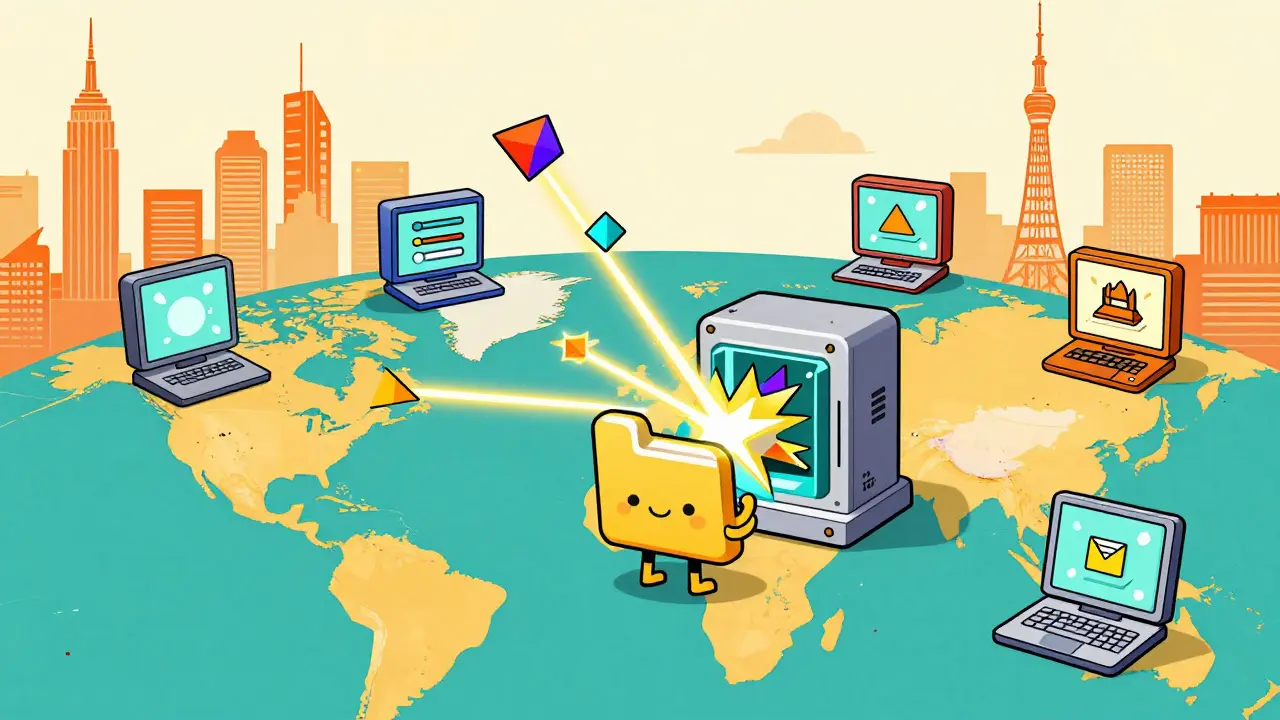
- Distribution Across Nodes: These shards are sent to hundreds or thousands of independent nodes (computers) around the world. These nodes are part of a peer-to-peer (P2P) network. Some might be in New Zealand, others in Germany, Brazil, or Japan.
- Redundancy and Replication: To prevent data loss if a node goes offline, the system creates multiple copies of each shard. For example, Filecoin might store three copies of every shard on different nodes.
- Blockchain Verification: A blockchain ledger records where the data is stored and verifies that the nodes are actually holding the data. Smart contracts handle payments to node operators only if they prove they still have your data intact.
This architecture means there is no "main server" to hack. To steal your file, an attacker would need to simultaneously compromise dozens of unrelated computers across different continents and then somehow obtain your private encryption key. The odds are statistically near zero.
| Feature | Centralized Cloud (AWS, Google) | Decentralized Storage (Filecoin, Arweave) |
|---|---|---|
| Data Ownership | Provider holds keys; you rent access | User holds keys; full ownership |
| Failure Risk | High (single point of failure) | Negligible (distributed redundancy) |
| Censorship Resistance | Low (provider can delete/ban) | High (no central authority) |
| Hack Surface Area | Large (one big target) | Small (scattered fragments) |
| Cost Structure | Subscription fees, often rising | Pay-per-use or one-time fee (depending on protocol) |
Key Protocols: IPFS, Filecoin, and Arweave
Not all decentralized storage is built the same. Different protocols solve different problems. Understanding the differences helps you choose the right tool for your specific needs.
IPFS (InterPlanetary File System) is a peer-to-peer hypermedia protocol designed to make the web faster, safer, and more open. Think of IPFS as the addressing system. Instead of finding a file by its location (URL), you find it by its content hash. If the file changes, the hash changes. IPFS itself does not incentivize nodes to store data long-term; it is primarily a retrieval system. It is excellent for sharing large files quickly but less ideal for permanent archival without additional layers.
Filecoin is a decentralized storage network that builds on top of IPFS to provide economic incentives for storage providers. While IPFS tells you where data is, Filecoin pays people to keep it there. Users sign smart contracts with storage miners, paying in FIL tokens. Miners must provide Proof-of-Replication and Proof-of-Spacetime to prove they are still storing your data. This makes Filecoin highly reliable for long-term, secure storage.
Arweave is a protocol designed for permanent data storage, often referred to as 'permaweb'. Unlike Filecoin, which requires ongoing payments, Arweave uses an endowment model. You pay once upfront, and that payment generates interest over time, which funds future storage costs. This makes Arweave unique for applications requiring immutable, forever-available data, such as historical records, legal documents, or NFT metadata.
Cryptographic Foundations of Security
The security of decentralized storage rests heavily on advanced cryptography. Without these mechanisms, distribution alone would not be enough.
End-to-End Encryption (E2EE) is non-negotiable. In decentralized networks, E2EE ensures that data is encrypted on your device before transmission. The network nodes never see the raw data. They only handle encrypted blobs. This protects against curious node operators or malicious actors within the network.
Secret Sharing Schemes take encryption a step further. Technologies like Shamir's Secret Sharing split your encryption key into multiple parts. To decrypt the file, you need a minimum number of key shares (e.g., 3 out of 5). This prevents a single compromised key share from exposing your data. It also solves the problem of key loss-if you lose one share, you can still recover your data with the remaining ones.
Merkle Trees are used to verify data integrity. When you retrieve a file, the system checks the Merkle root hash against the original. If even a single bit of data has been corrupted or altered during storage or transmission, the hash will not match, and the system will reject the file. This ensures that the data you get back is exactly what you put in.
Challenges and Risks to Consider
Despite its strengths, decentralized storage is not a magic bullet. There are practical challenges you must navigate.
Key Management Responsibility is the biggest hurdle for users. In centralized cloud storage, you can click "Forgot Password" and reset access via email. In decentralized storage, if you lose your private key or seed phrase, your data is gone forever. There is no customer support team to help you recover it. This requires strict backup habits and potentially hardware wallets for high-value data.
Retrieval Speed and Latency can vary. Because data is fetched from multiple nodes globally, initial download speeds might be slower than downloading from a nearby AWS edge server. However, technologies like IPFS gateways and caching layers are improving this significantly. For most use cases, the speed difference is negligible, but for high-frequency, low-latency applications, it may require optimization.
Regulatory Uncertainty exists because decentralized networks operate across borders. While censorship resistance is a feature, it can complicate compliance with laws like GDPR (General Data Protection Regulation), which includes the "right to be forgotten." Deleting data from a fully distributed, replicated network is technically difficult. Solutions like encrypting data and then destroying the decryption key (crypto-shredding) are emerging as workarounds, but legal frameworks are still catching up.
Best Practices for Implementing Decentralized Storage
If you are ready to adopt decentralized storage, follow these steps to ensure maximum security and reliability:
- Start Small: Test with non-critical data first. Understand the workflow of uploading, managing keys, and retrieving files.
- Secure Your Keys: Use a hardware wallet (like Ledger or Trezor) to store encryption keys. Never store seed phrases digitally. Write them down on metal backups and store them in separate physical locations.
- Choose the Right Protocol: Use Filecoin for cost-effective, long-term storage. Use Arweave for permanent, immutable records. Use IPFS for fast, temporary sharing.
- Verify Data Integrity: Regularly check that your files are retrievable and intact. Don't assume set-and-forget applies here.
- Understand Costs: Calculate the total cost of ownership, including gas fees (transaction fees) and storage miner payments. Prices fluctuate with market conditions.
Decentralized storage security represents a fundamental shift from trusting corporations to trusting mathematics and code. It empowers users with true ownership and resilience against systemic failures. While it requires more responsibility from the user, the payoff is a level of privacy and security that centralized clouds simply cannot offer.
Is decentralized storage completely unhackable?
No system is 100% unhackable, but decentralized storage is significantly harder to attack. Since data is encrypted and fragmented across thousands of nodes, there is no single target for hackers. The weakest link is usually the user losing their encryption keys, not the network being breached.
What happens if I lose my private key in decentralized storage?
If you lose your private key, you permanently lose access to your data. Unlike centralized services, there is no password reset option. This is why creating multiple secure backups of your seed phrase or using secret sharing schemes is critical.
How does decentralized storage compare to Google Drive in terms of speed?
For small files and frequent access, Google Drive may feel faster initially because it uses optimized, localized servers. However, decentralized networks like IPFS are rapidly improving with caching layers. For large files or archival purposes, the speed difference is often negligible, and the security benefits outweigh minor latency issues.
Can decentralized storage comply with GDPR's 'right to be forgotten'?
Compliance is challenging because deleting data from a distributed network is difficult. However, many platforms use 'crypto-shredding,' where the encryption key is destroyed. Without the key, the data remains on the network but is unreadable and effectively deleted, satisfying privacy requirements.
Which is better for long-term storage: Filecoin or Arweave?
It depends on your needs. Filecoin is better if you want flexible, ongoing storage with competitive pricing and don't mind paying recurring fees. Arweave is ideal for permanent, immutable data where you want to pay once and never worry about future costs or availability.