Flash Loan Profitability in 2026: Strategies, Risks, and Real Returns
 Jul, 15 2026
Imagine borrowing $1 million without a credit check, no collateral, and no paperwork. You use that money to make a trade, pocket the profit, and pay back the loan-all within seconds. If it sounds too good to be true, you’re right. But in the world of decentralized finance (DeFi), this is exactly how flash loans work. As we move through 2026, these tools have shifted from experimental hacks used by early adopters to serious instruments for sophisticated traders and institutions. But here is the hard truth: making consistent money with flash loans is no longer about finding an easy glitch. It’s a high-speed, highly competitive arms race where milliseconds and gas fees decide whether you win or lose.
What Exactly Are Flash Loans?
To understand the profitability, you first need to grasp the mechanics. A flash loan is an uncollateralized loan that must be borrowed and repaid within a single blockchain transaction block. This means if your strategy fails, or if you don’t have enough funds to repay the loan plus fees at the end of the transaction, the entire process reverses. It’s as if the trade never happened. The lender takes zero risk because they get their money back instantly, or they get nothing. For you, the borrower, it’s a way to access massive capital without tying up your own assets.
This mechanism relies on smart contracts-self-executing code on the blockchain. In 2026, platforms like Aave dominate this space. Aave charges a standard fee of 0.09% on flash loans. While that sounds small, when you are working with thin margins, every basis point counts. Another major player is Balancer, which offers zero-fee flash loans. This distinction is critical. If your expected profit is only 0.05%, using Aave would wipe out your gains, while Balancer might let you keep them. Choosing the right platform is step one in any profitable strategy.
The Main Ways to Make Money with Flash Loans
There isn’t just one way to use a flash loan. Different strategies carry different levels of complexity and risk. Here are the primary methods traders use in 2026:
- Cross-Exchange Arbitrage: Buying a token on one exchange where it’s cheap and selling it on another where it’s expensive.
- Triangular Arbitrage: Trading three different tokens in a loop on a single exchange to exploit price discrepancies between pairs.
- Liquidity Provision: Borrowing funds, adding them to a liquidity pool to capture trading fees, then withdrawing and repaying the loan.
- Collateral Swapping: Using a flash loan to replace underperforming collateral in a lending position to avoid liquidation.
- Yield Farming Sniping: Depositing borrowed funds into protocols offering immediate reward distributions to capture bonus tokens.
Cross-Exchange Arbitrage: The Classic Strategy
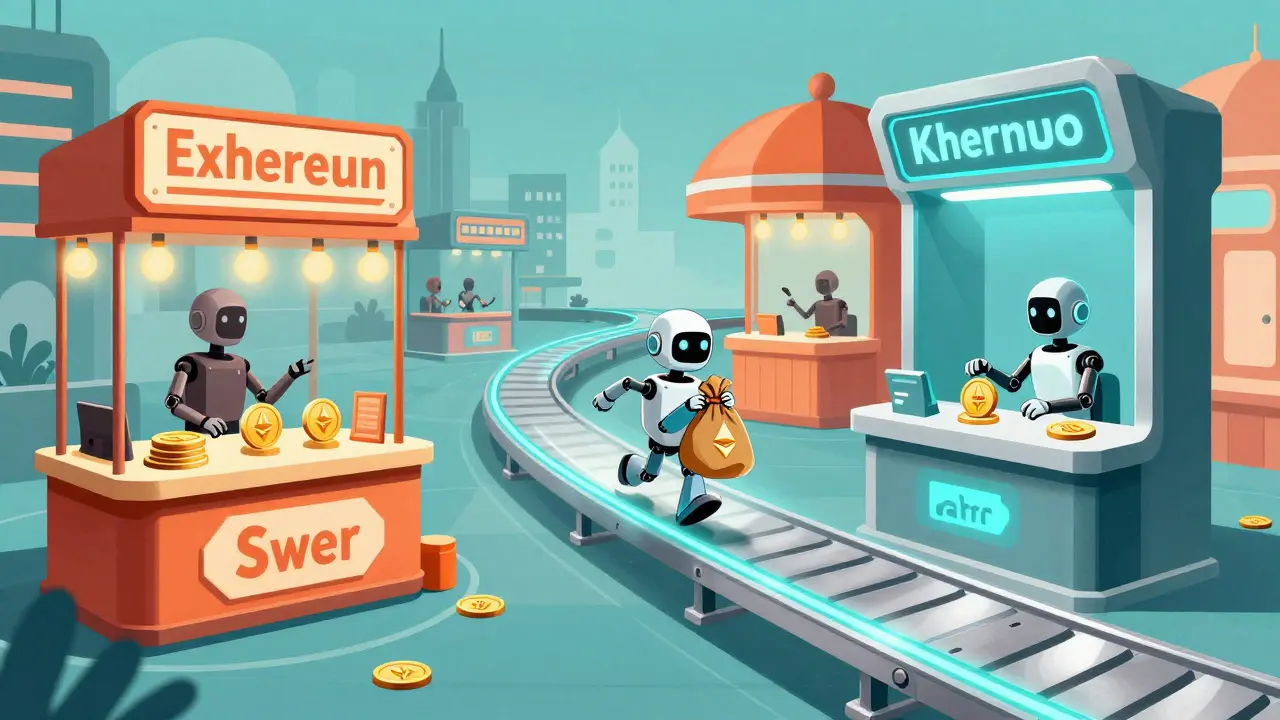
This is the most common approach. Let’s look at a concrete example from early 2026. Suppose Ethereum (ETH) is trading at $3,450 on Uniswap but $3,500 on SushiSwap. That’s a $50 difference per ETH. You borrow $345,000 via a flash loan, buy 100 ETH on Uniswap, sell those 100 ETH on SushiSwap for $350,000, repay the $345,000 loan, pay the 0.09% fee ($310.50), and cover gas costs. Your gross profit looks like $4,689.50.
On paper, it’s simple. In reality, these large gaps rarely last long. By 2026, hundreds of automated bots scan the blockchain continuously. They detect these discrepancies in milliseconds. If you try to execute this manually, you will likely fail. The bot that spotted the gap before you already took the profit. To succeed, you need your own bot, optimized code, and fast execution infrastructure. The competition is fierce, and the "easy" trades are gone.
Triangular Arbitrage: Staying on One Exchange
Sometimes, moving assets between exchanges is too slow or expensive due to network congestion. Triangular arbitrage solves this by staying on one platform. Imagine trading ETH for USDC, then USDC for DAI, and finally DAI back to ETH. If the exchange rates aren’t perfectly aligned, you can end up with more ETH than you started with. This strategy is less dependent on cross-chain latency but requires precise calculation of slippage and fees. It’s often used when specific token pairs show temporary inefficiencies that multi-exchange routes can’t exploit quickly enough.
Liquidity Provision and Yield Farming
Not all flash loan strategies involve buying low and selling high. Some focus on capturing fees. When you provide liquidity to a decentralized exchange (DEX) like Uniswap, you earn a share of the trading fees generated by other users. Normally, you’d need significant capital to earn meaningful fees. With a flash loan, you can borrow millions, deposit them into a high-volume pool, collect the fees generated during that single block, withdraw, and repay the loan.
Similarly, some DeFi protocols offer immediate rewards for providing capital. If a protocol distributes reward tokens instantly upon deposit, you can borrow funds, deposit them, claim the rewards, sell the rewards for profit, and repay the loan. However, this only works for short-term incentives. Long-term yield farming doesn’t fit the flash loan model because the repayment must happen in the same transaction block.
The Hidden Costs: Gas Fees and Competition
Profitability isn’t just about the price difference. It’s about what it costs to execute the trade. Gas fees-the payment you make to miners or validators to process your transaction-can eat into your profits significantly. On Ethereum mainnet, gas prices can spike during busy periods. A trade that looks profitable on paper might result in a loss once you factor in a $50 or $100 gas bill.
This is why many traders have moved to Layer 2 networks like Arbitrum and Optimism. These networks sit on top of Ethereum, offering much lower gas fees while maintaining security. In 2026, Arbitrum and Optimism are hotbeds for flash loan activity because the cost of entry is lower, allowing for smaller, more frequent trades. Other chains like Solana and BNB Chain also offer competitive environments, depending on where the liquidity and price discrepancies exist.
| Platform/Network | Flash Loan Fee | Key Advantage | Best For |
|---|---|---|---|
| Aave | 0.09% | Deep liquidity, multichain support | Large volume trades, established protocols |
| Balancer | 0% | No fee on flash loans | Thin-margin arbitrage, cost-sensitive strategies |
| Ethereum Mainnet | N/A (Gas varies) | Highest liquidity, most protocols | Institutional-grade trades, high-value assets |
| Arbitrum/Optimism | N/A (Low Gas) | Low transaction costs, Ethereum security | High-frequency trading, retail-friendly bots |
| Solana | N/A (Low Gas) | Extreme speed, low fees | Ultra-fast arbitrage, meme coin trading |
Risks and Security Concerns
While flash loans eliminate counterparty risk for lenders, they introduce other dangers for borrowers. The biggest risk is failure. If your code has a bug, or if market conditions change slightly during execution, the transaction reverts. You lose the gas fee, but you don’t lose the borrowed capital. However, repeatedly failing transactions can drain your wallet dry.
There’s also the risk of sophisticated attacks. Flash loans have been used in the past to manipulate oracle prices and drain lending protocols. In response, the industry has evolved. By 2026, "Flash Loan 2.0" standards include integrated oracle protections and reentrancy guards. Top platforms now prioritize these security layers. As a trader, you must ensure your strategies comply with these updated security frameworks. Attempting to exploit outdated vulnerabilities is not only unethical but increasingly unlikely to succeed due to advanced audit protocols.
Is It Still Profitable in 2026?
The short answer is yes, but the bar for entry is higher. The days of casual users making thousands with a single click are over. Today, profitability comes from scale and efficiency. Successful participants run optimized bots that execute hundreds of small trades daily, accumulating profits through volume rather than magnitude. They monitor multiple chains, switch between Aave and Balancer based on fee structures, and optimize for gas costs on Layer 2 networks.
For the average person, flash loans are more of a tool for portfolio management-like swapping collateral to avoid liquidation-than a get-rich-quick scheme. If you want to pursue arbitrage, you need technical skills in Solidity or Rust, a deep understanding of DeFi mechanics, and capital to cover gas fees during development and testing. It’s a professional endeavor now, not a hobby.
Next Steps for Aspiring Traders
If you’re interested in exploring flash loans, start by learning the basics of smart contract development. Practice on testnets where gas is free and mistakes don’t cost real money. Analyze historical data to understand typical price discrepancies and gas patterns. Join communities focused on DeFi development to stay updated on new protocols and security standards. Remember, the goal isn’t just to find a trade; it’s to build a system that can find and execute trades faster and cheaper than everyone else.
Can beginners make money with flash loans?
It is extremely difficult for beginners to make consistent money with flash loans in 2026. The market is dominated by automated bots and experienced developers. Beginners should focus on learning smart contract coding and understanding DeFi mechanics before attempting live trades. Start with testnets to practice without financial risk.
What is the most profitable flash loan strategy?
There is no single "most profitable" strategy as it depends on market conditions. Cross-exchange arbitrage is the most common, but triangular arbitrage and liquidity provision can be more effective in certain scenarios. Success depends on execution speed, gas optimization, and the ability to identify rare price discrepancies before competitors do.
Are flash loans legal?
Yes, flash loans are legal financial instruments within the DeFi ecosystem. They operate on public blockchains and are governed by smart contracts. However, using them to exploit vulnerabilities or manipulate markets may violate terms of service and potentially local financial regulations. Always ensure your strategies are ethical and compliant.
Why did my flash loan transaction fail?
Flash loans fail if the loan is not repaid with fees within the same transaction block. Common reasons include insufficient profit margin to cover fees, unexpected price changes during execution, smart contract bugs, or high gas prices causing the transaction to timeout. Check your code logic and ensure your profit calculations account for all costs.
Which blockchain is best for flash loans?
Ethereum offers the deepest liquidity but has high gas fees. Layer 2 networks like Arbitrum and Optimism are often better for profitability due to lower costs. Solana and BNB Chain offer speed and low fees but may have less liquidity for large trades. Choose the chain based on where the price discrepancy exists and where your target protocols operate.