Future Halvings: Bitcoin, TAO & ETC Impact Analysis 2026-2028
 Aug, 18 2026
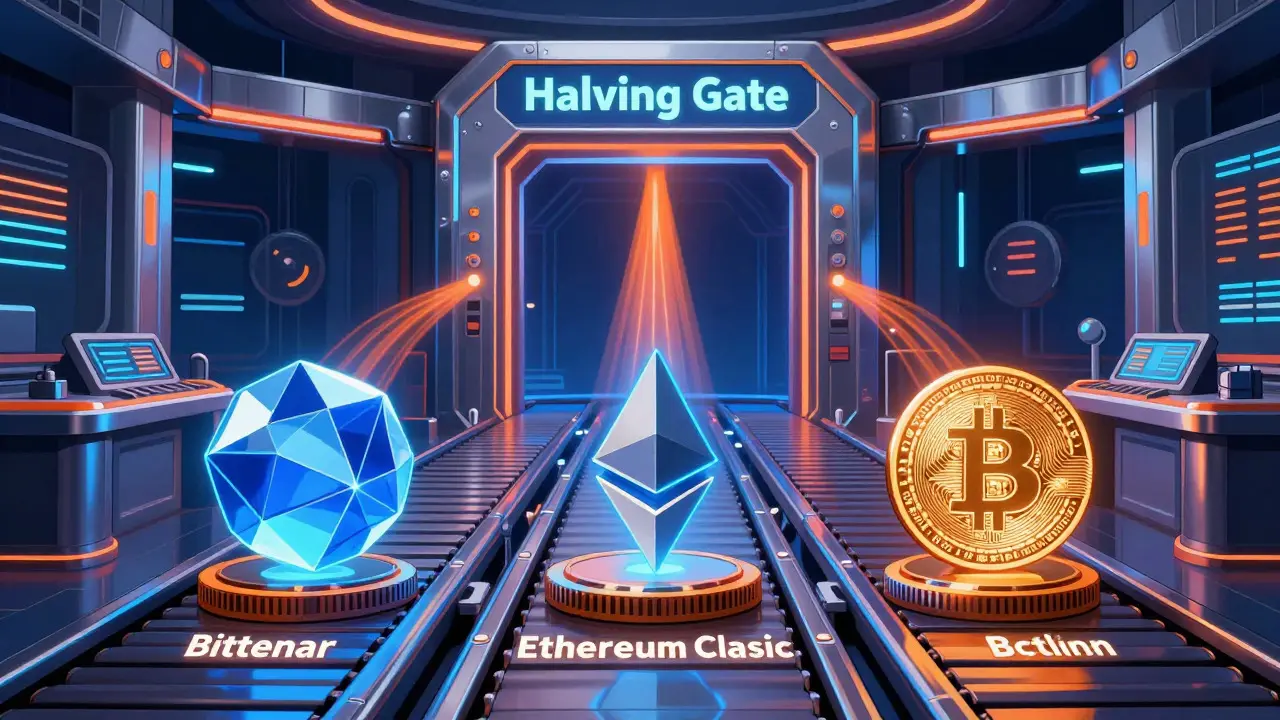
Most people think a crypto halving is just a number going down. But if you look at the calendar for the next three years, you’ll see something unusual happening. We are heading into a rare window where three major networks-Bittensor, Ethereum Classic, and Bitcoin-are all scheduled to cut their mining rewards in quick succession. This isn't just about one coin getting pricier; it’s a synchronized shift in how new tokens enter the market.
For investors and miners alike, the stakes are high. The timing of these events changes the math on profitability, network security, and price discovery. Let’s break down what’s actually coming, when it happens, and why the "old rules" of the four-year cycle might not apply anymore.
The Upcoming Halving Schedule: 2026 to 2028
First, let’s clear up the timeline. There is a lot of confusion online about dates, so here is the concrete schedule based on current block heights and protocol rules:
- Bittensor (TAO): Projected between December 2025 and February 2026. The trigger is hitting 10.5 million circulating tokens out of a 21 million hard cap. Taostats currently models this for mid-December 2025, but it depends on token recycling from miner deregistrations.
- Ethereum Classic (ETC): Scheduled for July 23, 2026, at block 25,000,001. This is a fixed-date event tied to block height, making it more predictable than TAO.
- Bitcoin (BTC): Expected around April 2028 at block 1,050,000. This will be the fifth halving, cutting rewards from 3.125 BTC to 1.5625 BTC per block.
Notice the clustering? Within roughly 28 months, three significant proof-of-work or hybrid networks will reduce their issuance rates. Historically, we’ve seen these events spaced out by years. Now, they’re stacking up. This creates a unique environment where capital rotation between these assets could be more intense than usual.
Why Bittensor’s Halving Is Different
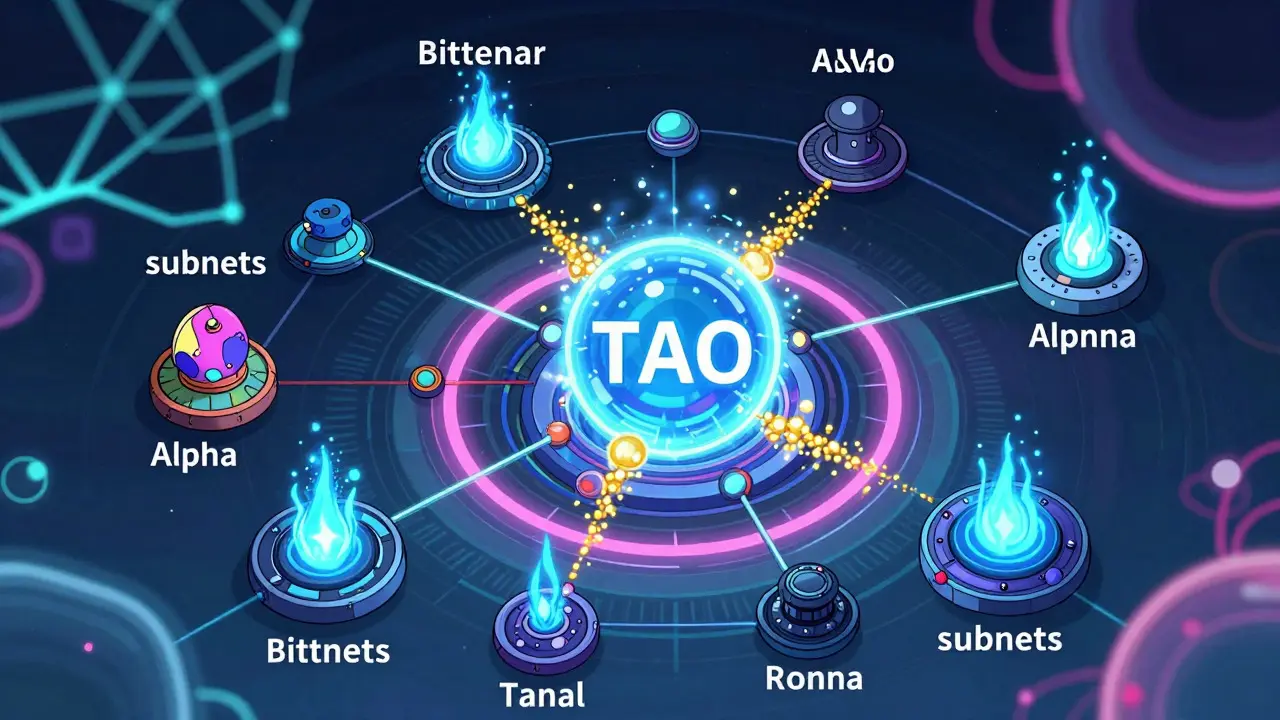
While Bitcoin halvings are straightforward, Bittensor introduces complexity that has no historical precedent. TAO operates on a multi-subnet architecture. Each subnet has its own native Alpha token used for incentives within that specific machine learning task.
When the TAO halving hits, the primary reward for validators and miners drops. However, the dilution rate of Alpha tokens relative to TAO changes. This matters because many subnets rely on Alpha emissions to attract developers and compute power. If TAO liquidity tightens due to the halving, but Alpha inflation continues, you could see a mismatch in value. Some subnets might thrive as their Alpha becomes more valuable against a scarcer TAO, while others might struggle if they can’t maintain incentive structures without fresh TAO issuance.
This makes TAO’s first halving a test case for decentralized AI networks. It’s not just a supply shock; it’s a stress test for an entire ecosystem of interconnected tokens.
Bitcoin’s Fifth Halving: The Institutional Era
Bitcoin remains the anchor of the crypto market. The upcoming halving in 2028 will cut daily new supply significantly. But here’s the twist: the market has changed since 2024.
In previous cycles, retail investors drove much of the post-halving rally. Today, institutional players like ARK Invest hold substantial positions. Cathie Wood’s firm recently purchased over $37 million in Bitcoin, signaling long-term confidence. These institutions don’t chase short-term pumps; they accumulate over years.
This shifts the dynamic. Instead of a sharp spike immediately after the halving, we might see a slower, more sustained grind higher. Analysts suggest the traditional four-year cycle may be extending. Why? Because macroeconomic factors-like interest rates and global M2 money supply growth-now play a bigger role than technical supply cuts alone. Bitcoin’s price reached nearly $110,000 in January 2025, well before the 2028 halving, showing that institutional demand can decouple price from immediate halving events.
| Asset | Estimated Date | Reward Change | Key Complexity Factor |
|---|---|---|---|
| Bittensor (TAO) | Dec 2025 - Feb 2026 | Variable (based on circulation) | Multi-subnet Alpha token dynamics |
| Ethereum Classic (ETC) | July 23, 2026 | Fixed reduction at Block 25M | Pure Proof-of-Work consistency |
| Bitcoin (BTC) | April 2028 | 3.125 BTC to 1.5625 BTC | Institutional accumulation vs. miner economics |
Ethereum Classic: The Steady Hand
Ethereum Classic offers a different perspective. Unlike Ethereum, which moved to proof-of-stake, ETC remains pure proof-of-work. Its halving on July 23, 2026, is predictable and clean. No complex subnet interactions, no staking yield competition. Just a simple reduction in block rewards.
For miners, this means they need higher ETC prices to stay profitable. Historically, ETC has had lower volatility than Bitcoin, but its halving could act as a catalyst for renewed interest in PoW assets. Since it falls between the TAO and Bitcoin events, it might serve as a mid-cycle check-in for the broader PoW sector. If TAO’s halving causes turbulence, ETC could become a safer haven for those still committed to mining hardware.
Long-Term Implications: Mining Economics and Network Security
Halvings aren’t just about price; they’re about survival. As block rewards shrink, miners must cover their electricity and hardware costs with fewer coins. This forces two outcomes:
- Price Appreciation: The token must rise in value to keep mining profitable. If it doesn’t, miners sell or shut down.
- Fee Revenue Dependence: Networks must generate enough transaction fees to compensate miners. For Bitcoin, this transition is critical. By 2140, when new BTC creation stops entirely, transaction fees will be the only source of income for miners. The question is whether usage volume will grow fast enough to support this shift.
If fee revenue lags behind declining block rewards, network security can weaken. Fewer active miners mean less hash rate, which increases the risk of attacks. This is why watching miner behavior during these halving windows is essential. Are they holding their coins (accumulation) or selling to pay bills (distribution)? Data from platforms like CryptoQuant shows exchange reserves declining, suggesting accumulation. That’s a bullish sign for network stability.

Will the Four-Year Cycle Still Hold?
Many traders swear by the four-year halving cycle. Buy after the halving, sell eighteen months later. But recent data suggests this pattern is evolving. The 2024 halving showed a muted immediate price response, with the big move happening earlier in the cycle due to institutional inflows.
Going forward, expect more nuance. Macroeconomic conditions-such as central bank policies and global liquidity-will likely override pure supply-demand mechanics. If global M2 money supply expands rapidly, Bitcoin could rally regardless of the halving date. Conversely, if rates stay high, even a halving might not trigger a massive spike.
So, don’t bet everything on a single date. Look at the confluence of factors: supply reduction, institutional positioning, and macro trends. The halving is a necessary condition for scarcity, but not a sufficient one for price explosions.
Practical Takeaways for Investors
Here’s how to approach this period strategically:
- Diversify Across Halving Events: Don’t put all your eggs in the Bitcoin basket. TAO and ETC offer different risk profiles. TAO is high-risk/high-reward due to its novel structure. ETC is lower-risk but potentially lower-reward.
- Watch Miner Behavior: Monitor exchange outflows. If miners are moving coins to cold storage, it signals confidence. If they’re dumping on exchanges, be cautious.
- Understand Subnet Dynamics (for TAO): Research which subnets have strong utility. A halving won’t help a subnet with no real-world use case. Focus on subnets with active development and user adoption.
- Prepare for Volatility:** The convergence of multiple halvings could create unpredictable price swings. Keep some cash available to buy dips if sentiment turns negative.
The next few years will redefine how we view crypto supply shocks. It’s no longer just about Bitcoin. It’s about a coordinated shift across multiple ecosystems, each with its own rules and risks. Stay informed, watch the data, and avoid chasing hype.
When exactly is the next Bitcoin halving?
The fifth Bitcoin halving is expected around April 2028, specifically at block 1,050,000. The exact date depends on network hash rate and block time, but April 2028 is the widely accepted estimate.
How does Bittensor's halving differ from Bitcoin's?
Bittensor's halving is triggered by reaching 10.5 million circulating TAO tokens, not a fixed block height. Additionally, TAO has a complex multi-subnet structure with Alpha tokens, creating ripple effects across different parts of the network that Bitcoin doesn't have.
Do halvings always lead to price increases?
Historically, yes, but with a delay. Price appreciation typically occurs six to twelve months after the halving. However, in the current institutional era, price movements may be influenced more by macroeconomic factors and institutional accumulation than by the halving event itself.
What happens to miners after a halving?
Miners receive half the previous block reward. To remain profitable, they either need the token price to double, reduce their operational costs, or rely more on transaction fees. Inefficient miners may shut down, temporarily reducing network hash rate until the remaining miners adjust.
Is Ethereum Classic's halving important for the broader market?
Yes, because it reinforces the viability of proof-of-work consensus. As Ethereum moved to proof-of-stake, ETC remains a major PoW asset. Its halving serves as a benchmark for how pure PoW networks handle supply reductions, influencing sentiment across other PoW chains.