How Layer 2 Improves Blockchain Scalability: A Practical Guide
 Oct, 9 2026
You’ve probably felt the pain. You’re trying to buy a coffee with crypto, or swap tokens on a decentralized exchange, and suddenly your wallet asks for $40 in gas fees. Or maybe you just wait five minutes for a transaction that should take seconds. This isn’t a bug; it’s a feature of how most blockchains work. Bitcoin and Ethereum prioritize security and decentralization over speed, which creates a bottleneck. If everyone tries to use the network at once, things grind to a halt.
This is where Layer 2 solutions come in. They aren’t new blockchains competing with Bitcoin or Ethereum. Instead, they are protocols built on top of them, designed specifically to handle traffic more efficiently. Think of Layer 1 as a busy highway during rush hour. Layer 2 is like building an express lane above it. The cars (transactions) move faster and cheaper because they aren’t stuck in the main traffic jam, but they still rely on the highway’s foundation for safety and finality. Here’s exactly how this architecture solves the scalability crisis without sacrificing the core principles of blockchain technology.
The Core Problem: Why Blockchains Get Slow
To understand why we need Layer 2, you have to look at the "Trilemma." Vitalik Buterin, the co-founder of Ethereum, famously described this as the struggle between three properties: scalability, security, and decentralization. In traditional databases, you can have all three easily. In blockchain, picking two usually means losing the third. Bitcoin and Ethereum chose security and decentralization first. Every node in the network verifies every transaction. This is great for trust-you don’t need to trust a bank-but it’s terrible for speed.
Bitcoin handles about 7 transactions per second (TPS). Visa processes thousands. Ethereum improved this, managing around 15-30 TPS depending on congestion, but demand often exceeds supply. When demand spikes, users bid up gas fees to get their transactions processed first. This creates a poor user experience. You can’t build a global payment system if sending $5 costs $10. Layer 2 addresses this by changing where the computation happens, not necessarily who secures the data.
What Exactly Is a Layer 2 Solution?
A Layer 2 solution is a protocol built on top of a Layer 1 blockchain that processes transactions off-chain while inheriting the security guarantees of the base layer. It’s crucial to distinguish this from sidechains. Sidechains are separate blockchains with their own consensus mechanisms and security models. If a sidechain gets hacked, its assets might be lost forever because it doesn’t share the same security pool as Bitcoin or Ethereum. Layer 2s, particularly rollups, anchor their state back to the Layer 1 chain. This means if the Layer 2 operator goes rogue, the underlying Layer 1 network can step in to recover funds.
The magic lies in batching. Instead of submitting every single transaction to the main blockchain individually, Layer 2 networks bundle hundreds or thousands of transactions together. They process these transactions among themselves, update the state, and then submit a compressed summary or a cryptographic proof to the Layer 1 chain. The main chain only needs to verify that the summary is valid, not re-execute every single trade. This drastically reduces the computational load on the main network.
Key Mechanisms: Rollups, Channels, and Sidechains
Not all Layer 2s work the same way. There are three main categories, each with different trade-offs regarding speed, cost, and compatibility.
Rollups: The Current Gold Standard
Rollups are currently the most popular approach for Ethereum scaling. They execute transactions outside the main chain but post transaction data back to the Layer 1. This ensures data availability-meaning anyone can reconstruct the history of the Layer 2 chain using data stored on Ethereum. There are two types:
- Optimistic Rollups: These assume transactions are valid by default. They include a "challenge period" (usually 7 days) where anyone can dispute a transaction if they find fraud. Examples include Arbitrum and Optimism. They are highly compatible with existing Ethereum apps because they mimic the Ethereum Virtual Machine (EVM).
- ZK-Rollups (Zero-Knowledge): These use complex cryptography to generate a mathematical proof that all bundled transactions are valid. Once the proof is verified on Layer 1, the state is finalized immediately. No waiting period. Examples include zkSync and StarkNet. They offer better long-term scalability but are harder to build for developers due to the complexity of zero-knowledge proofs.
State Channels: The Lightning Model
If you’ve used Bitcoin for payments, you’ve likely heard of the Lightning Network. This is a state channel solution. Two parties open a channel by locking up some funds on the main chain. Then, they can send unlimited transactions between each other instantly and nearly for free. Only when they close the channel do they record the final balance on the main chain. This is ideal for frequent, small-value transfers between known parties, like paying for streaming services or micro-tips.
Sidechains: Parallel Universes
Solutions like Polygon PoS operate as independent blockchains connected to Ethereum. They have their own validators and consensus rules. Because they don’t inherit Ethereum’s security directly, they are technically distinct networks. However, they offer massive throughput and low fees, making them attractive for gaming and social apps where absolute financial-grade security is less critical than speed.
Performance Metrics: How Much Faster Are We Talking?
The difference isn’t marginal; it’s exponential. Let’s look at the numbers as of late 2026.
| Metric | Ethereum Mainnet (L1) | Optimistic Rollup (e.g., Arbitrum) | ZK-Rollup (e.g., zkSync) | Lightning Network (BTC) |
|---|---|---|---|---|
| Transactions Per Second (TPS) | ~15-30 | ~2,000 - 4,000 | ~2,000 - 10,000+ | Unlimited (per channel) |
| Average Transaction Fee | $2 - $50+ (variable) | $0.01 - $0.10 | $0.001 - $0.05 | Negligible (<$0.001) |
| Finality Time | ~12-15 seconds | ~1 week (withdrawal) | Minutes | Instant |
| Security Source | Native Consensus | Inherited from L1 | Inherited from L1 | Inherited from BTC |
Notice the fee reduction. On a congested Ethereum day, swapping tokens might cost $20. On a ZK-rollup, that same swap might cost a fraction of a cent. For high-frequency trading or gaming, this makes the application viable. Without Layer 2, many of these use cases simply wouldn’t exist because the economics don’t work.
The Security Trade-Offs
Is everything perfect? Not quite. Moving computation off-chain introduces new risks. With optimistic rollups, the 7-day withdrawal delay is annoying for users who want to exit quickly. While you can use bridges to withdraw instantly, those bridges charge a fee. With ZK-rollups, the tech is newer. If there’s a bug in the circuit design (the code that generates the proofs), funds could theoretically be at risk until patched. However, audits and formal verification mitigate much of this risk.
Another concern is centralization. Many current Layer 2 operators control the sequencers-the machines that order transactions. If a sequencer goes down, the network halts. Decentralizing sequencers is a major focus for 2026, with projects moving toward permissionless validator sets. Until then, you’re trusting a smaller group of entities to keep the network running smoothly, even if the final settlement remains secure on Layer 1.
Why Developers and Users Should Care
For developers, Layer 2s lower the barrier to entry. High gas fees previously made it impossible to build apps that required frequent user interaction, like social media on-chain or real-time games. Now, you can build applications that feel like Web2-fast and cheap-while retaining Web3 benefits like ownership and composability.
For users, the shift is already happening. Most new DeFi activity now happens on Layer 2s. Your wallet probably has options to bridge funds to Arbitrum or Base automatically. The user experience is improving rapidly. Wallets hide the complexity of bridging, showing you one unified balance across multiple chains. The goal is abstraction: you shouldn’t need to know what a "rollup" is to use it, just like you don’t need to know TCP/IP to browse the web.
Looking Ahead: Interoperability and The End Game
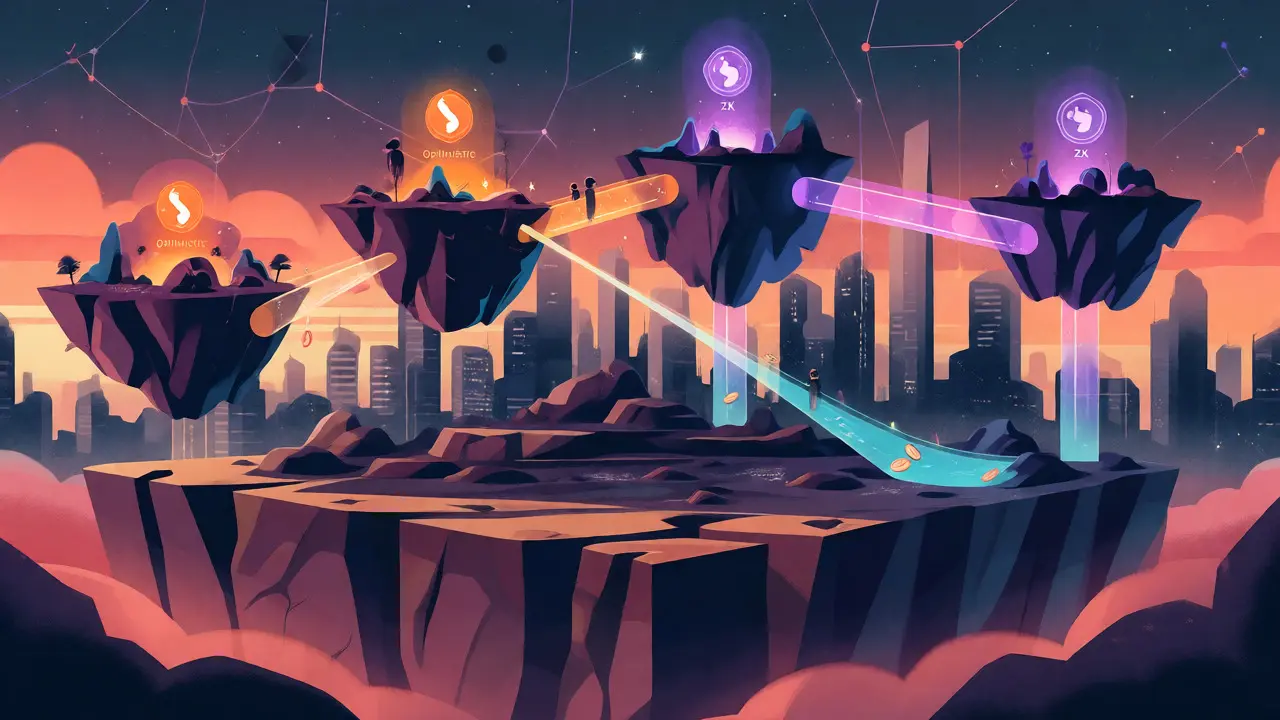
The next frontier is interoperability. Right now, moving assets between different Layer 2s can be clunky. You might bridge from Arbitrum to Optimism via Ethereum, taking time and fees. New standards like ERC-7683 are emerging to standardize cross-chain messaging, allowing assets to move between L2s almost instantly. This creates a cohesive ecosystem rather than isolated islands.
Ultimately, Layer 2 doesn’t replace Layer 1. It complements it. Ethereum and Bitcoin remain the settlement layers-the supreme courts of finance. Layer 2s are the commercial districts where business happens at scale. As technology matures, expect fees to drop further and speeds to increase, bringing blockchain closer to the performance levels of centralized systems without giving up censorship resistance.
Frequently Asked Questions
Are Layer 2 solutions safe?
Yes, generally speaking. Most modern Layer 2s, especially rollups, inherit security from the underlying Layer 1 blockchain. If the Layer 2 fails, you can typically recover your funds on the main chain. However, smart contract bugs in the Layer 2 itself can pose risks, so always check audit reports before depositing large sums.
Do I need a new wallet for Layer 2?
Usually no. Most wallets like MetaMask support Layer 2 networks natively. You use the same private key and address. You just switch the network in your wallet interface to view balances and make transactions on the specific Layer 2 chain.
What is the difference between a sidechain and a Layer 2?
The main difference is security inheritance. A true Layer 2 posts data or proofs to the main Layer 1 chain, meaning its security is tied to the main network's hash power or stake. A sidechain runs its own consensus mechanism and validators. If a sidechain is compromised, its assets may be lost independently of the main chain.
Why do withdrawals from Layer 2 take so long?
This is common with Optimistic Rollups. They have a challenge period (often 7 days) to allow anyone to dispute fraudulent transactions. ZK-Rollups finalize much faster because they provide immediate cryptographic proofs. Some platforms offer instant withdrawal bridges for a small fee.
Can I use any token on Layer 2?
Not automatically. Tokens must be bridged from the main chain to the Layer 2. Popular tokens like USDC, ETH, and DAI are widely supported on major L2s. Always ensure the token exists on the target network before sending funds, or use a trusted bridge aggregator.