How Proposal Creation and Voting Work in DAOs
 Dec, 17 2025
How Proposal Creation and Voting Work in DAOs
Imagine a company where no CEO makes decisions alone. Instead, every big move-spending money, hiring people, changing rules-is decided by a vote from everyone who owns a piece of it. That’s what a DAO is. Short for Decentralized Autonomous Organization, a DAO runs on code, not corporate hierarchies. And at the heart of every DAO are two things: proposal creation and voting. Without them, there’s no governance. Just code sitting idle.
DAOs aren’t theoretical. As of late 2023, over 10,500 active DAOs managed more than $9 billion in assets. From funding open-source software to buying historic documents like the U.S. Constitution (yes, ConstitutionDAO tried), these groups are making real decisions. But how do they actually vote? And why do some proposals fail while others sail through? Let’s break it down.
How Proposals Are Created
Anyone can usually submit a proposal in a DAO-but that doesn’t mean every idea gets a vote. Most DAOs have guardrails to stop spam. For example, MolochDAO requires three members to sponsor a proposal before it’s even visible to voters. That means if you want to suggest spending DAO funds on a new tool, you need at least three people to back you up first. It’s not about popularity; it’s about accountability.
On platforms like Aragon or DAOhaus, creating a proposal is straightforward. You start by logging into your DAO’s dashboard, click “Create Proposal,” and fill in a title, summary, and detailed description. You also set the voting period-usually 3 to 7 days-and decide whether the proposal should trigger an automatic action, like transferring funds from the treasury once approved.
But here’s the catch: poorly written proposals get ignored. A 2023 survey by Colony found that 73% of DAO members spend hours just trying to understand what a proposal is asking for. If the description is vague, lacks context, or doesn’t explain the financial impact, voters will skip it. Good proposals include:
- A clear goal: “Fund $50,000 to hire a frontend developer for 3 months.”
- Cost breakdown: Where will the money come from? What’s the ROI?
- Alternatives considered: Why this option and not another?
- Links to supporting documents: GitHub repos, budgets, past discussions.
DAOs like MakerDAO and Aave publish detailed proposal templates. Others? Not so much. In fact, 43% of DAOs don’t even have a standard format. That’s why many new members feel lost. Training can take 4 to 6 hours just to learn how to write a proposal that stands a chance.
How Voting Works: Token Weight vs. Quadratic Voting
There are two main ways DAOs handle voting: token-weighted and quadratic. Most DAOs (about 65%) use token-weighted voting. That means your voting power equals the number of tokens you hold. If you own 1,000 tokens, you get 1,000 votes. Simple. Efficient. But deeply unfair.
Take Uniswap’s September 2022 proposal. It passed with 97.3% approval. Sounds overwhelming, right? But only 15.2% of token holders actually voted. The top 10 wallets controlled over 50% of the voting power. That’s whale dominance. One person with a big wallet can swing a vote-and they often do.
Quadratic voting fixes this. Instead of one token = one vote, it uses a formula: votes = square root of tokens held. So if you have 4 tokens, you get 2 votes. If you have 9 tokens, you get 3 votes. To get 10 votes, you’d need 100 tokens. That makes it expensive for whales to dominate, but affordable for small holders to have a real say.
Gitcoin and MolochDAO use this system. Gitcoin’s 2021 experiment showed a 37% drop in voter turnout because the math was confusing. But in 2023, users praised it: 87% said it helped small projects get funded fairly. The trade-off? Complexity. Most people don’t understand square roots in voting. That’s why only 12% of DAOs use it.

Other Voting Systems: Rage Quit, Timelocks, and Delegation
Not all voting is about passing proposals. Some systems are designed to protect members from bad decisions.
Rage quitting lets voters walk away if a proposal they opposed passes. If you voted against funding a risky project and it gets approved, you can pull out your tokens and leave the DAO. It’s a safety valve. But it slows things down. MolochDAO found that rage quitting extended decision timelines by 200-300% because people wait to see if others will rage quit before finalizing.
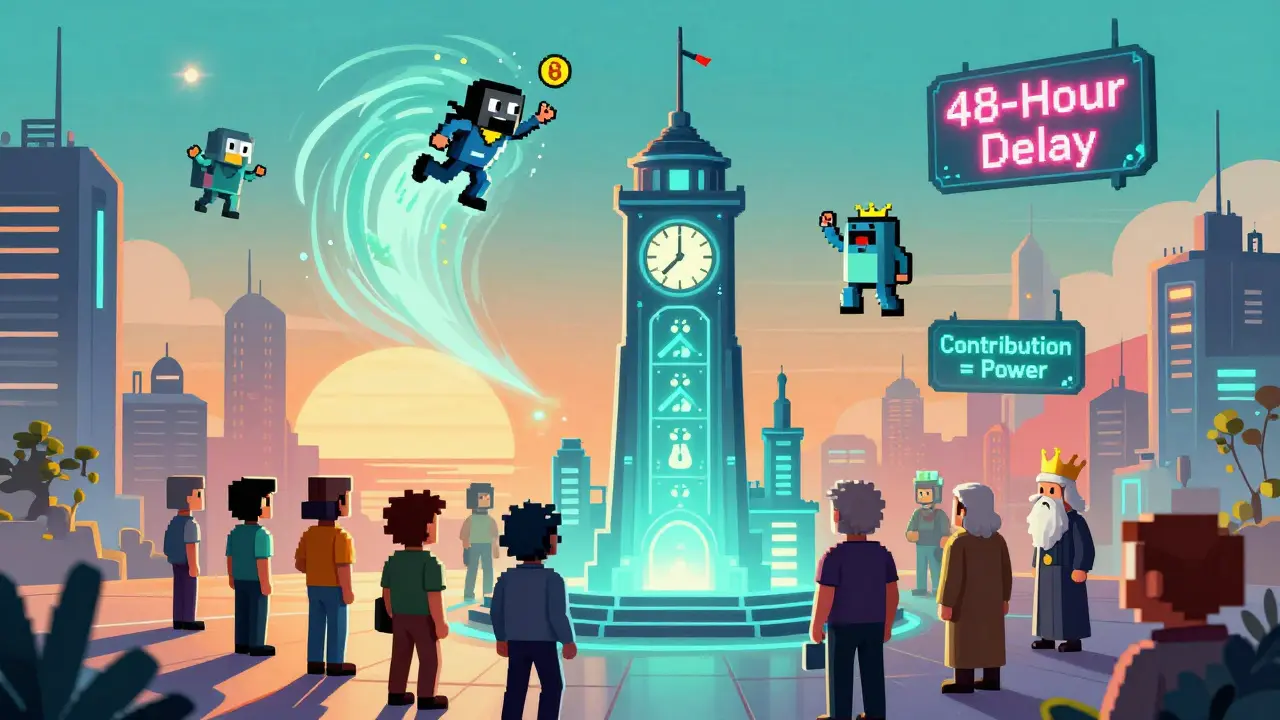
Timelocks are mandatory delays between vote approval and execution. If a proposal passes, the action doesn’t happen right away. Usually, there’s a 48- to 168-hour window. This gives people time to react, report bugs, or raise alarms. About 78% of Treasury DAOs use timelocks. MakerDAO’s timelock is 48 hours. Without it, a hacker could vote to drain the treasury and walk away before anyone notices.
Delegated voting is the newest twist. Instead of voting yourself, you assign your vote to someone else-like a trusted member who follows proposals closely. Aave tested this in 2023 and saw a 12% increase in participation. It’s like having a proxy in a shareholder meeting. Great for busy people. But it risks centralization if too many delegate to the same few wallets.
Why So Many Proposals Fail
It’s not just about bad proposals. It’s about low turnout. Most DAOs see voter participation between 15% and 20%. That’s way below the 30-50% quorums many require to make a vote valid. ConstitutionDAO’s $47 million campaign had just 9.3% turnout. Why?
- Information overload: 68% of members say they’re overwhelmed by the number of proposals.
- Perceived lack of impact: 52% think their vote won’t matter, especially if whales dominate.
- Technical barriers: Not everyone knows how to connect a wallet or use Snapshot.
- No consequences: If you don’t vote, nothing happens. There’s no penalty.
Some DAOs are trying to fix this. Juicebox added achievement badges for voting. DAOhaus built a no-code proposal builder. Aragon introduced voting power decay-where holding tokens too long reduces your voting weight, encouraging turnover. But progress is slow.
Tools That Make It Easier
You don’t need to code to participate. Most DAOs use off-chain voting tools. Snapshot is the most popular-used by 82% of DAOs. It lets you vote for free, without paying gas fees. You just sign a message with your wallet. Voting takes under two minutes.
Other tools include:
- Aragon: Full governance suite with built-in treasury management. Used by 9% of DAOs.
- Colony: Uses reputation points instead of tokens for some votes. Good for teams doing ongoing work.
- DAOhaus: Designed for beginners. No code, drag-and-drop proposal creation.
Even with these tools, the biggest barrier isn’t tech-it’s time. A BanklessDAO member reported spending three hours reviewing one proposal because the documentation was messy. If your DAO doesn’t have clear templates, you’re doing your members a disservice.
What’s Next for DAO Governance
DAOs are evolving. The next big thing? Hybrid models. Experts like Vitalik Buterin and the Ethereum Foundation are pushing for systems that combine on-chain voting with off-chain reputation. Imagine earning trust points for contributing code, writing proposals, or moderating discussions. Your voting power grows not from how many tokens you hold, but from how much you’ve contributed.
Conviction voting is another promising idea. Your vote gets stronger the longer you hold your tokens. That discourages short-term speculators and rewards long-term believers. Gitcoin’s 2023 trial showed a 31% boost in small-holder participation.
But challenges remain. Sixty-three percent of DAOs still have no formal dispute resolution. In 2023 alone, 27 governance attacks stole $184 million. And regulators are watching. The SEC’s 2023 action against Nexus Mutual showed that DAOs could be treated as unregistered securities.
For now, the best DAOs are the ones that balance openness with structure. They set clear rules, document everything, and make participation easy. They don’t just rely on code-they build community.
Frequently Asked Questions
Can anyone create a proposal in a DAO?
In most DAOs, yes-anyone with a wallet can submit a proposal. But many require sponsorship from other members before it goes live. This prevents spam. For example, MolochDAO needs three members to back a proposal before it’s visible to voters. Some DAOs also require you to stake tokens as a deposit, which is returned if the proposal reaches a vote.
Do I need to own tokens to vote in a DAO?
Usually, yes. Most DAOs use token-weighted voting, so you need to hold the DAO’s native token to cast a vote. But some, like Colony, use reputation systems where you earn voting power by contributing work-like writing, coding, or moderating. These systems are designed to reward participation, not just token ownership.
What’s the difference between on-chain and off-chain voting?
On-chain voting happens directly on the blockchain. Every vote costs gas fees and is permanently recorded. Off-chain voting, like Snapshot, happens off the blockchain. Votes are signed with your wallet but not recorded on-chain until execution. Off-chain is cheaper and faster, which is why 82% of DAOs use it. But it’s not as secure-someone could theoretically alter the results if they control the platform. On-chain is more trustworthy but expensive.
Why do some proposals take days to execute after voting?
That’s called a timelock. It’s a delay between approval and execution-usually 48 to 168 hours. It gives members time to spot errors, raise concerns, or even exit if they disagree. Without timelocks, a malicious actor could vote to drain funds and execute immediately. Timelocks are a security feature, not a bug. About 78% of Treasury DAOs use them.
How can I get more people to vote in my DAO?
Start with clarity. Use templates, write clear summaries, and explain why the vote matters. Make it easy: use Snapshot for voting and Discord for discussion. Gamify participation with badges or rewards. Offer quick tutorials for new members. And don’t just post proposals-host live Q&As. Most people don’t vote because they don’t understand the impact. Show them their vote counts.
Are DAO votes legally binding?
Not yet. DAOs operate in a legal gray area. While smart contracts execute votes automatically, courts don’t recognize DAO decisions as legally binding contracts. The SEC has taken action against DAOs it considers unregistered securities. That means while your DAO’s vote may trigger a wallet transfer, it doesn’t guarantee legal protection. Always consult legal counsel if your DAO handles real-world assets or hires people.