How to Prevent Liquidation in Margin Trading: A Practical Guide
 Jun, 18 2026
You place a trade. The market moves against you. Suddenly, your position vanishes, and your capital is gone. This isn't bad luck; it's liquidation, a mechanism designed to protect exchanges from counterparty risk by automatically closing positions when losses hit a critical threshold. For many traders, especially in the volatile cryptocurrency markets, this is the most feared outcome of using borrowed funds.
Liquidation happens when your account equity falls below the required maintenance margin level. It’s not a punishment; it’s a circuit breaker. However, with over $1.2 billion in crypto positions liquidated in Q2 2023 alone, understanding how to avoid this fate is essential for any serious trader. You don’t need to predict the market perfectly to survive. You just need to manage your risk better than the exchange’s algorithms expect you to.
Understanding the Mechanics of Liquidation
To prevent something, you first have to understand how it works. When you trade on margin, you’re borrowing money from the exchange or other traders to increase your position size. This is where leverage comes in. Leverage amplifies both gains and losses. If you use 10x leverage, a 10% move against you wipes out your entire initial margin. That’s when the exchange steps in.
Every exchange has specific thresholds. For example, Binance triggers liquidation when your margin level drops below an asset-specific threshold, often between 1.25x and 1.5x the maintenance margin. Coinbase uses a tiered system where larger positions require higher margins, ranging from 0.5% for small trades up to 10% for massive ones. Margex sets a hard limit at 10% for cross-margin positions. Once you hit these numbers, the game is over unless you add more funds immediately.
The key metric to watch is your liquidation price. This is the exact market price at which your position will be forcibly closed. You can calculate it manually for long positions using the formula: Entry Price × (1 - Initial Margin Rate / Leverage). Knowing this number allows you to set protective measures before the market gets there. Many beginners ignore this calculation, leading to sudden shocks during high-volatility events like the SEC lawsuit announcements that spiked XRP prices by 22% in under two minutes.
The Danger of High Leverage
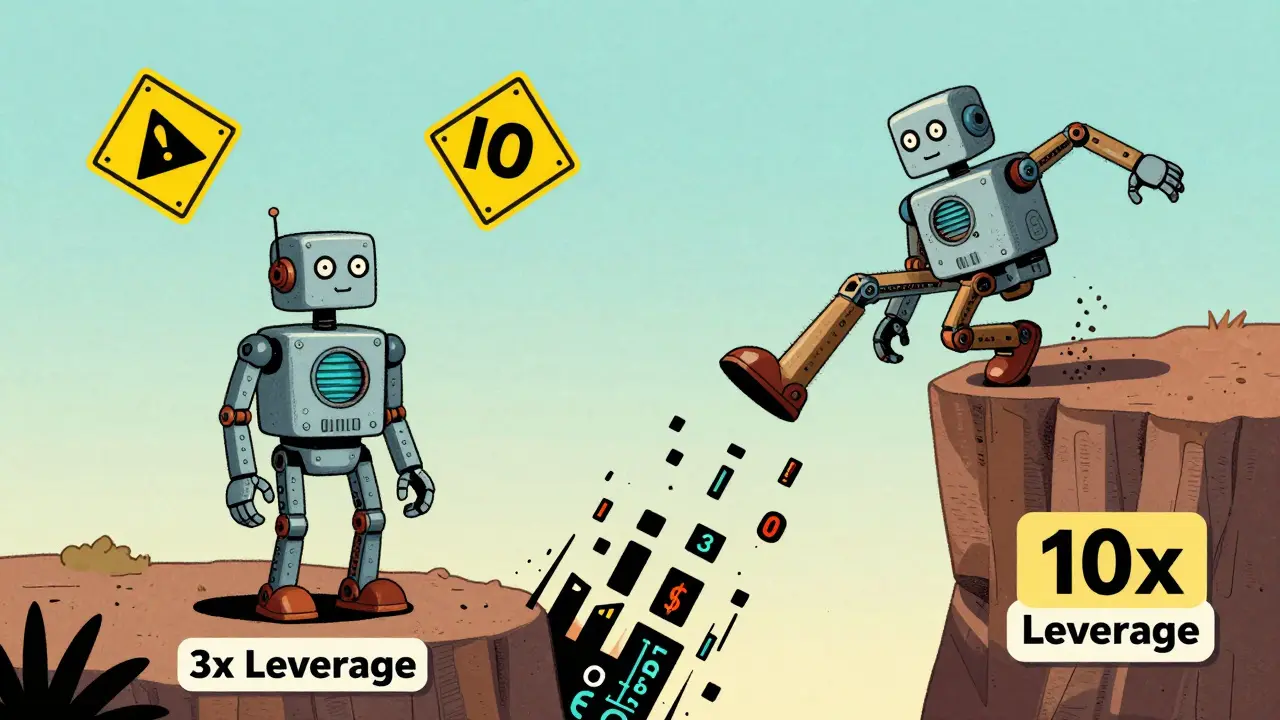
High leverage is the fastest way to get liquidated. It feels exciting because small price movements result in large percentage gains. But mathematically, it’s a trap. A position with 3x leverage requires a 33.3% adverse price movement to reach liquidation. A 10x leveraged position dies after just a 10% drop. In crypto, where daily swings of 5-10% are common, 10x leverage is essentially gambling.
Data supports the conservative approach. Backtesting from 2019 to 2023 showed that strategies using 3x leverage outperformed those using 10x leverage by 22.7% annually. Why? Because the 10x traders got wiped out repeatedly, forcing them to restart with smaller accounts or quit entirely. Lower leverage gives the market room to breathe. It allows you to stay in a trade through normal noise without being shaken out by temporary dips.
Consider the difference between traditional finance and crypto. Traditional brokers like Fidelity enforce strict rules, such as Regulation T, which mandates a 50% initial margin and 25% maintenance margin for equities. Crypto exchanges often allow up to 100x leverage. While this freedom is attractive, it exposes retail traders to extreme risks that institutional players mitigate with sophisticated hedging. As a retail trader, you must impose your own limits. Treat high leverage as a tool for experts who have deep liquidity buffers, not for everyday trading.
Setting Effective Stop-Loss Orders
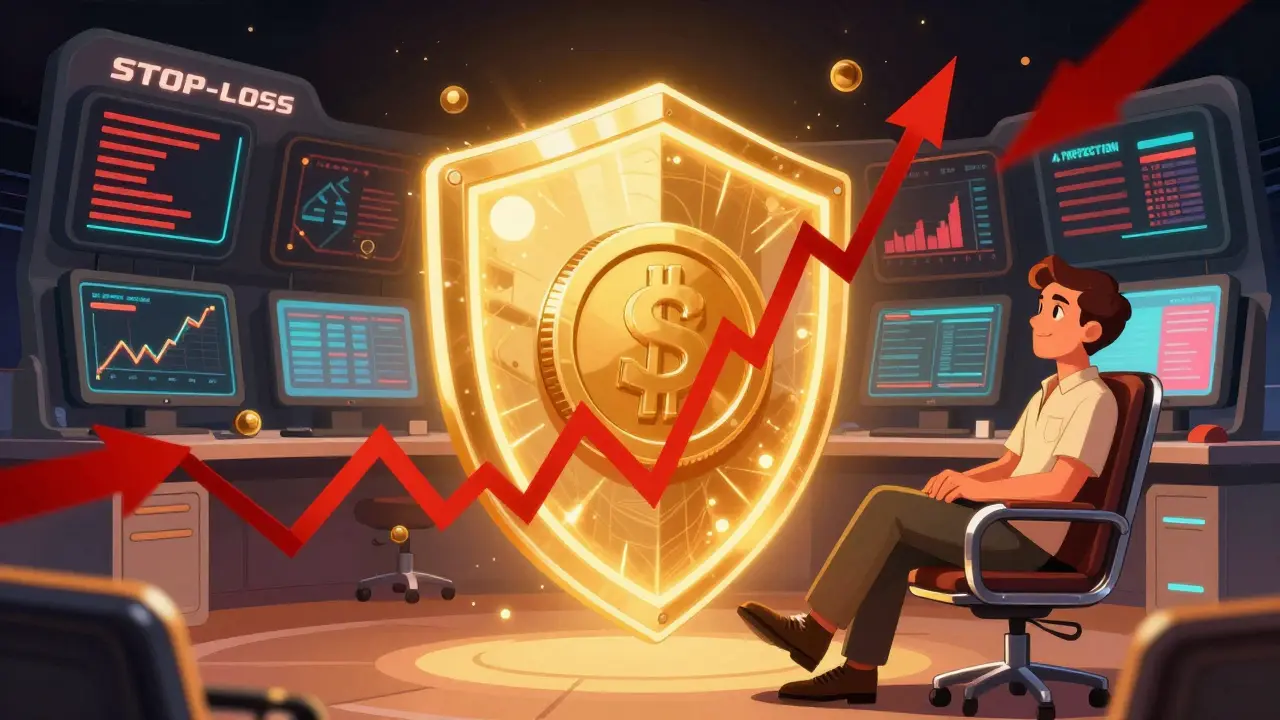
A stop-loss order is your best defense against liquidation. It’s an automatic instruction to close your position if the price hits a certain point. By setting a stop-loss, you control exactly how much you lose, rather than letting the exchange decide based on their liquidation engine.
Where should you place it? Research from the CFA Institute suggests placing stop-losses at 70-80% of your maintenance margin level. This creates a buffer zone. If your liquidation price is $50,000 for Bitcoin, and your maintenance margin triggers around $52,000, set your stop-loss at $53,000. This ensures you exit with some capital remaining, even if the market crashes hard.
However, stop-losses aren’t foolproof. During flash crashes, liquidity can dry up instantly. In the May 2021 Bitcoin crash, 87% of stop-loss orders executed at prices 15-30% worse than their trigger levels due to liquidity gaps. This phenomenon, known as slippage, means your stop-loss might still result in a significant loss. To mitigate this, avoid placing stops at round numbers where everyone else does. Use limit orders instead of market orders for your stops if possible, though this carries the risk of not executing at all during extreme volatility.
Risk Management Protocols
Preventing liquidation isn’t just about one trade; it’s about your entire account health. The golden rule cited by MIT’s Dr. Alexander Lipton is simple: never risk more than 1-2% of your total account value on a single position. If you have $10,000 in your account, your maximum loss per trade should be $100 to $200. This might sound small, but it keeps you in the game. Traders who risk 5% per trade had a survival rate of only 38.2% over 1,000 simulated trades, compared to 94.7% for those risking 1-2%.
Diversification also plays a role. Don’t put all your margin into one asset. If Bitcoin crashes, Ethereum might hold steady or even rise. Spreading your exposure reduces the impact of a single catastrophic event. Additionally, monitor funding rates in perpetual futures contracts. These rates can eat into your profits or add to your costs over time, effectively reducing your available margin and bringing you closer to liquidation.
Use the tools provided by your exchange. Binance offers customizable margin call ratios and auto top-up features. Coinbase introduced a 'Liquidation Buffer' that provides an extra 5-15% price movement cushion. Margex uses MP Shield Technology to aggregate liquidity from multiple providers, reducing the chance of being liquidated by a fake spike on one exchange. Enable these features. They are designed to give you a second chance when the market turns ugly.
Choosing the Right Platform
Not all exchanges are created equal when it comes to protecting your capital. Some platforms prioritize speed and leverage, while others focus on stability and user protection. Your choice of platform directly impacts your liquidation risk.
| Exchange | Max Leverage | Liquidation Mechanism | Safety Features | Best For |
|---|---|---|---|---|
| Binance | Up to 125x | Auto-deleveraging & Insurance Fund | Real-time margin dashboard, Auto top-up | Active traders needing advanced tools |
| Coinbase | Up to 10x (Perps) | Tiered Maintenance Margin | Liquidation Buffer (5-15%) | Beginners seeking simplicity |
| Kraken | Up to 50x | Standard Margin Call | Strict solvency proof, Low fees | Security-conscious traders |
| Fidelity | 2x (Equities) | Regulation T Compliance | Conservative requirements, Delayed updates | Long-term investors in stocks |
If you trade frequently, Binance’s real-time updates every 300 milliseconds provide crucial visibility. For those new to margin, Coinbase’s buffer feature offers peace of mind. Avoid platforms with poor customer support or unclear liquidation policies. Check reviews on sites like Trustpilot, where users have reported sudden liquidations during volatility spikes on less regulated exchanges. Always verify if the exchange has an insurance fund to cover negative balances, ensuring you don’t owe money after a liquidation.
Psychological Discipline and Monitoring
Even with the best tools, human error remains the biggest cause of liquidation. Fear and greed drive traders to ignore warning signs. When a trade goes red, the instinct is to hope it comes back. Instead, you must act decisively. Add margin if you truly believe in the thesis, or cut losses immediately. Hesitation costs money.
Monitoring your positions is non-negotiable. Set alerts for price levels near your stop-loss and liquidation points. Don’t rely solely on mobile notifications; keep a desktop dashboard open. During major news events, such as central bank announcements or regulatory crackdowns, volatility spikes can happen in seconds. Being present allows you to react faster than automated systems sometimes can, especially if you choose to manually adjust your position size.
Education is also part of prevention. The learning curve for effective risk management takes 3-6 months of dedicated practice. Study order book depth to anticipate liquidity issues. Understand how funding rates affect your long-term holding costs. Join communities like Reddit’s r/BitMEX to learn from others’ mistakes. One user reported avoiding liquidation during the Silvergate collapse thanks to color-coded margin warnings. Learn from these real-world examples.
Future Trends in Liquidation Prevention
The industry is evolving to make margin trading safer. AI-driven risk management is becoming standard. Binance’s 'Advanced Margin Protection' uses machine learning to predict liquidation risk based on 17 volatility indicators, reducing events by 43% in beta tests. Coinbase plans to launch 'Liquidation Shield,' which automatically resizes positions to maintain solvency. These tools shift the burden from the trader to the algorithm, potentially saving accounts from emotional errors.
Regulatory pressure is also mounting. The CFTC has proposed capping leverage at 25x for US exchanges, down from 100x. This could reduce liquidation frequency by 62%. While lower leverage limits profit potential, they significantly enhance survivability. Institutional adoption of multi-exchange liquidity aggregation is another trend, preventing single-exchange manipulation from triggering mass liquidations. As a retail trader, staying informed about these changes helps you adapt your strategy to a safer, more regulated environment.
What is the safest leverage ratio for beginners?
For beginners, a leverage ratio of 2x to 3x is considered safest. This allows for significant market fluctuations without immediate liquidation. Higher leverage increases the risk of being wiped out by normal market noise.
Can I add margin to avoid liquidation?
Yes, adding margin increases your account equity and raises your liquidation price. However, this ties up more capital and doesn't change the underlying market direction. It should be used cautiously as part of a broader risk management plan.
Why did my stop-loss execute at a worse price?
This is called slippage. During high volatility or low liquidity, there may not be enough buyers/sellers at your stop-loss price. The order fills at the next available price, which can be significantly worse. Using limit orders or wider buffers can help mitigate this.
Is cross-margin safer than isolated margin?
Cross-margin uses your entire account balance as collateral, providing a larger buffer against liquidation. Isolated margin limits loss to the allocated amount. Cross-margin is safer for experienced traders who monitor their total exposure, while isolated margin protects the rest of your portfolio from a single bad trade.
How do funding rates affect liquidation risk?
In perpetual futures, funding rates are periodic payments between long and short traders. If you pay the funding rate regularly, it reduces your account balance, bringing you closer to the maintenance margin requirement. Ignoring these costs can lead to unexpected liquidation over time.