NFT Royalty Percentage Standards: A Guide to Creator Earnings
 Apr, 23 2026
| Marketplace | Typical Royalty Rate | Focus/Philosophy |
|---|---|---|
| Objkt (Tezos) | 17.5% | High creator support |
| Rarible | 15% | Strong artist compensation |
| OpenSea / Foundation | 10% | Industry balanced standard |
| Blur | 5% | Trader liquidity and speed |
How NFT Royalties Actually Work
At the heart of this system are Smart Contracts is self-executing contracts with the terms of the agreement directly written into lines of code on a blockchain. When an artist mints an NFT, they don't just upload a file; they program the rules of ownership. By embedding a royalty percentage into the contract, the creator instructs the blockchain to divert a slice of any future sale price back to their wallet. For most, the ERC-2981 is an Ethereum standard that provides a universal way for NFTs to signal their royalty information to any marketplace. Before this standard arrived on July 24, 2021, royalties were often "hard-coded" into specific marketplaces. If you sold your art on Platform A, you got paid; if it moved to Platform B, you were invisible. ERC-2981 created a standardized interface so that any wallet or marketplace can ask the NFT, "What is your royalty rate?" and receive a consistent answer. To visualize the math, let's look at a typical transaction. If an NFT sells for $1,000 with a 10% royalty and a 3% marketplace fee:- The Creator gets $100 (10% of $1,000).
- The Marketplace gets $30 (3% of $1,000).
- The Seller receives the remainder: $870.
The Strategic Balance of Percentage Rates
Setting your royalty rate isn't just about greed; it's a strategic decision. If you set your rate too high, you might discourage professional traders from flipping your work, which could actually lower the overall visibility and price floor of your collection. If you set it too low, you leave money on the table during massive price spikes. Different networks influence these choices. On Ethereum is the primary blockchain platform for high-value NFT collections and smart contract execution, collectors often view higher royalties as a badge of supporting the artist's long-term career. Conversely, on Polygon is a Layer 2 scaling solution for Ethereum that offers lower gas fees and faster transactions, the audience is often more price-sensitive. Creators here frequently drop their rates to ensure the assets keep moving, as high fees on a low-cost network can kill trading volume.The Enforcement Gap: A Major Hurdle
Here is the uncomfortable truth: the blockchain can define the royalty, but it can't always force the marketplace to pay it. While ERC-2981 tells a marketplace what the royalty *should* be, the actual payment happens at the application level. This means royalty enforcement is largely voluntary. This has led to a "race to the bottom." Platforms like Blur entered the market by offering lower or optional royalties to attract "whales" and professional flippers who care more about profit margins than artist support. This creates a scenario where an artist might mint a piece on Rarible with a 15% royalty, but if a buyer moves that piece to a platform that ignores those rules, the artist earns $0 from the resale. It's a digital cat-and-mouse game where technical standards are fighting against market incentives.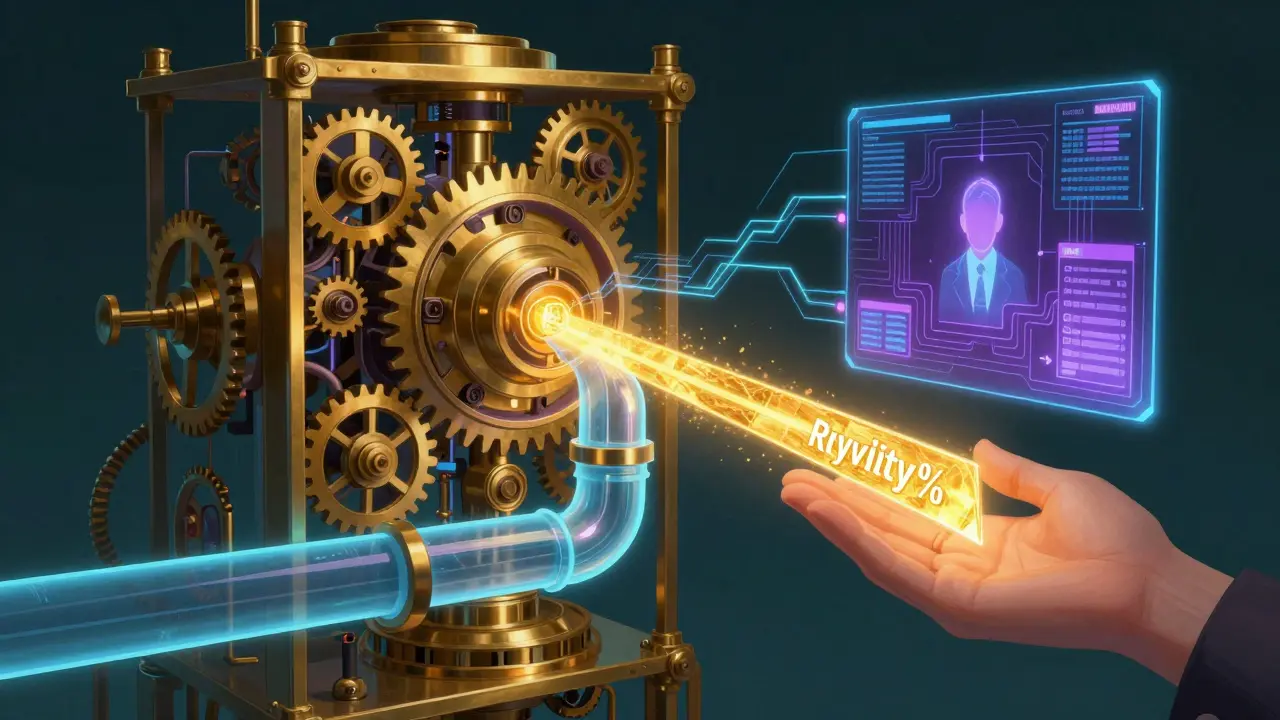
Real-World Successes and Scale
Despite the enforcement issues, the impact of royalties can be staggering. Take the artist Beeple. When his piece "Crossroads" was resold for $6.6 million, a 10% royalty meant he earned $660,000 from a single secondary transaction. That is a level of passive income virtually unheard of in the traditional art world. Then there is Yuga Labs is the creative studio behind the Bored Ape Yacht Club and Otherde Generation collections. They set a modest 2.5% royalty. While that seems low, the sheer volume of trades in a collection with a high floor price turns that small percentage into a massive, ongoing revenue stream that funds their entire ecosystem. For smaller creators, the value is in the scaling. An artist who sells a piece for $1,000 with a 7% royalty makes $70. If the artist's fame grows and that piece resells for $10,000, that same 7% becomes $700. The royalty acts as a hedge, ensuring the artist benefits from their own growth in popularity.Advanced Implementation and Collaborative Splits
Modern royalty setups are moving beyond a single wallet address. Through advanced smart contracts, creators can now implement "royalty splitting." This means that instead of all the money going to one person, the contract automatically divides the funds among a team. For example, a project might be coded to send 50% to the lead artist, 30% to the developer, and 20% to a community treasury. For those who minted NFTs before these standards existed, there are "wrapper contracts." These allow creators to burn their original tokens and wrap them in a new contract that supports ERC-2981. It's a technical workaround that allows old art to finally start earning secondary income.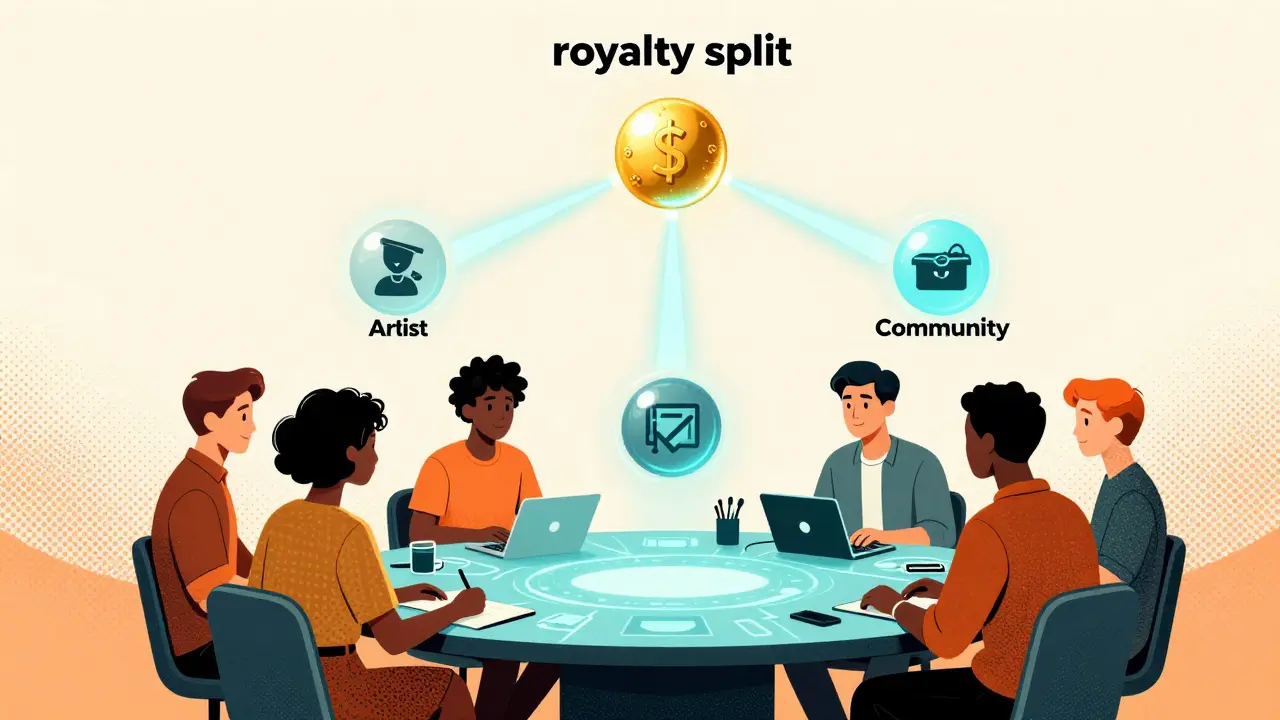
The Future of Digital Compensation
As we move toward 2026, the tension between trader efficiency and creator rights continues. We are seeing a shift toward more sophisticated blockchain-level enforcement-essentially making it impossible to transfer a token without the royalty being paid. While this is technically challenging across different chains, it's the only way to stop the voluntary-payment loophole. We also have to consider the legal side. In most countries, these royalty payments are taxable income. Because they arrive in cryptocurrency, creators are increasingly needing specialized accounting to track these sporadic windfalls. As the market matures, we'll likely see these standards evolve from simple percentages into more complex models, perhaps including tiered royalties that decrease as the price of the asset hits certain milestones.What is a typical NFT royalty percentage?
Most NFT royalties fall between 5% and 10%. However, this varies by platform; for example, Objkt often sees rates as high as 17.5%, while trader-focused platforms like Blur may hover around 5%.
Does ERC-2981 guarantee I will get paid?
No. ERC-2981 is a technical standard that allows your NFT to tell a marketplace what the royalty should be. However, the marketplace must actually choose to honor that request and execute the payment. It is not a forced blockchain-level lock.
Can I change my royalty percentage after minting?
Generally, no. Once a smart contract is deployed on the blockchain, it is immutable. Some specialized contracts allow for updates, but most require you to use a wrapper contract or burn the original token to implement a new royalty structure.
How are royalties calculated if there are marketplace fees?
Royalties and fees are typically calculated based on the total gross sale price. For a $100 sale with a 10% royalty and 3% fee, the creator gets $10 and the marketplace gets $3, regardless of the other's cut.
Why do some platforms offer 0% royalties?
Platforms that ignore royalties aim to attract professional traders and "flippers." By reducing costs, they increase trading velocity and volume, which attracts more users, even if it hurts the original artists.