Optimistic vs ZK-Rollups: The Definitive Layer 2 Comparison for 2026
 Jul, 19 2026
Imagine trying to send money across town, but the bank tells you it’ll take seven days to clear. Sounds ridiculous, right? Yet, that is exactly what happens when you try to withdraw funds from many popular Ethereum Layer 2 networks using Optimistic Rollup technology. You might think blockchain is all about instant speed, but if you’ve ever used a decentralized exchange or an NFT marketplace on Ethereum’s secondary networks, you know the reality can be frustratingly slow.
This isn’t just a minor inconvenience; it’s a fundamental architectural choice. The crypto world is currently split between two main ways to scale Ethereum: Optimistic Rollups and ZK-Rollups (Zero-Knowledge Rollups). Both promise cheaper transactions and faster speeds than the main Ethereum network, but they achieve this in wildly different ways. One assumes everything is honest until proven guilty, while the other uses heavy mathematics to prove honesty upfront. Understanding which one you are using-and why-can save you time, money, and headaches.
How Optimistic Rollups Work: The "Trust First" Approach
Optimistic Rollups, such as Arbitrum and Optimism, operate on a simple principle: assume validity. When a batch of transactions is processed off-chain, the system posts the data to Ethereum’s mainnet without verifying every single step immediately. It trusts that the transaction is correct.
If someone thinks a transaction is fraudulent, they have a specific window-usually exactly 7 days-to challenge it. This is called the fraud proof period. During these 168 hours, your funds are essentially locked. If no one challenges the transaction, it becomes final. If someone does challenge it and proves fraud, the invalid state is reverted, and the challenger is rewarded.
This approach has massive benefits for developers. Because Optimistic Rollups are often EVM-equivalent (meaning they speak the same language as Ethereum), you can copy-paste your existing smart contracts from Ethereum mainnet with almost zero changes. This ease of use is why platforms like Uniswap and Aave grew so quickly on Arbitrum and Optimism. According to Dune Analytics data from early 2025, Optimistic Rollups still hold the majority of Total Value Locked (TVL) in the Layer 2 space, controlling roughly 58% of the market.
However, the trade-off is brutal for users who need liquidity. That 7-day wait is not a suggestion; it’s a hard-coded security feature. As Chainalysis noted in late 2024, nearly 18% of users abandon withdrawal attempts simply because they get tired of waiting. For a gamer wanting to sell an NFT or a trader needing to move capital during a market crash, a week-long delay is unacceptable.
How ZK-Rollups Work: The "Prove First" Approach
ZK-Rollups, including projects like zkSync and StarkNet, take the opposite stance. They don’t trust anyone. Instead, they use complex cryptography-specifically Zero-Knowledge Proofs (like zk-SNARKs or zk-STARKs)-to mathematically verify that every transaction in a batch is valid before it ever hits the Ethereum mainnet.
Think of it like a sealed envelope. With Optimistic Rollups, everyone assumes the letter inside is real until someone opens it and finds it blank. With ZK-Rollups, a cryptographic stamp on the envelope proves the letter is real without anyone needing to read it. This allows for near-instant finality. Once the proof is verified on Ethereum, your funds are yours to move immediately, often within minutes or even seconds.
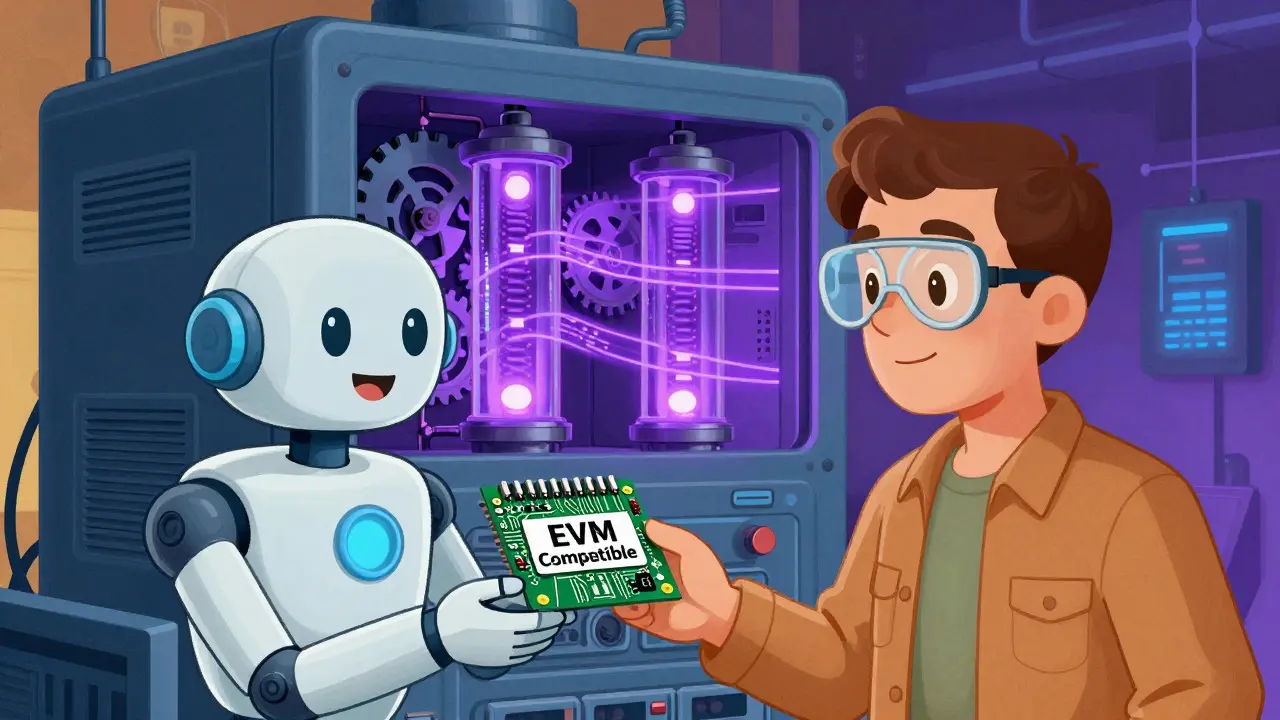
The downside? Complexity. Generating these proofs requires significant computational power. Early ZK-Rollups required developers to learn new programming languages like Cairo (for StarkNet) instead of the standard Solidity used on Ethereum. This created a high barrier to entry. However, the landscape has shifted dramatically in 2025. Newer iterations like zkSync Era now offer full EVM compatibility, meaning developers can deploy standard Ethereum contracts while still enjoying the security benefits of ZK technology.
Vitalik Buterin, co-founder of Ethereum, has repeatedly stated that ZK-Rollups represent the long-term future of scaling. Why? Because as hardware gets better, the cost of generating proofs drops, making them more efficient over time. In contrast, the 7-day wait of Optimistic Rollups doesn’t really go away unless the underlying mechanism changes entirely.
Head-to-Head: Performance and Costs
Let’s look at the numbers, because theory is nice, but gas fees and speed are what matter in your wallet.
| Feature | Optimistic Rollups | ZK-Rollups |
|---|---|---|
| Withdrawal Time | 7 Days (Standard) | Minutes to Hours |
| Average Gas Fee | $0.10 - $0.50 | $0.20 - $1.50 |
| Developer Ease | High (Native EVM) | Medium-High (Improving EVM support) |
| Privacy | Low (Data exposed on L1) | High (Cryptographic obfuscation) |
| Hardware Requirements | Standard Cloud Servers | High-end GPUs/RAM |
In terms of raw transaction costs, Optimistic Rollups currently have the edge. Because they don’t need to generate heavy cryptographic proofs for every batch, their overhead is lower. For simple token transfers, you might pay pennies on Arbitrum compared to a few cents on a ZK chain. However, this gap is closing. Research from UC Berkeley in early 2025 showed that for complex smart contract interactions, ZK-Rollups are becoming 25% more cost-efficient due to better data compression.
But the real winner here is user experience regarding withdrawals. If you are moving large amounts of capital, the ability to bridge back to Ethereum in an hour rather than a week is invaluable. This is why institutional players and privacy-focused applications are increasingly favoring ZK solutions. The EU’s MiCA regulatory framework, for instance, views ZK-Rollups more favorably because their cryptographic verifiability offers clearer audit trails, a crucial factor for compliance.
Security and Trust Models
Security is where the philosophical divide gets interesting. Optimistic Rollups rely on economic incentives. Validators stake ETH to secure the network. If they cheat, they lose their stake. This works well as long as there are enough honest validators watching the network. Barry Whitehat, a prominent Ethereum researcher, warned in early 2025 that if validator participation drops below a certain threshold (around 33%), the security model could degrade. It’s a game-theoretic vulnerability.
ZK-Rollups, on the other hand, rely on mathematical truth. A valid proof cannot be faked. This removes the reliance on human behavior or economic stakes for basic validity. However, ZK systems introduce a new risk: the setup ceremony and the complexity of the code itself. Bugs in the proof generation software can lead to catastrophic failures. We saw glimpses of this in January 2025 when a bottleneck in zkSync’s proof generation temporarily spiked transaction costs by 300%. While the network didn’t fail, the user experience suffered.
Conversely, Optimistic Rollups faced their own scare in late 2024 when a flaw in a fraud proof detection mechanism caused a 4-hour network pause on Optimism. Both systems are battle-tested, but they fail in different ways. Optimistic fails due to coordination or incentive issues; ZK fails due to computational or cryptographic bugs.

Which One Should You Use?
So, which side are you on? The answer depends entirely on what you are trying to do.
Choose Optimistic Rollups if:
- You are a developer deploying a DeFi protocol quickly. The EVM compatibility means you can launch in weeks, not months.
- You prioritize low gas fees for simple transactions and don’t mind waiting a week to withdraw large sums.
- You want to join the largest existing ecosystem. Projects like Arbitrum and Optimism have deeper liquidity and more integrated dApps right now.
Choose ZK-Rollups if:
- You need fast finality. Gaming, NFT trading, and high-frequency trading require instant settlement.
- Privacy is a concern. ZK technology inherently obscures transaction details, offering better protection against surveillance.
- You are building for the long term. As hardware improves, ZK costs will drop further, and the technology is widely seen as the endgame for Ethereum scaling.
It’s worth noting that the lines are blurring. Projects like Linea are experimenting with hybrid models, and upgrades like Arbitrum’s Nova aim to reduce withdrawal times significantly. By 2027, experts predict ZK-Rollups could capture 60% of the market share as proof generation becomes cheaper. But for today, both technologies coexist, serving different needs.
The Future: Convergence and Hybrid Solutions
We are heading toward a future where you won’t have to choose. The industry is moving toward "modular blockchains," where the execution layer (where transactions happen) is separated from the settlement layer (where security is enforced). In this model, a dApp might execute on an Optimistic Rollup for cheap development but settle on a ZK-proof for security.
Ethereum’s upcoming Pectra upgrade, scheduled for mid-2025, will introduce standardized blob transactions that benefit both types of rollups, potentially cutting ZK costs by another 40%. Furthermore, innovations like recursive proof composition are making ZK proofs lighter and faster. StarkWare’s recent Panther upgrade already reduced proof generation time by 70% in a single quarter.
For the average user, this means less friction. Imagine swapping tokens on a ZK-powered exchange and withdrawing to your bank account in minutes, with fees lower than a cup of coffee. That is the promise of Layer 2 scaling. Whether through Optimistic trust or ZK mathematics, the goal remains the same: making Ethereum usable for billions of people, not just thousands.
What is the main difference between Optimistic and ZK-Rollups?
The core difference lies in how they verify transactions. Optimistic Rollups assume transactions are valid and only check them if challenged, leading to a 7-day withdrawal period. ZK-Rollups use cryptographic proofs to verify transactions instantly, allowing for near-immediate withdrawals but requiring more computational power.
Are ZK-Rollups more secure than Optimistic Rollups?
They offer different types of security. ZK-Rollups provide mathematical certainty that transactions are valid, removing reliance on human validators. Optimistic Rollups rely on economic incentives (staking) to ensure honesty. While ZK is theoretically more robust against collusion, it is more vulnerable to software bugs in the proof generation process.
Why do I have to wait 7 days to withdraw from Optimism or Arbitrum?
This is the "fraud proof" window. Since Optimistic Rollups post transactions without immediate verification, they need time for anyone to spot and challenge invalid data. If no one challenges the transaction within 7 days, it is considered final. This is a security feature to prevent bad actors from stealing funds.
Which Layer 2 is best for developers in 2026?
It depends on your goals. For rapid deployment of standard DeFi apps, Optimistic Rollups like Arbitrum remain easier due to mature tooling. However, ZK-Rollups like zkSync and StarkNet have improved significantly with EVM compatibility, making them viable for most developers while offering better long-term scalability and privacy features.
Do ZK-Rollups offer better privacy?
Yes. Because ZK-Rollups use zero-knowledge proofs, they can hide the specific details of a transaction while still proving it is valid. Optimistic Rollups typically expose full transaction data on the Ethereum mainnet, making them less private.