RWA Tokenization Market Size: Current Valuation, Growth Drivers, and 2030 Projections
 Jan, 14 2026
The RWA tokenization market didn’t just grow in 2025-it exploded. By October 24, 2025, the total value of real-world assets tokenized on blockchain hit $34.86 billion. That’s up from $24 billion just four months earlier. In less than a year, it added more than $10 billion in value. This isn’t a slow ramp-up. It’s a full-speed takeover of traditional finance by digital ownership.
What Exactly Is RWA Tokenization?
RWA tokenization means turning something real-like a building, a government bond, or a gold bar-into a digital token on a blockchain. Each token represents a share of ownership. Instead of buying a whole property worth $1 million, you can buy a token worth $10 that gives you a tiny slice of it. That’s the core idea: breaking down big, illiquid assets into small, tradeable pieces. This isn’t sci-fi. It’s happening right now. BlackRock’s BUIDL token, representing U.S. Treasury bonds, hit $2.85 billion in value by late 2025. Tether’s XAUT, a gold-backed token, crossed $1.6 billion. These aren’t experiments. They’re institutional products with real money behind them.The Big Players Driving Growth
Three asset classes dominate the RWA market: private credit, U.S. Treasuries, and commodities. Private credit leads the pack at $14.5 billion, making up 58% of the total. These are loans to private companies-usually not available to regular investors. Tokenization lets retail and institutional investors buy fractions of these loans, earning higher yields than traditional bonds. The appeal? Steady income with less volatility than stocks. U.S. Treasuries come second at $7.4 billion, or 34% of the market. BlackRock’s BUIDL is the biggest player here. Tokenized Treasuries offer the same safety as government bonds but with 24/7 trading, instant settlement, and lower minimums. No more waiting days for settlement. No more $10,000 minimums. Now you can trade U.S. debt like crypto. Commodities are the fastest-growing segment. Gold-backed tokens like XAUT surged 72% in just 30 days. Total commodity tokenization hit $3.53 billion. Silver, oil, and even carbon credits are starting to follow. The demand? Investors want exposure to hard assets without the hassle of storage, insurance, or physical delivery. Real estate is still small at $1.2 billion, but it’s growing. DAMAC’s $1 billion tokenized property project in Dubai is one of the largest. Imagine owning a piece of a luxury Dubai apartment from your phone, no matter where you live.Why Is This Happening Now?
It’s not just tech. It’s regulation, economics, and timing. The U.S. GENIUS Act, passed in early 2025, gave legal clarity to tokenized assets. For the first time, institutions knew exactly how to comply. No more legal gray zones. No more fear of regulators shutting things down. That’s why BlackRock, J.P. Morgan, and Fidelity jumped in. The economics are too good to ignore. Tokenization cuts settlement times from days to minutes. It reduces transaction costs by 30-50%. It cuts the minimum investment for high-value assets from $100,000 to $10. It opens global markets to anyone with an internet connection. And the data proves it. The market grew 380% over three years. Then it grew 260% in just the first half of 2025. Then it jumped 45% in one quarter. That’s not linear growth. That’s exponential.
Who’s Buying and Selling?
As of late October 2025, there were 227 issuers-companies and funds creating these tokens-and nearly 500,000 asset holders. That’s up 7% in just a month. Institutions still dominate. Hedge funds, asset managers, and family offices account for most of the volume. But retail is catching up fast. Platforms like Superstate and Anemoy now let individual investors buy tokenized Treasuries and private credit with as little as $5. The shift is real: finance is moving from closed-door deals to open digital markets. You don’t need to be a billionaire to invest in a piece of a $500 million commercial building. You just need a wallet and a compliant exchange.What’s Next? Projections Through 2030
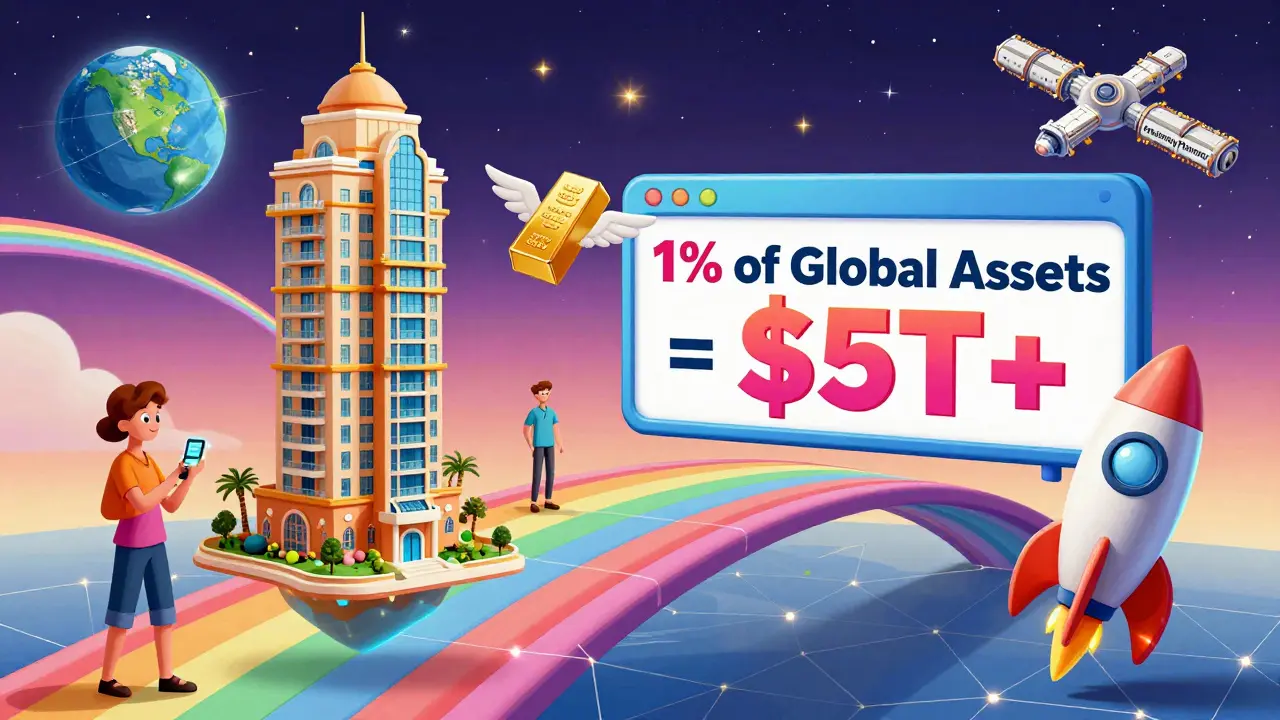
Predictions vary wildly-but they all agree on one thing: this market will be massive. McKinsey says $2-4 trillion by 2030. That’s conservative. BCG says $16 trillion. Standard Chartered says $30 trillion by 2034. Antier Solutions and CoinLaw both land around $18.9 trillion by 2033. Why such a big range? It depends on how fast regulation catches up globally. The U.S. is ahead. The EU is moving slower. Asia is still testing. If major economies align on rules, adoption skyrockets. The most realistic path? Even if only 1% of global real estate, bonds, and private credit get tokenized, we’re talking $5-10 trillion. That’s not speculation. That’s math.