Crypto Activity: What’s Really Happening in Blockchain Right Now
When you hear "crypto activity," you might think of wild price charts or viral memecoins—but real crypto activity, the measurable actions users take on blockchain networks, like trading, staking, or claiming tokens. Also known as on-chain behavior, it reveals who’s actually using the tech, not just speculating on it. Most people think volume equals health, but that’s not true. A coin can have high trading volume and still be dead—like Poupe (POUPE), with $3,560 in market cap and almost no trades. Real crypto activity means people are using a platform, not just flipping tokens.
Look at what’s driving real movement: blockchain transactions, the secure, math-based proof that someone owns and moves their crypto. Also known as on-chain transfers, they’re verified by digital signatures and kept forever on public ledgers. That’s why Uniswap v2 on Arbitrum is growing—users swap tokens with low fees and fast confirmations, and every trade leaves a trace. Meanwhile, in Iran, $4.18 billion moved out of the country using crypto because banks failed. That’s not speculation—it’s survival. And in Bangladesh, people trade USDT anyway, even though it’s illegal, because there’s no other way to protect their money.
Then there’s crypto airdrop, free tokens given to users for completing simple tasks, often to bootstrap a new project. Also known as token distribution events, they’re everywhere—but most are traps. TOPGOAL’s Footballcraft airdrop asked users to do nine steps. Most quit. FEAR’s NFT airdrop promised rewards but never launched a game. And Unbound’s "SuperHero NFT airdrop" doesn’t exist—it’s a scam rumor. Real airdrops come from projects with working products, not hype.
And then there’s the quiet engine behind it all: the liquidation engine, the automated system that shuts down risky leveraged trades when collateral drops too low. Also known as auto-deleveraging, it’s what wipes out traders who don’t understand risk. You see it on Vauld, where users lost everything because the platform couldn’t handle margin calls. You see it on DeepBook Protocol, where active traders rely on tight spreads and low fees to avoid getting liquidated. This isn’t theory—it’s daily reality for anyone using leverage.
Some of this activity is legal. Portugal still lets you trade crypto tax-free. Norway never gave miners tax breaks—they just have cheap power. But in Myanmar and Bangladesh, trading crypto means risking your bank account, your freedom, even your jail time. Crypto activity doesn’t happen in a vacuum. It’s shaped by laws, economics, and desperation.
Below, you’ll find real stories—not guesses. From how digital signatures keep your coins safe, to why a dead token like Vital Network still shows up on CoinMarketCap, to what’s actually working on the Sui blockchain. This isn’t about what’s trending. It’s about what’s happening—and who’s really in control.
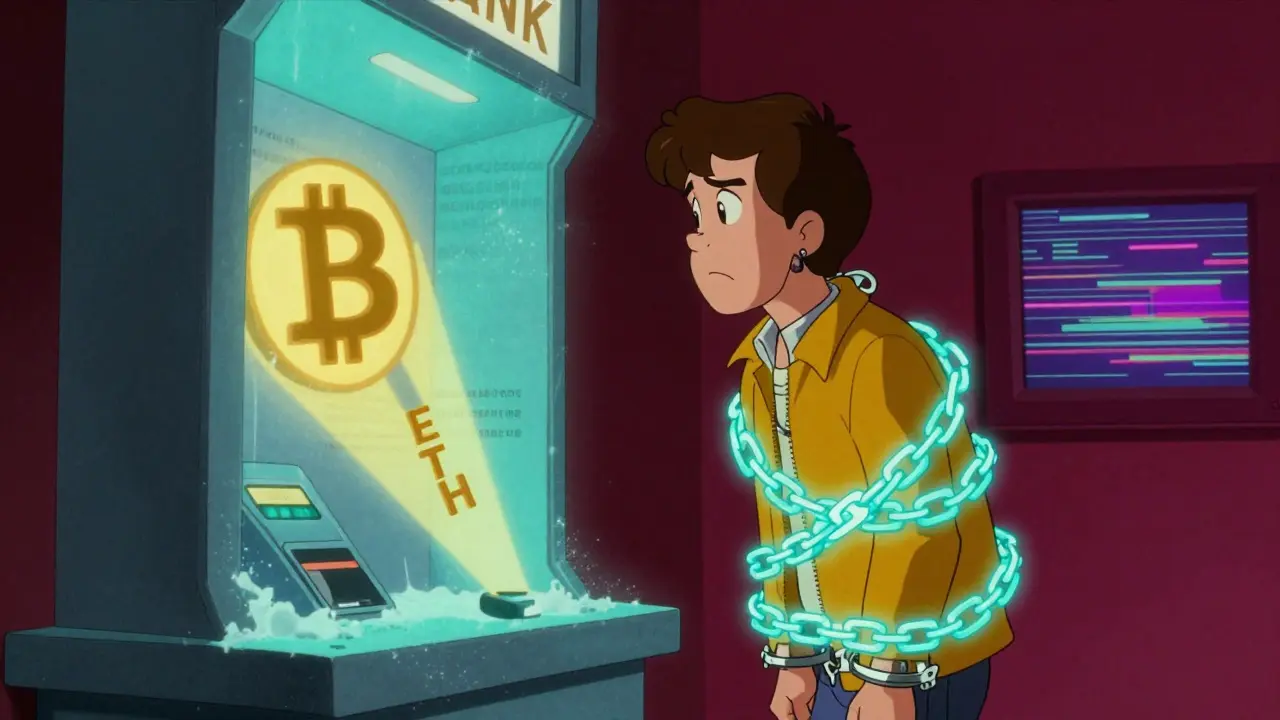
In 2025, your bank can freeze your account just because you received crypto from a suspicious address - even if you had no idea. Here’s how it works, who’s affected, and how to protect yourself.
More