Understanding Block Structure in Cryptocurrency Networks: The Anatomy of a Blockchain
 Jun, 24 2026
Imagine you are trying to send money to a friend, but instead of using a bank, you are shouting the transaction details into a crowded room. Everyone in that room writes it down in their own notebook. Now, imagine those notebooks aren't just loose pages; they are bound books where every new page is glued to the previous one with super-strong adhesive. If someone tries to rip out a page or change a number on an earlier page, the glue breaks, and everyone sees it.
That "glue" and those "pages" are what we call blocks in cryptocurrency networks. They are the fundamental building units of blockchain technology. Without understanding how these blocks are structured, you cannot truly grasp why Bitcoin, Ethereum, and other cryptocurrencies are secure, transparent, and immutable. It’s not magic; it’s computer science architecture designed to trust math over people.
The Two Halves of a Block
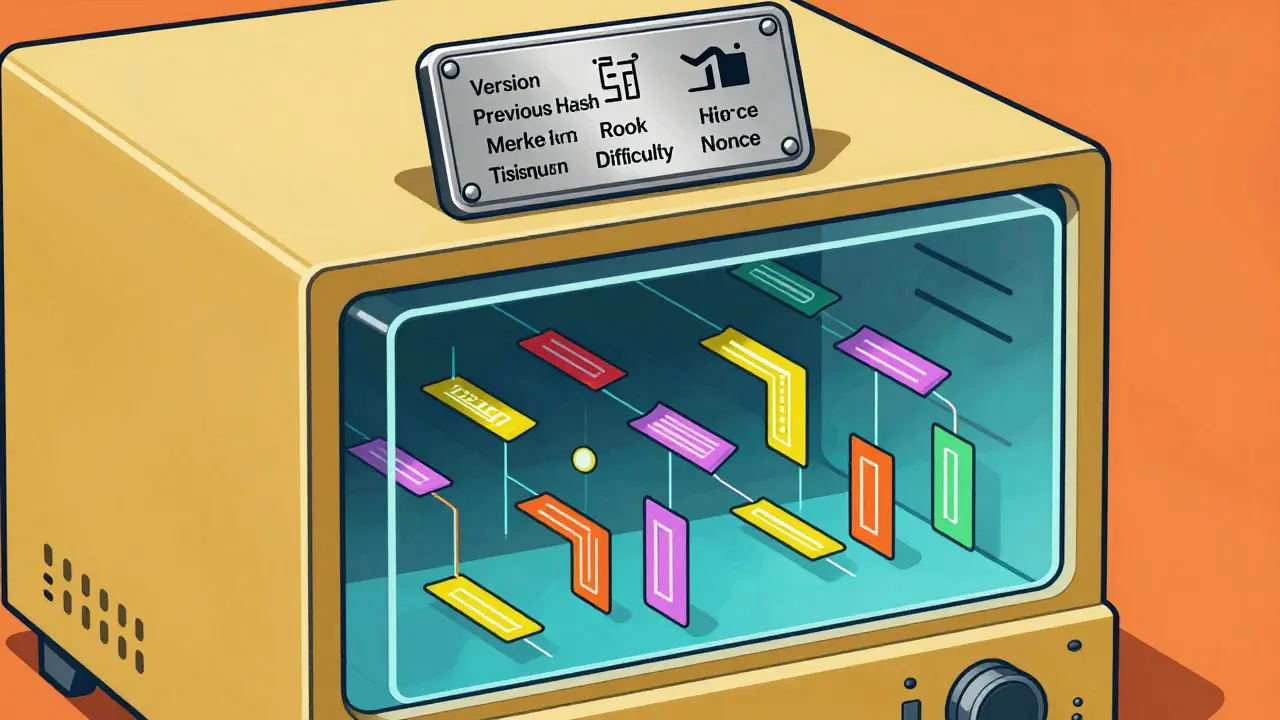
Every block in a cryptocurrency network is essentially a digital container. But it isn’t just a random pile of data. It has a very specific, rigid anatomy divided into two main parts: the block header and the transaction data (often called the body). Think of the header as the book’s cover and metadata, while the body contains the actual story-the transactions.
This separation is crucial for efficiency. The header is small and fixed in size, allowing nodes (computers on the network) to quickly verify the chain’s integrity without downloading every single transaction detail immediately. The body holds the heavy lifting: who sent what to whom.
| Component | Size/Type | Purpose |
|---|---|---|
| Block Header | 80 bytes (in Bitcoin) | Contains metadata, cryptographic links, and mining data. |
| Transaction Counter | 1-9 bytes | Tells the node how many transactions are in the block. |
| Transactions List | Variable (up to block limit) | The actual data: sender, receiver, amount, signatures. |
Decoding the Block Header
The block header is the most critical part for security. In Bitcoin, this header is exactly 80 bytes long. It doesn’t contain the transaction amounts or addresses directly. Instead, it contains pointers and proofs. Let’s break down the six fields inside this header, because each one plays a specific role in keeping the network honest.
- Version: A 4-byte field indicating which version of the protocol rules were used to create this block. This allows the network to upgrade over time. If a miner tries to submit a block with an outdated or invalid version, nodes will reject it.
- Previous Block Hash (hashPrevBlock): This is the 32-byte fingerprint of the block that came before it. This is the "glue." By including the hash of the previous block, the current block cryptographically locks itself to history. You cannot change the previous block without changing its hash, which would then invalidate the current block, and so on, all the way back to the start.
- Merkle Root (hashMerkleRoot): Another 32-byte field. This is a single hash that summarizes every single transaction in the block’s body. We’ll dive deeper into Merkle trees below, but think of this as a checksum for the entire list of transactions. If even one bit of data in any transaction changes, this root hash changes completely.
- Timestamp: A 4-byte field recording when the block was created. This helps maintain chronological order and ensures blocks aren’t being dated from the future or too far in the past, which could disrupt consensus mechanisms.
- Difficulty Bits: A 4-byte field that tells miners how hard the puzzle needs to be. In Proof of Work systems like Bitcoin, the network adjusts this difficulty every 2,016 blocks to ensure new blocks are found roughly every 10 minutes, regardless of how much computing power joins the network.
- Nonce: A 4-byte number that miners change repeatedly. This is the variable in the equation. Miners tweak this number millions of times per second until the resulting hash of the entire header meets the difficulty target. Once found, the nonce proves that significant computational work was performed.
The Magic Number and Block Size
Before the header, there are often additional structural elements depending on how the data is serialized. For example, in Bitcoin’s wire format, you’ll see a magic number (a 4-byte field, typically 0xD9B4BEF9 for mainnet). This acts like a file signature, telling the software, "Hey, this data stream is indeed a Bitcoin block, not some random noise."
Then comes the block size field. This sets the cap on how much data the block can hold. Bitcoin famously limits this to 1 megabyte (MB) per block. Why? To prevent network congestion and keep nodes lightweight enough for regular computers to run. However, this limit creates a trade-off: fewer transactions fit in each block, leading to higher fees during busy times. Other chains, like Litecoin or Ethereum, have different size parameters or dynamic gas limits to handle throughput differently.
Inside the Body: Transaction Data
Now let’s look at the body. This is where the value moves. The first thing you’ll notice is that the first transaction in almost every block is special. It’s called the Coinbase Transaction (or generation transaction).
This transaction has no inputs-it doesn’t spend existing coins. Instead, it creates new ones. It awards the block subsidy (newly minted cryptocurrency) and collects the transaction fees from all other transactions in the block. The miner specifies their own wallet address here to receive the reward. After the coinbase transaction, the rest of the block contains standard user transactions.
Each standard transaction includes:
- Inputs (Txins): References to previous outputs that the sender owns. This proves they have the funds.
- Outputs (Txouts): Where the funds are going. Each output specifies an amount and a locking script (usually a public key hash) that only the recipient can unlock.
- Signatures: Cryptographic proof that the owner of the input funds authorized this transfer.
- Lock Time: An optional field that prevents the transaction from being valid until a certain block height or timestamp. This is useful for advanced contracts or preventing double-spends in specific scenarios.
In modern Bitcoin, thanks to Segregated Witness (SegWit), signature data is moved outside the main block structure into a "witness" area. This technically increases the effective block space without breaking the 1MB legacy limit, improving scalability and fixing transaction malleability issues.
The Merkle Tree: Efficient Verification
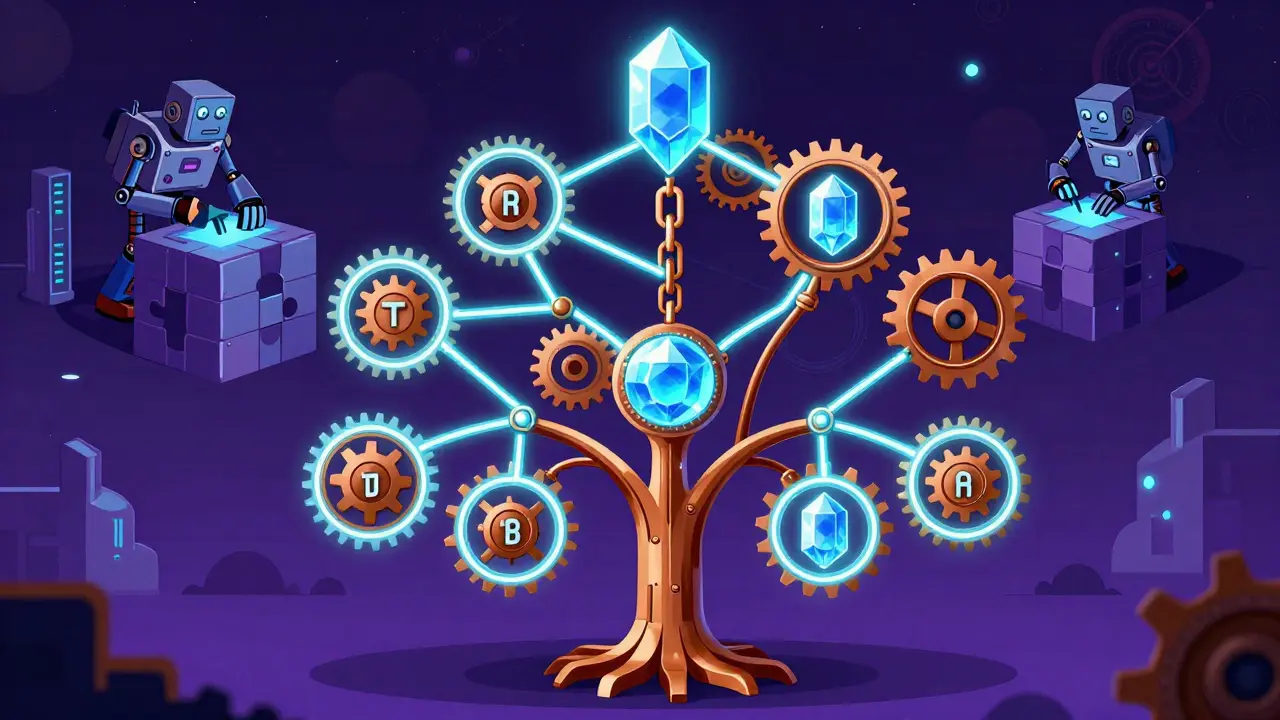
You might wonder: how does the network verify thousands of transactions quickly? Enter the Merkle Tree. This is a binary tree structure where every leaf node is a hash of a transaction. These pairs are hashed together, and the process repeats up to a single root hash-the Merkle Root mentioned in the header.
This structure is brilliant for two reasons. First, it provides extreme data integrity. Changing one transaction changes its leaf hash, which changes its parent hash, all the way up to the root. Second, it enables Simplified Payment Verification (SPV). Lightweight wallets don’t need to download the entire blockchain. They only need the block headers and the specific branch of the Merkle tree proving their transaction exists. This allows your phone to verify a payment without storing terabytes of data.
How Blocks Are Created and Linked
So, how does a block go from a collection of pending transactions to a permanent record? It starts with broadcasting. When you send crypto, your transaction goes into a pool of unconfirmed transactions (the mempool). Miners or validators pick transactions from this pool, usually prioritizing those with higher fees.
They bundle these transactions into a candidate block. Then, the race begins. In Proof of Work (PoW) networks like Bitcoin, miners compete to find a valid nonce. They hash the block header with different nonces until the result is lower than the network’s difficulty target. This requires immense energy and computing power. Once a miner finds the solution, they broadcast the block to the network.
Other nodes receive the block and perform checks: Is the signature valid? Do the inputs exist? Does the Merkle root match the transactions? Is the difficulty correct? If everything checks out, they add the block to their copy of the ledger. In Proof of Stake (PoS) systems like Ethereum, validators are chosen pseudo-randomly to propose blocks based on the amount of cryptocurrency they’ve locked up as collateral, rather than solving puzzles. The logic of verification remains similar, but the selection mechanism differs.
Why This Structure Matters
Understanding block structure isn’t just academic trivia. It explains the core properties of cryptocurrency:
- Immutability: Because each block contains the hash of the previous one, altering a past transaction requires re-mining that block and all subsequent blocks. As the chain grows, this becomes computationally impossible for anyone without controlling majority of the network’s power.
- Transparency: All transaction data in the body is public. Anyone can inspect the inputs, outputs, and amounts. Privacy comes from pseudonymity (wallet addresses), not secrecy of data.
- Consensus: The strict rules of block structure mean all nodes agree on what is valid. There is no central server deciding truth; the structure itself enforces agreement.
Whether you are a developer building dApps, an investor analyzing network health, or a user concerned about security, knowing how blocks are built gives you insight into the resilience of the system. It’s a design where code replaces trust, and mathematics secures value.
What is the difference between a block header and block body?
The block header is a small, fixed-size section (80 bytes in Bitcoin) containing metadata like the previous block hash, timestamp, and nonce. It is used for linking blocks and verifying chain integrity. The block body contains the actual transaction data, including sender/receiver addresses and amounts. The header points to the body via the Merkle root, allowing efficient verification without processing all transaction details immediately.
Why is the 'nonce' important in a block?
In Proof of Work cryptocurrencies, the nonce is a variable number that miners change repeatedly to produce a block hash that meets the network's difficulty target. Finding the correct nonce proves that computational work was performed, securing the network against spam and attacks. It is the core mechanism of mining.
What is a Coinbase transaction?
The Coinbase transaction is the first transaction in every new block. Unlike regular transactions, it has no inputs. Instead, it generates new cryptocurrency (the block reward) and collects transaction fees. It pays the miner or validator who successfully added the block to the chain.
How does the Merkle tree improve blockchain efficiency?
The Merkle tree hashes all transactions in a block into a single root hash stored in the header. This allows nodes to verify the integrity of all transactions by checking just one hash. It also enables lightweight wallets to prove a transaction exists without downloading the entire blockchain, saving storage and bandwidth.
Can the size of a block change?
Yes, block size limits vary by cryptocurrency. Bitcoin has a base limit of 1 MB, though SegWit effectively increases capacity. Ethereum uses a dynamic gas limit rather than a strict byte size. Some newer chains have larger blocks to handle more transactions per second. Changes to block size usually require network consensus or soft/hard forks.