What is Lucky Block v1 (LBLOCK)? Token Analysis, Risks, and V2 Upgrade
 Jun, 6 2026
Imagine buying a ticket to a lottery where the results are written in code, impossible to cheat, and settled instantly on the blockchain. That was the promise of Lucky Block v1, also known as LBLOCK, a cryptocurrency token that powers a decentralized gaming and lottery ecosystem. Launched in 2021, it aimed to disrupt traditional gambling by offering transparency through smart contracts. But if you are looking at LBLOCK today, you might notice something strange: the price is practically zero, trading volume is ghostly low, and major exchanges have largely ignored it. Why did this once-hyped project fade into the background? And more importantly, is there still any value left in holding or buying the V1 token?
To understand where LBLOCK stands now, we need to look past the marketing hype and examine the hard data. This isn't just about what the token *is*; it's about what happened to it. We will break down the technical reality of the V1 token, compare it with its successor, and analyze whether this asset holds any weight for investors in mid-2026.
The Core Concept: Blockchain Meets Lottery
At its heart, Lucky Block is not just a coin; it is a utility token designed for a specific purpose. The platform operates as a multifaceted digital asset serving gaming, lottery, and betting systems. When you use LBLOCK, you aren't just speculating on price action like you would with Bitcoin or Ethereum. You are participating in an ecosystem that integrates cryptocurrency transactions with gaming experiences.
The core value proposition centers on fairness. Traditional lotteries are black boxes. You buy a ticket, hope for the best, and trust the operator. Lucky Block uses blockchain protocols to make every transaction verifiable. The inherent characteristics of blockchain, such as its distributed nature and immutability, provide a foundation that ensures all transactions and gaming outcomes are auditable. In theory, this fosters trust because users can mathematically verify that the odds weren't rigged after the fact.
However, being "fair" doesn't automatically mean being "popular." For a crypto gaming platform to succeed, it needs liquidity, active users, and seamless accessibility. This is where the story of Lucky Block gets complicated.
V1 vs. V2: The Critical Distinction
If you are researching Lucky Block, you will quickly run into two different tokens: V1 and V2. Confusing these two is the most common mistake new users make. They are not interchangeable, and they serve very different purposes in the current market landscape.
| Feature | Lucky Block V1 (LBLOCK) | Lucky Block V2 |
|---|---|---|
| Blockchain Network | Binance Smart Chain (BNB Chain) | Ethereum (ERC-20) |
| Primary Use Case | Legacy gaming, lower fees | Main platform operations, higher security |
| Liquidity & Listings | Very Low / DEX only | Higher / Wider exchange support |
| Transaction Speed | Fast | Variable (depends on Ethereum congestion) |
| Current Market Status | Negligible activity | Active development focus |
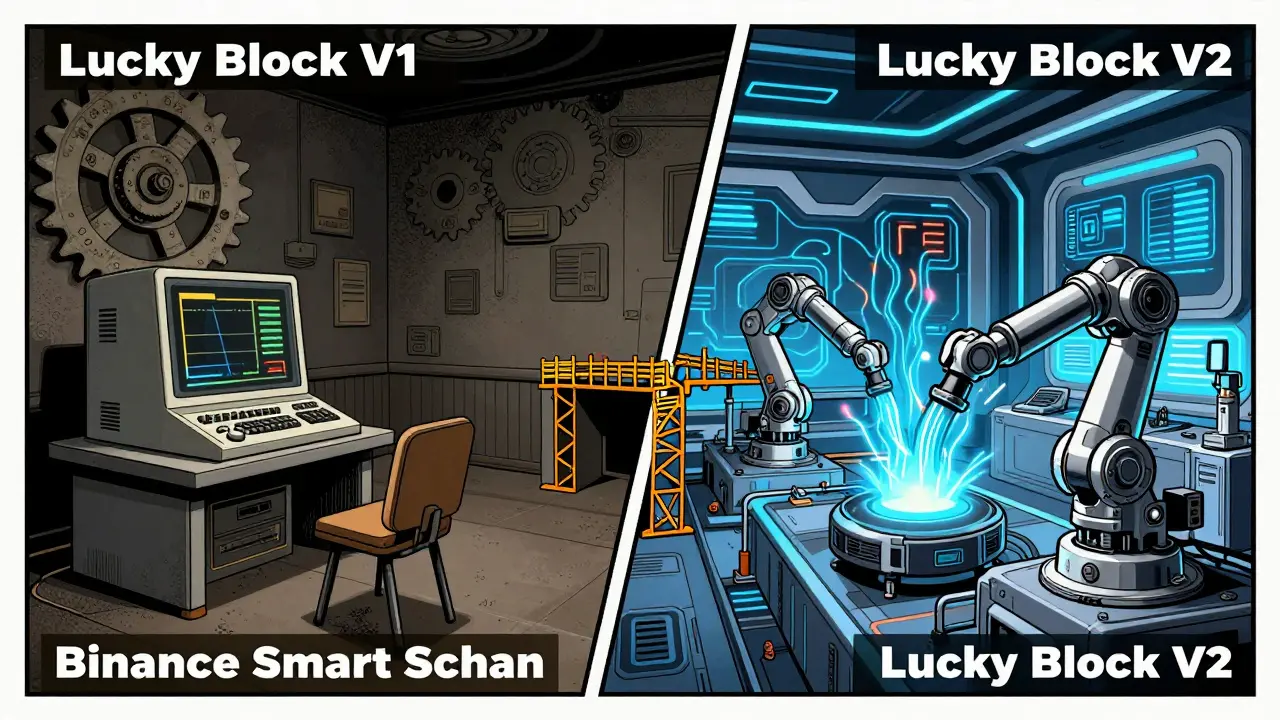
Lucky Block V1 was launched on the Binance Smart Chain (BSC). At the time, BSC was attractive because it offered lower transaction fees and faster confirmation times compared to mainnet Ethereum. This made sense for a high-frequency gaming platform where users didn't want to pay $50 in gas fees to spin a wheel. However, BSC sacrifices some degree of decentralization for speed.
Recognizing the limitations of the initial setup, the team developed Lucky Block V2. This version is an ERC-20 token deployed on the Ethereum network. The shift to Ethereum represents a move toward greater decentralization and enhanced smart contract functionality. V2 offers improved liquidity and wider exchange listings compared to V1. While V1 has substantially lower trading activity and market presence, V2 has become the primary vehicle for the platform's future growth. If you are looking to engage with the Lucky Block ecosystem today, V2 is almost certainly the token you should be aware of, not V1.
Market Reality Check: Price, Volume, and Liquidity
Let’s talk numbers, because they tell a stark story about LBLOCK V1. As of April 2026, the token price ranges from $0.0000001191 USD to $0.00000871 USD depending on the exchange. Some sources even note prices below $0.000001 USD. To put that in perspective, you would need millions of tokens to equal a single dollar.
The total token supply is approximately 100 billion LBLOCK tokens. With such a massive supply and a near-zero price, the market capitalization estimates vary considerably but remain extremely low-ranging from $4.68K USD to around $800K USD on certain platforms. This places LBLOCK ranked 2607 among all cryptocurrencies by market cap, which effectively puts it outside the top tier of recognized assets.
Perhaps the most telling metric is the 24-hour trading volume. It shows minimal activity, ranging from $0 USD to $9.71K USD across different exchanges. A healthy crypto asset typically sees daily volumes in the millions. Near-zero volume means illiquidity. If you hold V1 and decide you want to sell, you might find no buyers, or your sale could crash the price further due to thin order books.
Furthermore, the all-time high price reached $0.009617 USD. Comparing that peak to current levels reveals a depreciation of over 99.99%. This extreme devaluation significantly undermines confidence in long-term viability. It indicates either substantial project difficulties, market rejection, or a failed value proposition implementation during the initial hype cycle.
Where Can You Buy LBLOCK V1?
One of the biggest hurdles for anyone interested in LBLOCK V1 is accessibility. The token is not currently listed for trading on major centralized exchanges like Binance or Crypto.com. Crypto.com explicitly notes that LBLOCK is not tradable on their platform. This absence is significant. Major exchanges perform rigorous due diligence before listing assets. Their refusal to list V1 suggests institutional investors and retail traders have largely abandoned the project.
Users interested in acquiring LBLOCK V1 must rely on decentralized exchanges (DEXs) or secondary markets. This introduces several risks:
- Higher Transaction Costs: Without deep liquidity pools, slippage can eat into your trade value.
- Reduced Security: Interacting with obscure DEX pairs increases exposure to potential rug pulls or malicious contracts.
- Complexity: You need a compatible wallet (like MetaMask configured for BSC) and knowledge of how to swap tokens manually.
This lack of major exchange support creates a barrier to entry that stifles adoption. New users prefer the ease of buying on Coinbase or Binance. When an asset requires technical know-how to purchase, it limits its audience to hardcore crypto enthusiasts who are already well-capitalized elsewhere.
Risks and Red Flags for Investors
If you are considering adding LBLOCK V1 to your portfolio, you need to understand the risks involved. This is not a blue-chip investment. It falls into the category of high-risk, speculative assets with questionable fundamentals.
- Illiquidity Trap: With daily volumes often hitting $0, exiting a position can be difficult. You might own tokens that are theoretically worth something but practically unsellable without moving the market against yourself.
- Legacy Technology: The development focus has clearly shifted to V2 on Ethereum. V1 may be considered legacy technology. Holding a legacy token is akin to owning shares in a discontinued product line. There is little incentive for developers to improve V1 infrastructure when resources are poured into V2.
- Regulatory Ambiguity: Lottery and gambling-related cryptocurrency projects face varying legal treatments globally. The regulatory landscape for Lucky Block is not addressed in available sources, creating uncertainty. If regulators crack down on crypto-gambling in key jurisdictions, platforms like Lucky Block could face operational restrictions, further impacting token value.
- Lack of Community Engagement: Active crypto projects thrive on community discourse. The absence of user testimonials, detailed reviews on platforms like Trustpilot, or vibrant Reddit threads suggests limited community size. Minimal external attention often precedes project stagnation.
Security and transparency form core components of the platform's infrastructure, leveraging blockchain to ensure operations are secure. However, technical security does not protect you from market risk. Just because the smart contract is immutable doesn't mean the token has economic value.

Is There Any Future for LBLOCK V1?
Future developments and project status remain unclear from available sources. No recent announcements, roadmap updates, or development milestones are detailed for V1 specifically. The transfer of development focus to V2 suggests that V1’s role is diminishing. While the dual-token architecture allows users to interact with the platform through either blockchain network, the practical reality is that V1 has lost its competitive edge.
The ecosystem includes NFT competitions where LBLOCK tokens serve as rewards, creating intersection points between gaming, cryptocurrency, and non-fungible token markets. The platform supports multiple cryptocurrencies, facilitates instant withdrawals, and ensures user anonymity in deposits. These features were once strong selling points. Today, however, they are standard offerings in the broader Web3 gaming space. Competitors have caught up, and many offer better liquidity and more robust ecosystems.
For potential investors and users, the project presents high-risk characteristics including illiquidity, minimal trading activity, extreme historical depreciation, and questionable long-term viability based on current market conditions. Unless there is a sudden, unannounced pivot or buyback program for V1 holders, the trajectory appears flat to downward.
Conclusion: Proceed with Extreme Caution
Lucky Block V1 started with a promising vision: a transparent, blockchain-based lottery system. Technically, it delivers on that promise through its BNB Chain integration. However, the market has spoken. The severe price depreciation, lack of major exchange listings, and shift in developer focus to V2 indicate that V1 is no longer the center of gravity for this project.
If you are a collector or have old holdings, keep them in a secure wallet, but don't expect significant appreciation. If you are looking to enter the Lucky Block ecosystem, direct your attention to V2 on Ethereum, where the liquidity and development activity reside. Always remember that in crypto, liquidity is king. Without it, even the fairest lottery game is just a closed loop with no exit door.
What is the difference between Lucky Block V1 and V2?
The main difference lies in the blockchain network. Lucky Block V1 (LBLOCK) operates on the Binance Smart Chain (BNB Chain), offering faster and cheaper transactions but with lower liquidity and market presence. Lucky Block V2 is an ERC-20 token on the Ethereum network, providing greater decentralization, security, and wider exchange listings. V2 is the current focus of development, while V1 is considered legacy.
Can I buy LBLOCK V1 on Binance or Coinbase?
No, LBLOCK V1 is not listed on major centralized exchanges like Binance, Coinbase, or Crypto.com. To acquire V1, you must use decentralized exchanges (DEXs) on the BNB Chain, which involves higher complexity, potential slippage, and security risks associated with interacting directly with smart contracts.
Why has the price of LBLOCK dropped so much?
LBLOCK has experienced a depreciation of over 99.99% from its all-time high of $0.009617. This drop is due to a combination of factors: the shift of development focus to V2, lack of major exchange listings leading to illiquidity, intense competition in the crypto-gaming sector, and general market saturation with similar lottery/gaming tokens.
Is Lucky Block V1 safe to use?
From a technical standpoint, Lucky Block leverages blockchain technology to ensure transparent and verifiable gaming outcomes. However, "safe" also implies financial stability. Due to extreme illiquidity and low trading volume, holding V1 carries significant financial risk. Additionally, regulatory uncertainties surrounding crypto-gambling pose potential legal risks depending on your jurisdiction.
What is the total supply of LBLOCK tokens?
The total token supply of Lucky Block V1 is approximately 100 billion LBLOCK tokens. Some sources cite slightly lower figures around 99.6 billion. Given the near-zero price per token, the market capitalization remains very low despite the large supply number.
Should I invest in Lucky Block V1 in 2026?
Investing in LBLOCK V1 is highly speculative and risky. With minimal trading volume, no major exchange support, and a clear migration of project value to V2, V1 lacks the fundamental drivers for growth. Most experts would advise caution. If you are interested in the Lucky Block ecosystem, researching V2 on Ethereum would likely provide better liquidity and alignment with current development efforts.