Centralized vs Decentralized Exchanges: Complete Comparison
 Aug, 31 2026
Imagine handing your cash to a stranger who promises to keep it safe while you buy stocks. That’s essentially what happens when you use a Centralized Exchange (CEX). Now imagine buying those stocks directly from another person in a town square, holding the cash in your own pocket until the deal closes. That’s a Decentralized Exchange (DEX). The difference isn’t just technical; it’s philosophical. One prioritizes speed and ease, the other prioritizes control and sovereignty.
If you’re trying to figure out where to trade your Bitcoin or Ethereum, you’re probably staring at two very different interfaces. On one side, you have platforms like Binance or Coinbase that look like traditional stock brokerages. On the other, you have tools like Uniswap or PancakeSwap that feel more like interacting with code than visiting a website. Neither is strictly "better." It depends entirely on whether you value convenience or custody. Let’s break down exactly how they differ, where the money goes, and which one fits your risk tolerance.
The Core Difference: Who Holds the Keys?
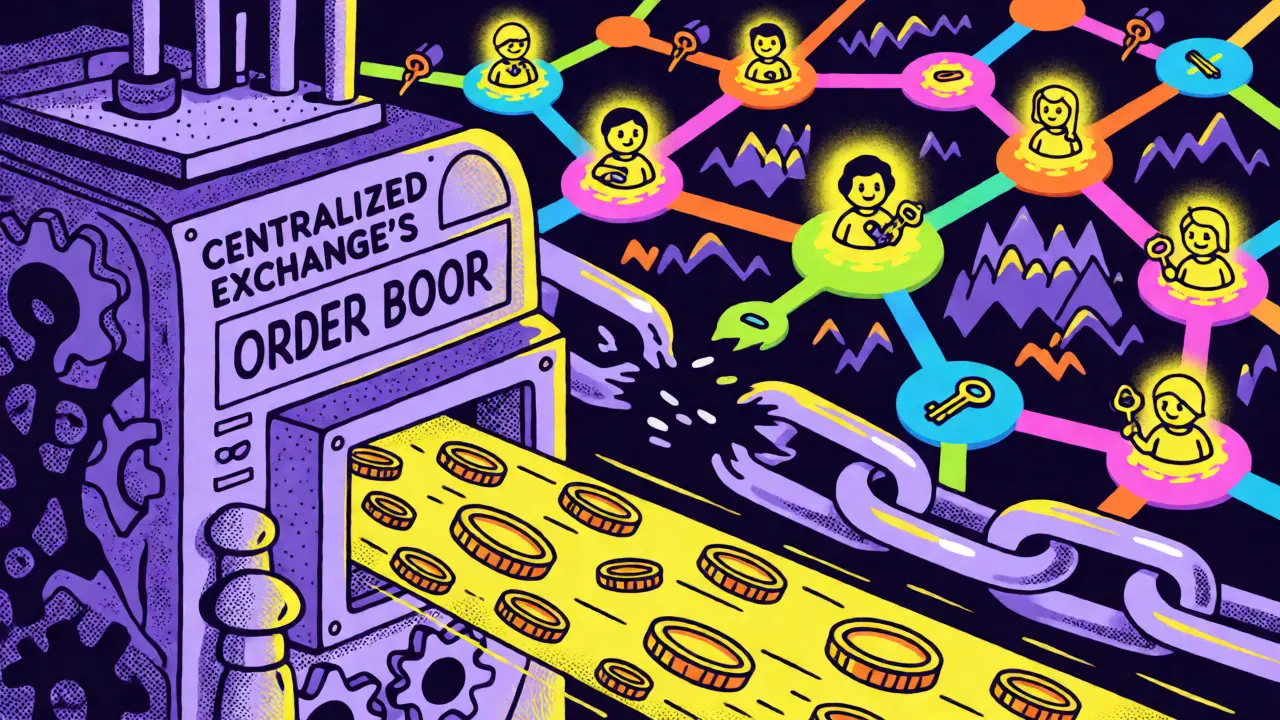
The biggest distinction between CEXs and DEXs comes down to custody. When you sign up for a centralized exchange, you deposit your funds into wallets controlled by the company. You get a login and a password, but the private keys-the cryptographic codes that actually move the money-belong to the exchange. This is similar to a bank account. You trust the institution not to lose your money, hack its servers, or freeze your assets.
In contrast, decentralized exchanges operate through smart contracts on a blockchain. You never send your crypto to the exchange. Instead, you connect a non-custodial wallet, like MetaMask, and trade directly from your own address. The smart contract acts as an automated escrow service. If the trade conditions are met, the tokens swap automatically. If something goes wrong, the transaction fails, and your funds stay in your wallet. You hold the keys, so you hold the power. But you also hold the responsibility. Lose your seed phrase, and there’s no customer support line to call.
Liquidity and Speed: Where the Volume Lives
Let’s look at the numbers. As of 2025, centralized exchanges still dominate the market, handling roughly 87% of all crypto trading volume. Platforms like Binance report daily spot volumes exceeding $79 billion. Why? Liquidity. Because millions of users pool their funds in one place, order books are deep. This means you can buy or sell large amounts of Bitcoin without significantly moving the price. Spreads-the difference between the buy and sell price-are tight, often less than 0.1% on major pairs.
DEXs have historically struggled with liquidity fragmentation. Since each DEX has its own pools, you might find low volume on smaller tokens, leading to high slippage (getting a worse price than expected). However, this gap is closing. Automated Market Makers (AMMs) like Uniswap v3 allow for concentrated liquidity, making trades more efficient. While Uniswap processed about $3.7 billion in Q1 2025, it’s growing fast. But if you need to execute a massive block trade instantly, a CEX’s off-chain matching engine, which processes transactions in milliseconds, still beats the blockchain confirmation times of most DEXs.
| Metric | Centralized Exchange (CEX) | Decentralized Exchange (DEX) |
|---|---|---|
| Custody | Exchange holds keys (Custodial) | User holds keys (Non-custodial) |
| Onboarding Time | 15-20 mins (KYC required) | Instant (No KYC) |
| Fiat Access | Direct Bank/Card integration | Limited (Crypto-to-Crypto mostly) |
| Average Fee | 0.1% - 0.6% + Gas | 0.01% - 1.0% Pool Fee + High Gas |
| Risk Profile | Hacks, Insolvency, Freezes | Smart Contract Bugs, User Error |
Security Risks: Hacks vs. Human Error
Security is often cited as the main reason people stick with CEXs. They have dedicated security teams, cold storage vaults, and insurance policies. But history tells a different story. Since 2011, centralized exchanges have suffered over 56 major hacks, totaling nearly $4.7 billion in losses. The collapse of FTX in 2022 was a wake-up call, proving that even the largest platforms can be mismanaged or fraudulent. When the exchange fails, your claim to the assets becomes an unsecured debt against a bankrupt entity.
DEXs eliminate counterparty risk because there is no central entity to fail. If the frontend website goes down, you can still interact with the smart contract directly using your wallet. However, DEXs introduce new risks. Smart contracts are code, and code can have bugs. The Wormhole bridge exploit in 2022 lost $320 million due to a vulnerability in the cross-chain protocol. Additionally, user error is rampant. Sending funds to the wrong address or approving a malicious token spend can drain your wallet instantly. There is no "undo" button on the blockchain.
Costs and Fees: The Hidden Math
Trading fees aren’t the only cost to consider. On a CEX like Coinbase, you might pay a tiered trading fee ranging from 0.00% to 0.60%. If you’re depositing fiat currency via a bank transfer, that’s often free, but card deposits can cost 1% or more. Withdrawal fees vary by network but are usually flat rates set by the exchange.
On a DEX, the costs are split between the protocol fee and network gas fees. Uniswap v3 charges a pool fee between 0.01% and 1.0%, depending on the volatility of the pair. But the real killer is gas. On Ethereum mainnet, a single swap can cost $10-$50 during congestion. Layer-2 solutions like Arbitrum or Optimism have reduced this dramatically, averaging around $1.27 per transaction in mid-2025. For small traders, these gas fees can eat up 5-10% of their capital, whereas a CEX’s flat fees might be cheaper for frequent, small trades.

Regulation and Accessibility
If you live in New Zealand or anywhere else, your location matters. Centralized exchanges are heavily regulated. Platforms like Kraken hold licenses in over 40 jurisdictions. This compliance provides legal clarity but limits access. Some countries ban certain tokens or require strict Know Your Customer (KYC) verification, meaning you must upload your passport and selfie before trading. This creates friction for privacy-focused users.
DEXs operate in a regulatory gray area. Most do not require KYC, allowing anyone with a wallet to trade anonymously. This censorship resistance is powerful. In 2024, Ukrainian users were able to continue trading via Kyber Network despite local banking restrictions. However, regulators are catching up. The SEC has filed lawsuits against major DEX providers, arguing they function as unregistered securities exchanges. If regulations tighten further, DEX frontends could face geo-blocking, though the underlying protocols remain permissionless.
Which One Should You Choose?
There’s no one-size-fits-all answer. Here is a quick decision framework:
- Choose a CEX if: You are new to crypto, want to buy with credit cards or bank transfers, prefer a familiar interface, and don’t mind trusting a third party for convenience. It’s the best on-ramp for beginners.
- Choose a DEX if: You already own crypto, prioritize self-custody, want to access early-stage tokens before they list on major exchanges, and understand how to manage gas fees and slippage settings.
- Use Both: Many experienced traders keep a small amount on a CEX for quick fiat withdrawals and store the bulk of their portfolio in a hardware wallet connected to a DEX for long-term holding and DeFi yield farming.
The market is evolving toward hybrid models. Coinbase’s Base network, for example, integrates DEX functionality within a CEX-like experience. This convergence suggests that the future isn’t about one replacing the other, but rather blending the accessibility of centralized platforms with the security of decentralized infrastructure.
Can I move my crypto from a CEX to a DEX easily?
Yes, but you need to ensure you are sending to the correct network. If you bought Ethereum on a CEX, you must withdraw it to the Ethereum network (or a compatible Layer-2 like Arbitrum) to use it on a DEX like Uniswap. Sending to the wrong network can result in permanent loss of funds.
Are DEXs completely anonymous?
Not entirely. While most DEXs do not require KYC, all transactions are recorded on a public blockchain. Anyone can trace the flow of funds from your wallet address. If you link your wallet to your identity (e.g., by withdrawing to a KYC’d CEX), your anonymity is compromised. True privacy requires mixing services or privacy-focused chains.
What happens if I make a mistake on a DEX?
Blockchain transactions are irreversible. If you set your slippage tolerance too low, your trade may fail and you’ll still pay the gas fee. If you approve unlimited spending on a malicious token, a hacker could drain your wallet. Always double-check addresses and limit approvals to specific amounts when possible.
Do I need to pay taxes differently on CEXs vs DEXs?
Generally, tax laws treat both similarly: swapping one crypto for another is often a taxable event. However, CEXs provide easy-to-download transaction history reports, which simplifies filing. On DEXs, you must manually track every swap across multiple platforms, which can be complex. Using tax software that connects to your wallet API is highly recommended.
Which exchange type is better for long-term investing?
For long-term holding (HODLing), self-custody via a hardware wallet is generally considered safest. Since DEXs allow you to keep funds in your own wallet, they align better with this strategy. Leaving large sums on a CEX exposes you to platform risk, such as insolvency or hacking, which are unnecessary risks for assets you plan to hold for years.