How Crypto Bypasses Banking Restrictions for Financial Inclusion in Developing Countries
 May, 7 2026
Imagine trying to send money home to your family, only to lose 10% of it in fees and wait three days for the transfer to clear. Now imagine doing that when you don't even have a bank account because you lack the right ID or live too far from a branch. This is the daily reality for over 1.4 billion adults globally, mostly in developing nations. Traditional banking systems were built for stable economies with robust infrastructure. They simply do not work for people living under strict financial restrictions, high inflation, or geographic isolation.
Cryptocurrency has emerged as more than just a speculative asset; it is becoming a critical tool for bypassing these systemic barriers. By leveraging decentralized blockchain technology a distributed ledger system that records transactions securely without a central authority, individuals can access financial services using nothing more than a smartphone and an internet connection. This shift isn't about replacing banks entirely-it's about providing a lifeline where traditional finance fails.
The Barrier: Why Traditional Banking Excludes Millions
To understand why crypto matters, we first need to look at what keeps people out of the formal economy. In many developing regions, particularly in Sub-Saharan Africa, the banking infrastructure is sparse. A significant portion of the population lives in rural areas where the nearest bank branch might be hours away by foot or bicycle. Even if someone could get there, the requirements are often prohibitive.
Banks typically demand extensive documentation-proof of address, steady income verification, and government-issued IDs. For informal workers, farmers, or those displaced by conflict, obtaining these documents is nearly impossible. Furthermore, minimum balance requirements act as a gatekeeper, excluding low-income earners from holding accounts. These aren't just inconveniences; they are structural restrictions that keep wealth trapped in cash, vulnerable to theft, loss, or rapid devaluation due to local currency instability.
| Feature | Traditional Banking | Cryptocurrency Wallets |
|---|---|---|
| Identity Verification | Strict (ID, Proof of Address) | None (Pseudonymous) |
| Minimum Balance | Often Required | Zero |
| Access Requirement | Physical Branch Proximity | Internet Connection |
| Cross-Border Fees | 6-15% of Transfer Amount | Typically Under 1% |
| Transaction Speed | Days to Weeks | Minutes to Hours |
Remittances: Cutting the Cost of Sending Money Home
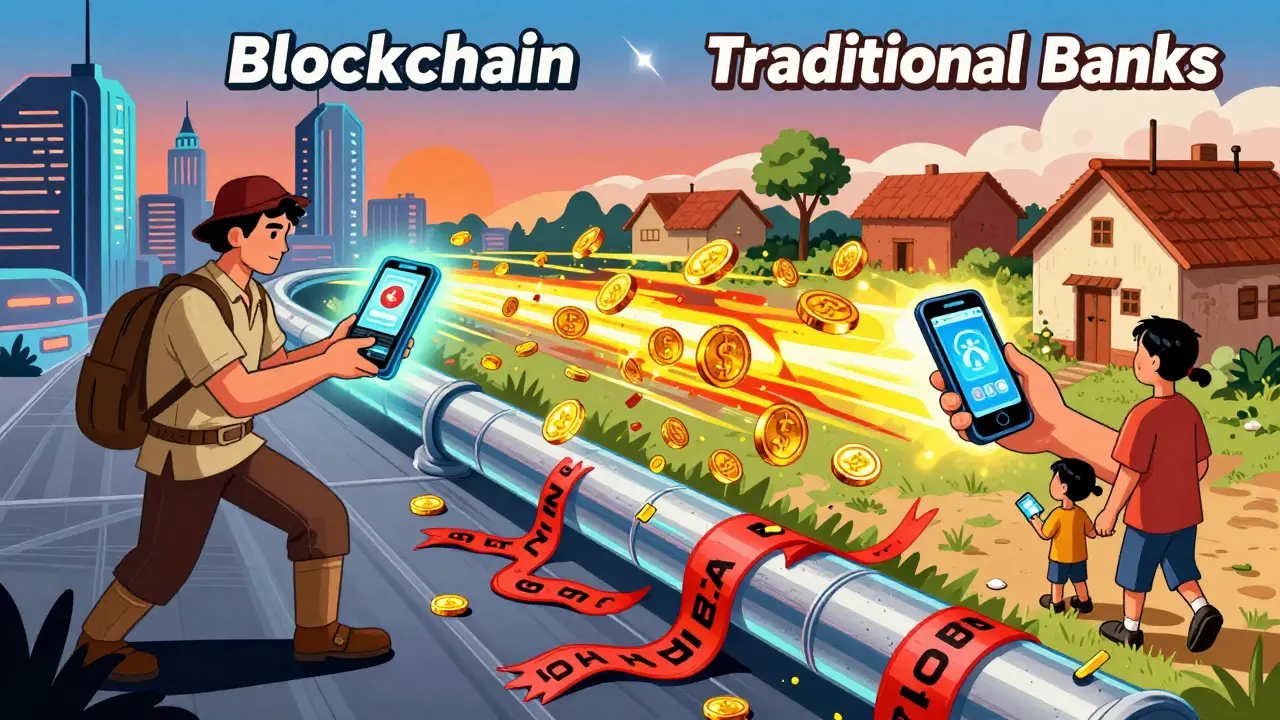
One of the most immediate impacts of cryptocurrency is on remittances. Migrant workers send billions of dollars back to their home countries every year, supporting families and local economies. However, conventional money transfer services like Western Union or MoneyGram charge exorbitant fees. In some corridors, sending $100 can cost $15 or more in fees alone.
Cryptocurrencies like Bitcoin the first decentralized cryptocurrency launched in 2009 and stablecoins allow users to bypass these intermediaries. Instead of routing money through multiple correspondent banks, each taking a cut, the value moves directly across the blockchain network. The sender buys crypto, transfers it to the recipient's wallet address, and the recipient sells it for local currency via a peer-to-peer platform or local exchange.
This process reduces fees to less than 1% in many cases and speeds up delivery from days to minutes. For a family relying on that monthly汇款 to buy food or pay school fees, saving 10-15% is life-changing. It’s not just about efficiency; it’s about dignity and keeping more hard-earned money within the community.
Hedging Against Hyperinflation and Currency Collapse
In countries experiencing economic turmoil, such as Venezuela, Argentina, or Nigeria, local currencies can lose value rapidly. When inflation runs double or triple digits, saving money in a local bank account is effectively losing money. People watch their purchasing power evaporate overnight.
Cryptocurrency offers a hedge against this erosion. Assets like Bitcoin have a fixed supply cap, meaning they cannot be printed endlessly by central banks to fund government deficits. While volatile, crypto assets provide a store of value that is independent of local monetary policy. Citizens can convert their depreciating local currency into crypto, preserving their wealth in a global asset class. This capability allows individuals to protect their savings from state-imposed financial restrictions and economic mismanagement.
Stablecoins, which are pegged to stable currencies like the US Dollar, offer another layer of protection. They combine the ease of blockchain transfers with the price stability of fiat money. For traders and small business owners in unstable economies, holding funds in stablecoins prevents them from being caught in the crossfire of sudden currency devaluations.

Regulatory Hurdles and Infrastructure Gaps
Despite the clear benefits, adoption is not seamless. A major obstacle remains regulatory uncertainty. Many governments in developing nations view cryptocurrency with suspicion, fearing capital flight or loss of control over monetary policy. Some countries impose outright bans, while others create ambiguous legal frameworks that discourage mainstream adoption.
Infrastructure also plays a critical role. Blockchain requires internet connectivity. While smartphone penetration is growing, reliable high-speed internet is still scarce in rural areas. If you can’t connect to the network, you can’t use the wallet. Additionally, the technical complexity of managing private keys poses a risk. Losing your seed phrase means losing your funds forever, with no customer service hotline to call. This steep learning curve creates a barrier for populations with limited digital literacy.
Security concerns are equally pressing. Scams, phishing attacks, and unregulated exchanges exploit users who are new to the space. Without strong consumer protection laws, victims of fraud have little recourse. These risks deter cautious users from fully embracing crypto as a primary financial tool.
Bridging the Gap: Education and Hybrid Models
The future of financial inclusion lies not in choosing between banks and crypto, but in integrating them. Experts suggest that cryptocurrency works best as a complement to traditional banking, especially for cross-border payments and unbanked populations. Rural farmers, for instance, might use mobile money apps that integrate backend crypto rails for cheaper settlements, without ever needing to understand the underlying blockchain mechanics.
Education is the key to unlocking this potential. Community-led training programs that teach basic digital hygiene, wallet security, and transaction verification can empower users to navigate the space safely. Governments and NGOs must collaborate to build trust, ensuring that regulations protect consumers without stifling innovation.
As infrastructure improves and regulatory clarity increases, we will likely see more hybrid solutions emerge. Central Bank Digital Currencies (CBDCs) are already being tested in countries like Ghana and Nigeria, aiming to combine the stability of state-backed money with the accessibility of digital tokens. Meanwhile, private sector innovations continue to lower the barrier to entry, making it easier than ever for anyone with a phone to participate in the global economy.
Is cryptocurrency safe for people in developing countries?
Safety depends on user behavior and infrastructure. While blockchain technology itself is secure, users face risks from scams, lost passwords, and volatile prices. Education on securing private keys and using reputable platforms is essential. For many, the risk of losing savings to hyperinflation outweighs the risks of crypto volatility.
Do I need a bank account to use cryptocurrency?
No. One of the main advantages of crypto is that it operates outside the traditional banking system. You only need a smartphone and an internet connection to create a digital wallet. You can buy, sell, and hold crypto without ever opening a bank account.
How does crypto help with high inflation?
Crypto assets like Bitcoin have a fixed supply, making them resistant to the inflation caused by printing more money. Stablecoins, pegged to the US Dollar, allow users to preserve value in a stable currency without needing a foreign bank account. This protects purchasing power during local currency crises.
What are the biggest barriers to crypto adoption in rural areas?
The main barriers are lack of reliable internet connectivity, low digital literacy, and regulatory uncertainty. Without consistent internet access, blockchain transactions cannot be processed. Additionally, fear of scams and complex technical requirements can deter non-tech-savvy users.
Can cryptocurrency replace traditional banks entirely?
Unlikely in the short term. Crypto excels at cross-border transfers and serving the unbanked, but traditional banks still handle large-scale domestic commerce, loans, and savings. The most effective model is a hybrid one, where crypto complements existing financial infrastructure rather than replacing it completely.