Blockchain
If you’ve ever wondered how modern finance, supply chains, or apps stay secure without a middleman, the answer lies in Blockchain. When working with Blockchain, a decentralized ledger that records transactions across a network of computers. Also known as distributed ledger technology, it eliminates the need for a central authority by letting participants verify data collectively. Smart contracts, self‑executing code that runs on a blockchain when predefined conditions are met enable automated agreements without human oversight. Decentralized finance, financial services built on blockchain that operate without traditional banks leverages these contracts to offer lending, trading, and earning opportunities directly to users.
One of the most talked‑about innovations is the blockchain bridge, a protocol that connects two separate blockchain networks allowing assets to move across them. Bridges make cross‑chain interoperability possible, so a token on one chain can be used in the ecosystem of another. While bridges expand utility, they also introduce security considerations that differ from native chain transactions. Meanwhile, on‑chain data mining, the extraction and analysis of blockchain transaction data for insights gives analysts the power to spot market trends, detect fraud, and improve compliance. Together, bridges and data mining illustrate how blockchain not only stores value but also fuels a new kind of data‑driven decision‑making.
Beyond the tech, blockchain reshapes business models by striking a balance between transparency and privacy. Public ledgers let anyone verify a transaction’s validity, yet privacy tools like zero‑knowledge proofs let participants keep sensitive details hidden. This tension drives designs that aim for both trust and confidentiality. In the fee world, understanding the difference between gas fees (the cost of executing operations on networks like Ethereum) and traditional transaction fees (fixed amounts paid to miners or validators) helps users keep costs low. Knowing when to optimize gas versus when a flat fee applies can save dollars on everyday transfers.
The benefits of blockchain—security, immutability, and reduced reliance on intermediaries—are tempered by challenges such as scalability, energy consumption, and regulatory uncertainty. Smart contracts can automate processes, but they also require careful coding to avoid bugs that become immutable. Bridges open new markets but add attack vectors, and on‑chain data mining empowers insight while raising privacy questions. Recognizing these trade‑offs equips you to decide when blockchain adds real value and when another solution might be a better fit.
Below you’ll find a curated collection of articles that dig deeper into each of these topics. From bridge design choices and on‑chain analytics to the mechanics of disintermediation and fee optimization, the guides are organized to give you actionable knowledge you can apply right away. Dive in and discover the practical angles that will help you design, analyze, and leverage blockchain for your projects.

Dollar-cost averaging (DCA) helps investors buy crypto consistently through bull and bear markets. In bull markets, you pay more per coin but benefit from long growth. In bear markets, you buy more at lower prices. The key is sticking with it-no timing needed.
More
Learn how to set up a Bitcoin or Ethereum full node with minimal cost and maximum security. No third-party trust needed. Just your hardware, the blockchain, and full control.
More
The blockchain metaverse combines virtual worlds with blockchain tech to give users real ownership of digital assets. Unlike games like Roblox, you truly own your land, clothes, and items - and can sell or use them across platforms.
More
Oracle's data verification methods ensure enterprise data accuracy through automated, code-driven validation with 11 status codes and industry-specific tools. Used in finance, healthcare, and manufacturing, it cuts errors by up to 90% and integrates deeply with Oracle Cloud apps.
More
DEXs offer freedom from central exchanges but come with hidden risks like smart contract exploits, infinite token approvals, and phishing scams. Learn how to trade safely in 2026.
More
NFT art’s environmental impact has dropped 99.9% since Ethereum’s 2022 energy shift. Today’s low-energy blockchains like Tezos and Polygon make sustainable digital art possible - if you know where to look.
More
Hardware 2FA keys offer superior security for blockchain users by preventing phishing and remote attacks, while software authenticators are convenient but vulnerable to device compromise. Learn which is right for your crypto holdings.
More
Blockchain is transforming how renewable energy credits are tracked, traded, and verified - eliminating fraud, slashing costs, and empowering producers. Here's how it works and who's using it today.
More
DAO Treasury Management ensures secure handling of decentralized funds. Learn key strategies like multi-sig wallets, audits, and transparent governance to protect assets and build community trust. Essential for any DAO's long-term success.
More
Race and Finney attacks are two ways hackers steal Bitcoin by exploiting zero-confirmation transactions. Learn how they work, who's vulnerable, and how merchants can protect themselves in 2026.
More
Diversification in blockchain investing means spreading risk across different assets, blockchains, and use cases to survive market crashes. It's not about owning more coins - it's about owning different kinds of coins that don't move together.
More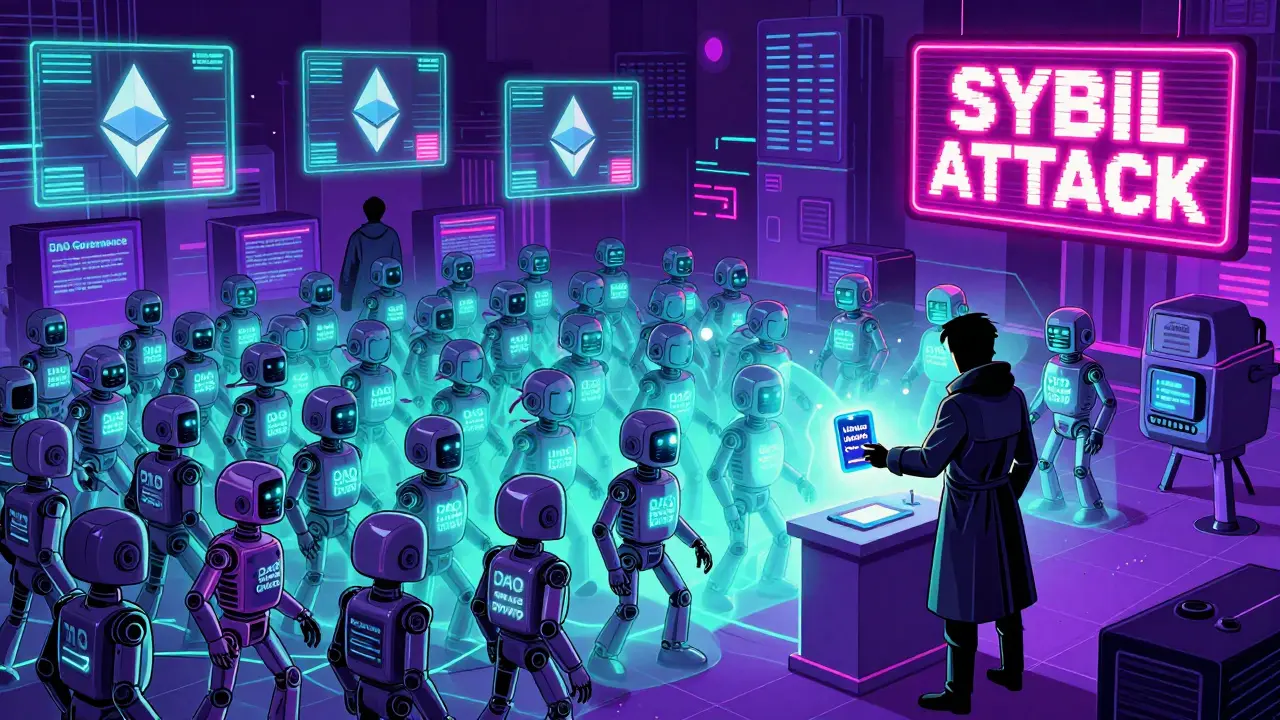
Identity verification is a key defense against Sybil attacks in blockchain networks, where fake identities can manipulate voting, airdrops, and governance. Learn how it works, its trade-offs with privacy, and what solutions are leading the way in 2026.
More